


Every homeowner who calls us about a heat pump eventually asks some version of the same question, usually right after they’ve decided to move forward: how long is this actually going to take? It’s a fair question, and it’s one most contractors answer with a shrug and a range so wide it’s barely useful: “a day or two, usually.”
We’d rather answer it with the actual data. Over more than a dozen documented installations across Seattle, Snohomish County, and the Eastside, we’ve tracked exactly how long each project took, what made the fast ones fast, and what made the long ones long. This is that data, laid out plainly.
How Long Does Heat Pump Installation Take? The Real Range
The honest answer is 6 hours to 4 days, and the gap between those two numbers is almost entirely explained by scope. A like-for-like outdoor unit swap with no new electrical work and no ductwork changes can be done in a single morning. A full duct system replacement across an attic and a basement, paired with multiple air handlers and a new electrical service, can take the better part of a week once every trade is accounted for.
Here’s the real spread, pulled directly from projects we’ve completed and published as case studies:
| Case | Location | Complexity | Installation Timeline |
| Lake Stevens heat pump replacement | 98258 | Minimal, like-for-like outdoor unit swap, no electrical or duct changes | 6–8 hours, single visit |
| Midea Evox G2 installation | Issaquah 98027 | Standard, with electrical work running in parallel | 1 day |
| Trane Resolute installation | Seattle 98115 | Standard, existing furnace retained | 1 day |
| Trane Resolute + Coleman furnace | Lake Stevens | Standard, 2 HVAC techs + 2 electricians | 1 day |
| Mitsubishi Hyper Heat + new circuits | Lake Stevens 98258 | HVAC crew 1 day, electrical work 4 hours in parallel | 1 day |
| Dual heat pump replacement | Mercer Island 98040 | Two full systems installed simultaneously, 4 HVAC techs + 2 electricians | 1 day |
| Mitsubishi Hyper Heat + water heater | Sammamish 98074 | Standard installation plus a bundled water heater replacement | 1 day |
| Furnace replaced with Mitsubishi Smart Multi | Issaquah 98027 | Full furnace-to-heat-pump conversion | 2 days |
| Mitsubishi Cold Climate + new ductwork | Wedgwood, Seattle 98115 | Full duct system replacement | 2 days |
| Mitsubishi Hyper Heat dual-fuel | Mercer Island 98040 | Dual-fuel system paired with a new furnace | 2 days |
| Smart Multi, relocated air handler | Shoreline 98177 | Air handler relocated to crawl space, plus water heater | 1.5 days |
| Hyper Heat + full panel + EV charger | Lake City, Seattle 98125 | HVAC install plus complete electrical panel upgrade and EV charger circuit | 3 days |
| 5-ton dual-zone, full duct replacement | North Bend 98045 | Complete attic and basement ductwork replacement, 2 air handlers, 3 ports | 4 days HVAC + 1 day electrical |
That’s the actual range we work with: from a single 6-hour morning to a four-day project spanning two levels of ductwork. Almost everything in between comes down to how much of the home’s existing infrastructure (ductwork, electrical circuits, furnace) the new system can reuse versus how much needs to be rebuilt around it.
The Fastest Installations: Like-for-Like Outdoor Unit Swaps
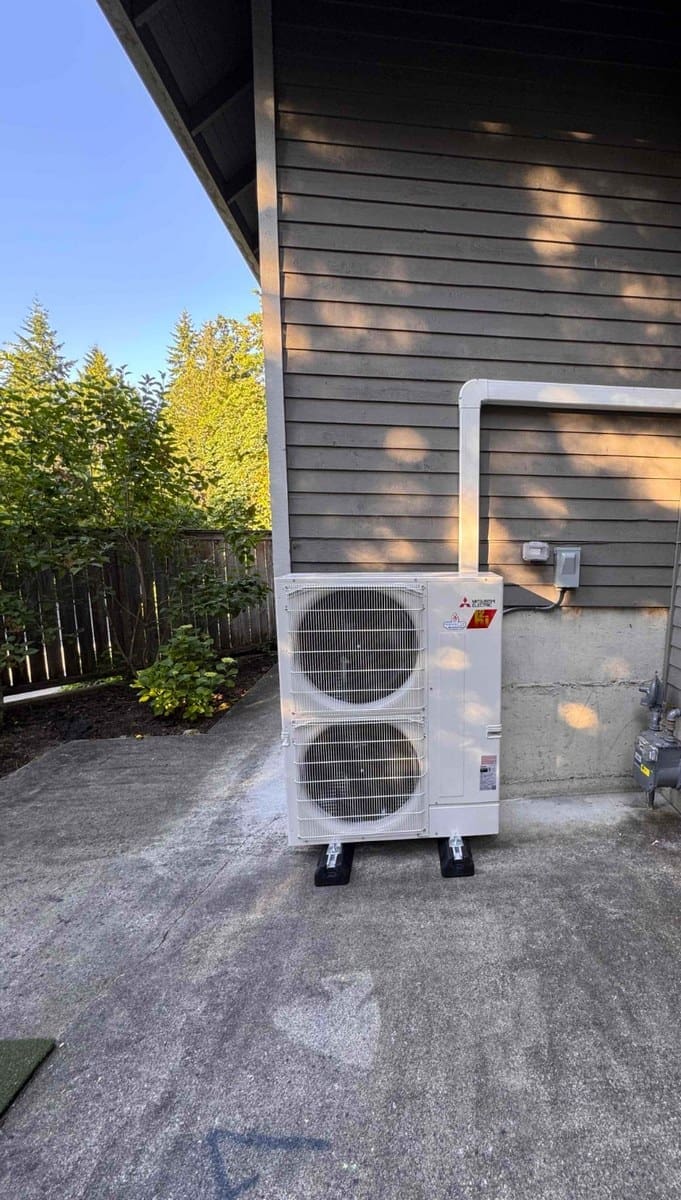
The single fastest category of heat pump installation timeline in Seattle and the surrounding areas is a straight outdoor unit swap, pulling out an old condenser and setting a new one in its place, using the same electrical circuit, the same line set routing, and the same indoor coil or air handler wherever possible. In our Lake Stevens 98258 case, that meant a 6-to-8-hour visit, start to finish, in a single day. No new electrical circuit to run, no ductwork to touch, no additional trades to coordinate. The crew showed up, removed the old unit, set the new one, connected it to the existing infrastructure, and commissioned the system before the day was out.
This is the fastest a same-day heat pump installation can realistically go, and it’s worth naming the specific conditions that make it possible: the existing electrical circuit has to be adequately sized for the new equipment, the line set routing has to still make sense for the replacement unit, and the indoor half of the system has to already be compatible or easily matched. When all three of those line up, a heat pump replacement genuinely can happen in less than a working day.
Standard Installations: What a Typical 1-Day Job Looks Like
Most of our installations land in this middle category: one day, one coordinated visit, but with more moving pieces than a pure outdoor swap. The Midea Evox G2 installation in Issaquah is a good example: standard scope, but with electrical work running in parallel to the HVAC crew rather than happening as a separate visit. That parallel scheduling is the real key to keeping a project with new electrical work inside a single day.
The same pattern shows up in our Trane Resolute installation in Seattle 98115, where the existing furnace was retained and only the outdoor and indoor coil components were replaced, and again in our Sammamish 98074 project, where a Hyper Heat installation was bundled with a water heater replacement and still wrapped in a single day. On the larger end of this category, our Mercer Island dual heat pump replacement installed two complete systems: one upstairs, one downstairs simultaneously, using four HVAC technicians and two electricians working side by side. That’s the largest crew we’ve documented on a single-day job, and it’s proof that a one-day timeline scales with crew size just as much as it depends on scope.
The common thread across every one-day project: HVAC and electrical trades working in parallel rather than sequentially, and no structural changes to the home’s existing ductwork.
When Installation Takes Longer: New Ductwork, Multi-Zone, and Electrical Work
The moment a project needs new ductwork, a full duct system replacement, or multiple indoor air handlers, the timeline stretches past a single day, and it stretches in a predictable way.
Our Wedgwood, Seattle 98115 project involved a full duct system replacement alongside a Mitsubishi Cold Climate heat pump installation, and took 2 days: one day dedicated substantially to the ductwork itself, with equipment installation and commissioning following once the new duct runs were in place. Our Mercer Island dual-fuel Hyper Heat installation, which paired a heat pump with a new furnace in a dual-fuel configuration, also took 2 days, reflecting the added complexity of coordinating two separate heating sources under one control system.
The longest HVAC timeline we’ve documented belongs to our North Bend 98045 project: a 5-ton system with two separate air handlers, a complete replacement of ductwork running through both the attic and the basement, and three separate refrigerant ports to manage across the dual-zone configuration. That project took 4 full days of HVAC work, plus an additional day of electrical work layered on top. When a project touches this much of a home’s existing infrastructure at once, the timeline reflects it honestly. There’s no way to compress a full duct rebuild into the same window as an outdoor unit swap, and we’d rather tell a homeowner that upfront than promise a one-day turnaround we can’t deliver.
What About Electrical Panel Upgrades and EV Chargers?
Adding a full electrical panel upgrade or an EV charger circuit to a heat pump installation is one of the more reliable ways to extend a project’s timeline, simply because it introduces a second major scope of work running alongside the HVAC installation. Our Lake City, Seattle 98125 project combined a Mitsubishi Hyper Heat installation with a complete electrical panel upgrade and a new EV charger circuit, and the full project took 3 days: a day for the panel work itself, additional time for the heat pump installation, and coordination between both trades to make sure the new panel could actually support the new HVAC load before the equipment went in.
This is a useful benchmark for any Seattle homeowner planning to bundle a panel upgrade with a heat pump project rather than treating them as two separate jobs down the road: expect the combined timeline to run close to 3 days rather than the single day a heat pump alone might take, but also expect meaningful savings in scheduling and cost compared to two entirely separate service visits months apart.
Permits and Inspections: The Part After Installation
This is where a lot of homeowners get their expectations tangled, and it’s worth separating clearly: the installation timeline and the full permitting timeline are two different clocks. Installation is the physical work, removing old equipment, setting new equipment, running lines and wiring, commissioning the system. Permitting is the paperwork and inspection process that follows, confirming the completed work meets code.
For projects inside Seattle city limits, permits are typically processed by Seattle’s Department of Construction and Inspections within about 4 to 24 hours, and inspections are usually scheduled for the following morning after installation wraps. That’s a fast turnaround by most standards, but it does mean a homeowner whose equipment was fully installed and running by the end of day one shouldn’t expect the entire process, inspection included, to close out on that same day. Projects outside Seattle (in Snohomish County, on Mercer Island, in Issaquah, Sammamish, or North Bend) go through their own local jurisdictions rather than Seattle’s, each with a similar but separately managed inspection process. In every case, we handle the permit filing, scheduling, and inspection coordination directly, so the only thing a homeowner actually has to do is be available for the walkthrough.
Will You Be Without Heat or AC During the Installation?
For most single-day or two-day projects, the gap without heating or cooling is limited to the hours the old system is disconnected and the new one is being commissioned, typically a matter of hours, not days. But for longer projects, especially ones involving a full furnace replacement or major ductwork, that gap can stretch across an overnight or longer, and we don’t leave a family to just wait it out.
Our Marysville case is a good example of how we handle that gap on a longer project: portable electric heaters went into the home immediately upon the crew’s arrival, before any equipment was even disconnected, specifically so the household never had to sit without heat while the actual installation work was underway. That’s a standard part of how we plan a multi-day project if the timeline is going to outlast a single day, we plan for what the family needs in the meantime, not just for the equipment itself.
Frequently Asked Questions: Heat Pump Installation Timelines in Seattle
How long does it take to install a heat pump in Seattle?
Based on more than a dozen documented Product Air installations, the real range runs from about 6 hours to 4 days, depending almost entirely on project scope. A like-for-like outdoor unit replacement with existing ductwork and electrical in place can finish in under a day, while a project requiring new ductwork, multiple air handlers, or a full electrical panel upgrade can take several days. Most standard single-zone installations with some accompanying electrical work land in the 1-day range.
What’s the fastest a heat pump installation can be completed?
The fastest documented timeline in our case history is 6 to 8 hours, completed in a single visit, for a like-for-like outdoor unit swap in Lake Stevens, 98258. That project didn’t require any new electrical circuits or ductwork changes, since the replacement unit used the same infrastructure as the system it replaced. Same-day heat pump installation is genuinely possible, but it depends on the existing electrical and ductwork already being compatible with the new equipment.
Does installing a heat pump with new ductwork take longer?
Yes, significantly. In our North Bend, 98045 case, a heat pump installation requiring a complete replacement of ductwork across both the attic and basement, along with two separate air handlers, took 4 full days of HVAC work alone, plus an additional day of electrical work. New ductwork is one of the most reliable factors that extends a heat pump installation timeline beyond a single day, since duct fabrication and routing take substantially more time than connecting to ductwork that’s already in place.
How long does permit inspection take after heat pump installation in Seattle?
Within Seattle city limits, permits are typically processed by the Seattle Department of Construction and Inspections within about 4 to 24 hours, with inspections usually scheduled for the morning after installation is completed. This is a separate timeline from the physical installation itself, a system can be fully installed and running before the permit inspection has taken place. Projects outside Seattle go through their own local jurisdiction’s permitting process, which we coordinate directly on the homeowner’s behalf.
Can two heat pump systems be installed in one house in a single day?
Yes, with the right crew size. In our Mercer Island, 98040 case, two complete heat pump systems (one serving the upstairs, one serving the downstairs) were installed simultaneously in a single day, using four HVAC technicians and two electricians working in parallel. Installing multiple systems in one day is possible when enough trained crew members are scheduled to work each system independently rather than one system being completed before the next begins.
Does adding a water heater extend heat pump installation time?
Not necessarily, if it’s scheduled as part of the same coordinated visit with enough crew to handle both projects in parallel. In our Sammamish, 98074 case, a Hyper Heat installation bundled with a water heater replacement still wrapped within a single day, and our Shoreline, 98177 project combined a relocated air handler with a water heater replacement in 1.5 days. Bundling a water heater replacement into an existing HVAC visit is often more time-efficient than scheduling it as a separate project later.
Does multi-zone heat pump take longer to install?
It depends more on ductwork and electrical scope than the number of zones alone. Our Mercer Island dual-system case installed two full zones in a single day with a large enough crew, while our North Bend dual-zone project took 4 days because it also required a complete ductwork rebuild across two levels. A multi-zone system with existing, compatible ductwork can often be installed in a similar timeframe to a single-zone system, while one requiring new ductwork for each zone will take considerably longer.
Key Takeaways for Seattle Homeowners Planning a Heat Pump Installation
- The real range for heat pump installation across our documented Seattle-area cases is 6 hours to 4 days, not a vague “one to three days” estimate.
- A like-for-like outdoor unit swap with existing electrical and ductwork in place is the fastest path to a same-day installation, typically completed in 6 to 8 hours.
- Most standard single-zone installations, even with some accompanying electrical work, are completed in a single day when trades are scheduled to work in parallel.
- New ductwork is the single biggest factor that extends an installation timeline, sometimes stretching a project to 4 days or more.
- Bundling a full electrical panel upgrade or EV charger with a heat pump installation typically adds 1 to 2 days but can save significant time and cost compared to scheduling the projects separately.
- Installation and permit inspection are two separate timelines, a system can be fully running before the permit inspection, which typically happens the following morning, has taken place.
- On longer projects, portable heating is brought in immediately so a household is never left without comfort while the actual installation is underway.
Every homeowner deserves an honest answer to “how long will this take,” not a hedge designed to avoid disappointing them later. That’s why we track this data across every project we complete, not to promise a number that sounds good on the phone, but to give people planning around a real installation the actual range they should expect, drawn from the work we’ve actually done.
— Serge Nikolin, Co-Founder, Product Air Heating, Cooling and Electric
Marysville · Issaquah · Seattle · Western Washington