

Location: 97th Drive Northeast corridor, Lake Stevens, WA 98258
Call Date: January 19, 2026
First Visit: January 19, 2026
Project Completion: February 16, 2026
Lead Technician: Eli, EPA-certified HVAC technician, 10 years in the trade, manufacturer-trained on Trane and Mitsubishi equipment
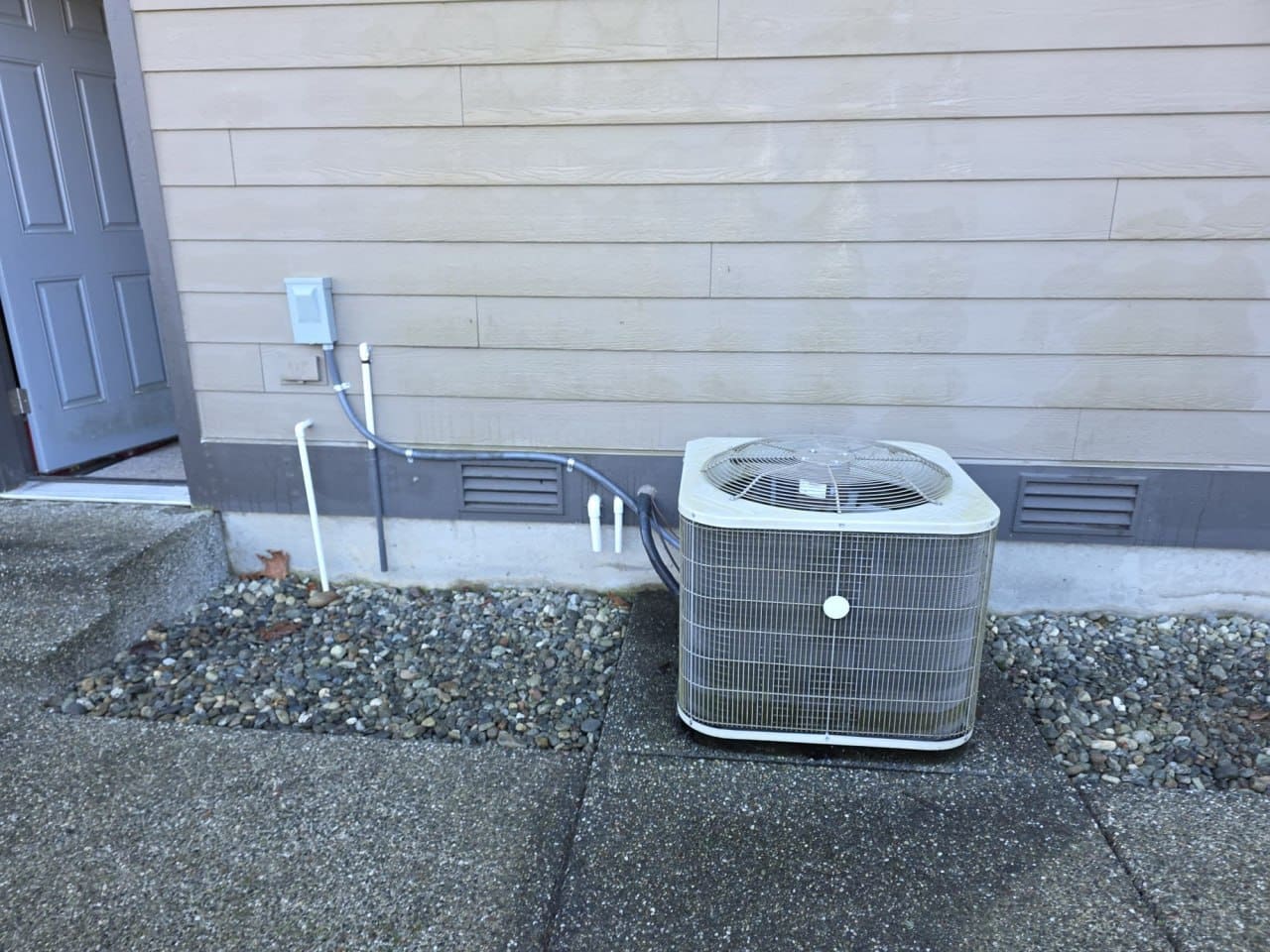
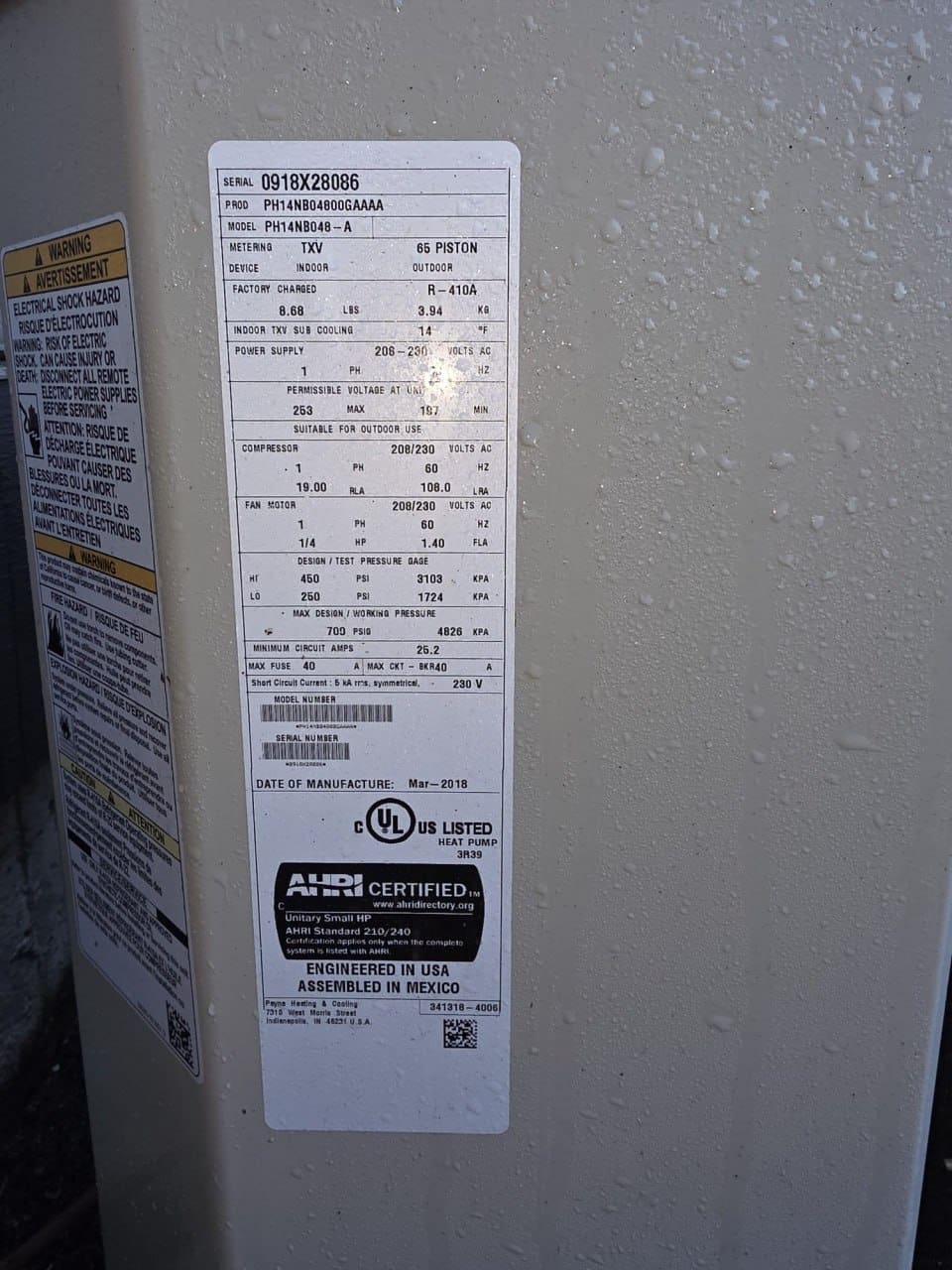
System Before: Outdoor heat pump unit, original to the home’s 2017 construction, failed reversing valve coil
System After: Resolute by Trane 4–5 Ton, 15.2 SEER2, Quiet Side Discharge Inverter Heat Pump, Model 4TXD2060A10NUA
Final Project Cost: $7,577.36
Why Was This Lake Stevens Heat Pump Blowing Fuses?
Frederick called Product Air on January 19, 2026, with a problem that had already cost him more than money. His heat pump had stopped functioning and started blowing a fuse, which meant the system was leaning hard on backup heat to keep the house warm, and the energy bill was climbing right along with it. That alone would have been frustrating enough. What made it worse was that another contractor had already been out to the house and left without an answer.
Frederick found Product Air through the company’s Google Business Profile, the same way most new customers do, and there was no history to build on here, no returning relationship, nothing but a homeowner who needed someone to actually find the problem this time. He was new to Product Air, and there were no special circumstances shaping the urgency beyond the obvious one: a heat pump that wasn’t working and a bill that proved it.
How We Diagnosed a Failed Reversing Valve
The home sits on 97th Drive Northeast in Lake Stevens, a 2017-built, two-story single-family house at 3,785 square feet, large enough that a heat pump running on backup resistance heat shows up fast on a winter utility bill. The outdoor heat pump unit was original to the home’s construction, which put it at roughly nine years old, well short of the 15-to-20-year service life a properly maintained system should deliver in this climate, and well short of the kind of age where a major failure is simply expected.
The previous contractor’s approach, as far as Frederick described it, had been to swap parts and hope. “Other contractors just kept changing parts and fees kept climbing,” is how the situation got described to Eli during the visit, and it’s a pattern technicians see often enough to recognize immediately: a system that keeps failing in the same general area, a string of invoices for components that didn’t address the actual cause, and a homeowner who has paid for several repairs without getting a single one that held.
Eli traced it to a short on the controls side of the heat pump, specifically an electrical short in the reversing valve coil, the component responsible for switching the system between heating and cooling modes. It is not a common failure. Eli’s read on it was direct: this kind of short is rare enough that it could point to a factory flaw rather than ordinary wear, the kind of issue a manufacturer warranty exists specifically to cover.
Except there was no manufacturer warranty to call on. The original installer had never registered the equipment with the manufacturer, the step that activates a system’s full warranty coverage. A heat pump that was nine years into what should have been a 10-year-plus manufacturer warranty had no coverage at all, not because the equipment failed too early to qualify, but because nobody on the original install ever filed the paperwork that would have made the warranty real in the first place.
Should You Repair or Replace a Failed Heat Pump?
By the time Eli sat down with Frederick, the question wasn’t whether something needed to happen. It was how much of the system to commit to, given that the original equipment had already shown one rare and serious failure with zero factory backing behind it. Product Air laid out three options, scoped from a direct repair up through a full system replacement:
Bronze Repair: recover refrigerant, remove and replace the failed reversing valve, install a new liquid line filter drier, evacuate and recharge the system, chemical flush of the existing line-set: $4,025.78, 90-day Product Air labor warranty
Silver Replacement: replace the outdoor heat pump condenser only, keep the existing air handler, chemical flush and reuse the existing line-set, new Product Air Smart Communicating Thermostat: $7,577.36, 10-year manufacturer warranty, 1-year Product Air labor warranty
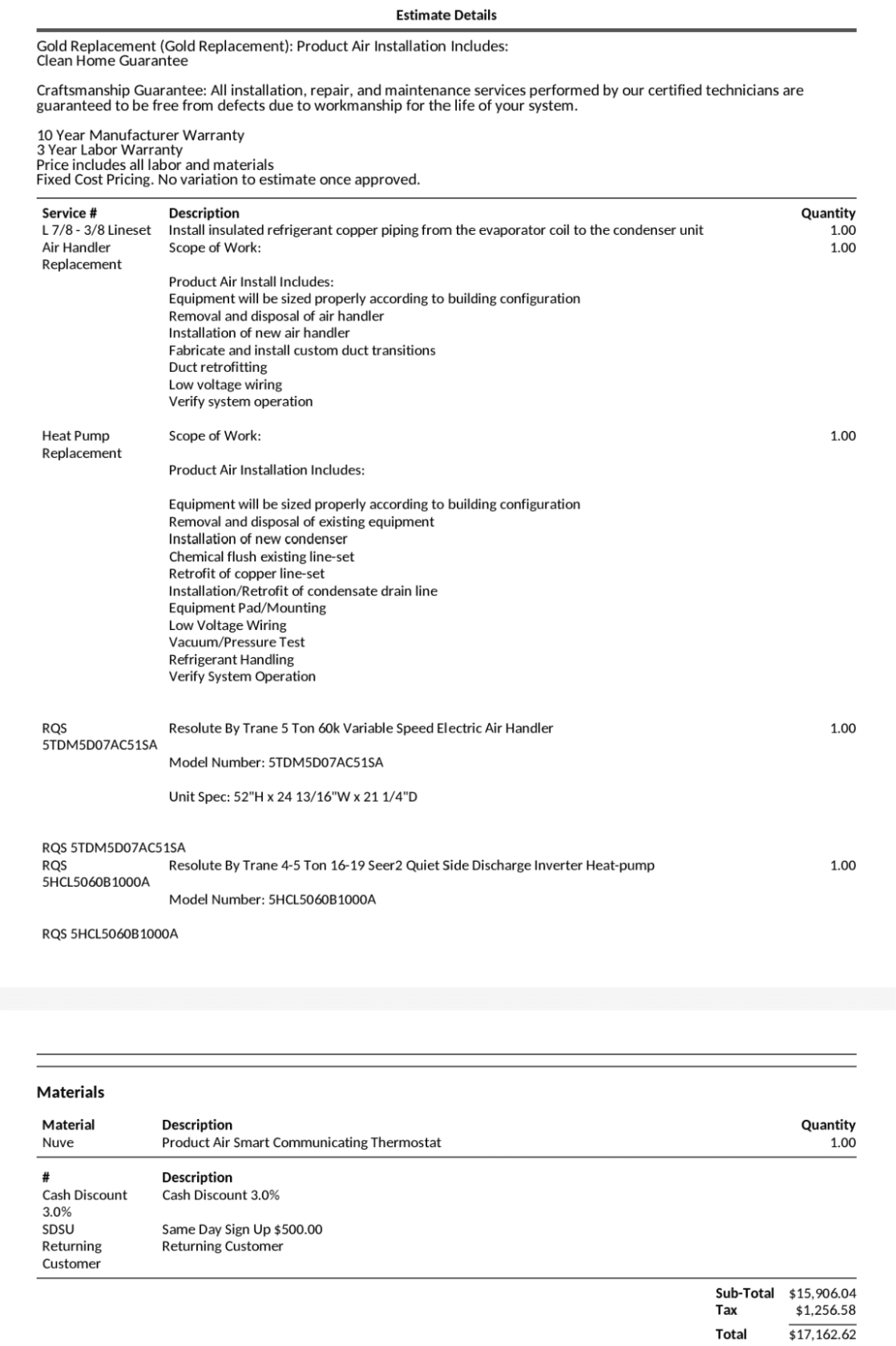
Gold Replacement: replace both the outdoor heat pump and the indoor air handler as a matched system, new line-set, full duct retrofitting, new Product Air Smart Communicating Thermostat: $17,162.62, 10-year manufacturer warranty, 3-year Product Air labor warranty
The repair option was the cheapest path on paper, but it was a patch on a component that had already failed once without warranty protection behind it, on a system old enough that a second failure was a real possibility rather than a hypothetical one. The full system replacement solved every variable at once but replaced an air handler that hadn’t shown any problem at all.
Frederick chose the middle option: replace the outdoor unit only, keep the air handler that was still doing its job, and walk away with an actual manufacturer warranty this time, one Product Air would register correctly the moment the new equipment went in.
Can You Replace Only the Outdoor Heat Pump?
Homeowners facing a heat pump failure tend to assume the choice is between a cheap patch and a full system replacement, with nothing reasonable in between. Frederick’s case is a clean example of why that assumption is usually wrong, and why a contractor’s first job is figuring out which component actually failed before pricing out the fix.
A reversing valve failure is a problem with the outdoor unit’s controls, not with the indoor air handler, the ductwork, or the thermostat. When a technician traces a failure to one specific component and confirms the rest of the system tested fine, replacing only the failed half of the system is not a corner-cutting compromise. It is the correctly scoped repair. Product Air’s Silver tier exists for exactly this situation: a new outdoor condenser, professionally matched to the existing air handler, with the line-set chemically flushed and reused rather than replaced outright, at less than half the cost of a full system swap.
The warranty registration piece deserves more attention than most homeowners give it. Every major manufacturer, Trane included, ties its full equipment warranty to a registration step completed at the time of installation, typically within 60 to 90 days. Skip that step, and the homeowner is left with whatever minimal base coverage applies by default, sometimes nothing at all on certain components. It is not a clerical formality. It is the difference between a $4,025 repair on a covered system and the same repair, or worse, on a system with no factory backing whatsoever. Frederick’s first contractor either never registered the original equipment or the registration never went through, and nine years later that omission turned a routine controls failure into an uncovered repair bill.
This is also why repeated, unsuccessful repairs cost more in total than committing to the right fix the first time. Every part swapped without confirming the actual failure point is money spent without resolving the underlying problem, and Frederick had already been through that cycle once before he ever called Product Air. A correctly diagnosed reversing valve short, traced in a single visit, is a faster and ultimately cheaper outcome than three rounds of guesswork, even when the individual repair invoices looked smaller along the way.
Product Air registers every system it installs with the manufacturer as a standard part of the install process, not an optional add-on. The 10-year manufacturer warranty on Frederick’s new outdoor unit is only meaningful because that registration actually happens this time.
Which Heat Pump Did We Install in the House on 97th Drive Northeast?
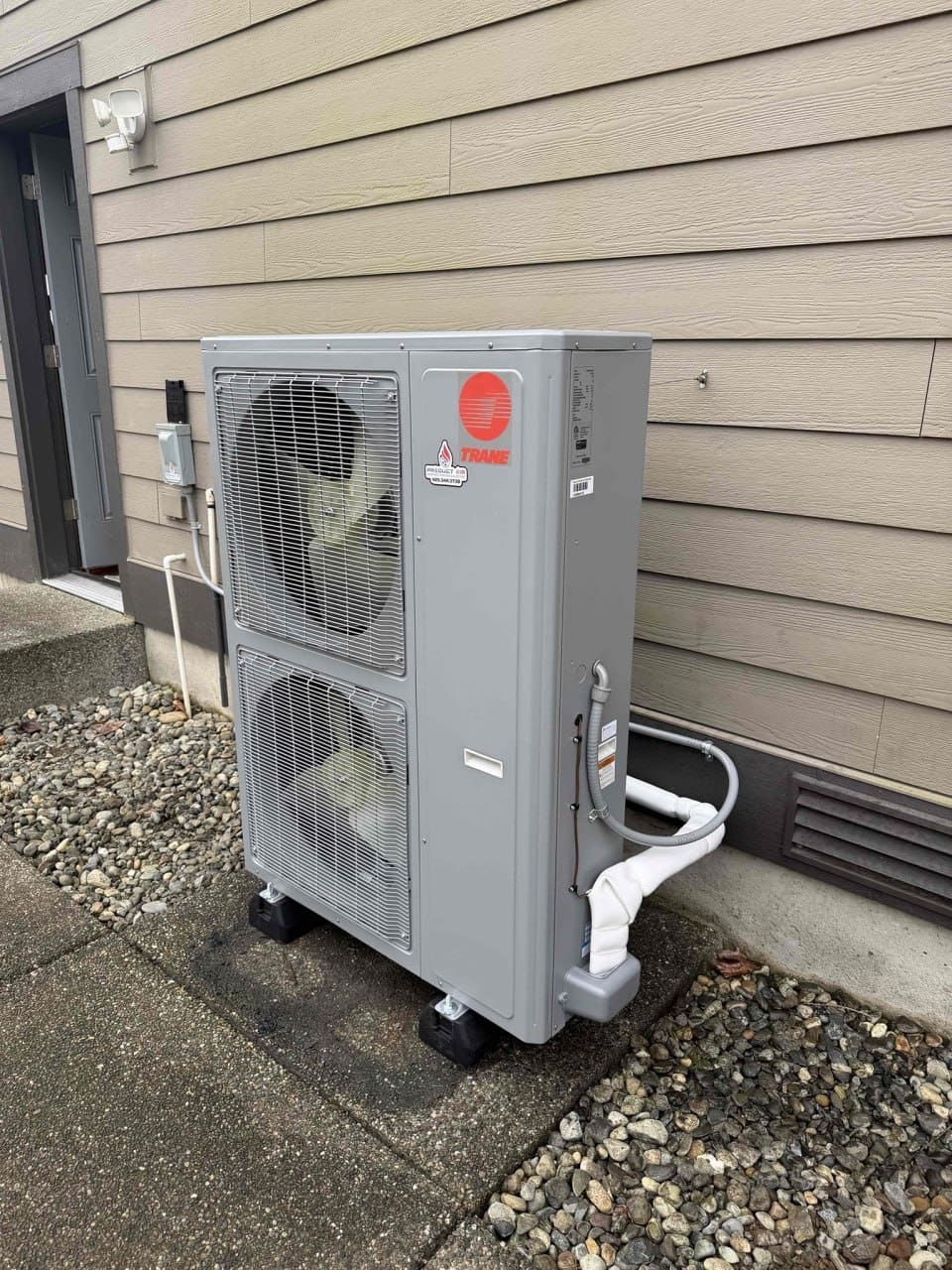
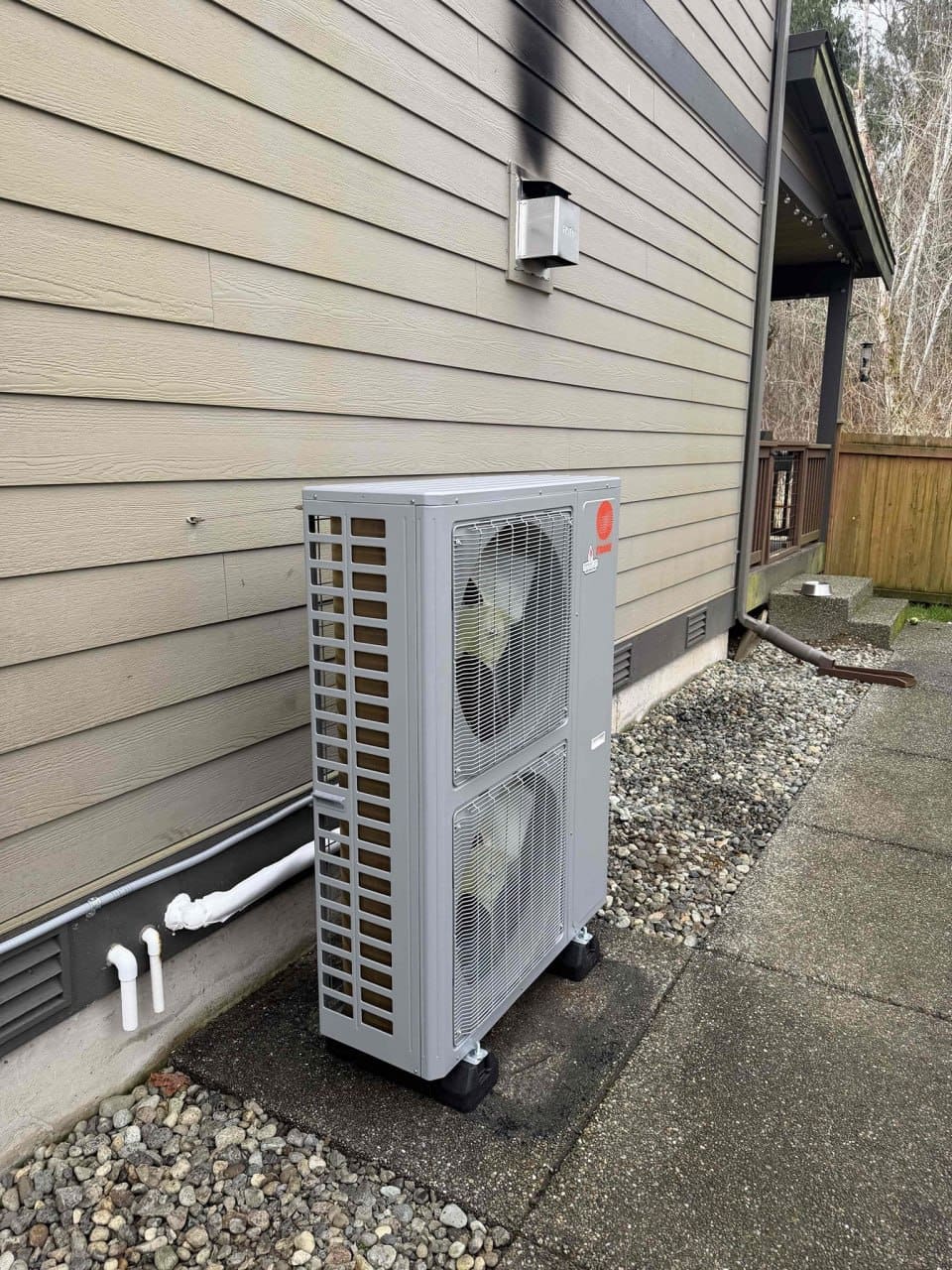
The new outdoor unit is a Resolute by Trane heat pump, 4-to-5 ton capacity, rated at 15.2 SEER2, with a quiet side-discharge design and inverter-driven operation, model number 4TXD2060A10NUA. Where the original system had no inverter modulation to speak of, the Resolute ramps its output to match the home’s actual heating and cooling demand rather than cycling on and off at full output, which is the source of both the efficiency gain and the quieter operation Frederick was told to expect.
The existing air handler stayed in place. Eli’s crew chemically flushed and reused the existing refrigerant line-set rather than running new lines, which kept the job scoped to exactly the failed component and avoided the cost and disruption of touching ductwork that was already working correctly. A new Product Air Smart Communicating Thermostat went in as part of the same visit, giving the system a controller built to work with the new inverter-driven unit’s variable output.
| Component | Detail |
| Outdoor Heat Pump | Resolute by Trane, 4–5 Ton, 15.2 SEER2, Quiet Side Discharge Inverter |
| Model Number | 4TXD2060A10NUA |
| Existing Air Handler | Retained; tested and confirmed in good working order |
| Refrigerant Line-Set | Existing line-set chemically flushed and reused |
| Thermostat | Product Air Nuve Smart Communicating Thermostat |
| Manufacturer Warranty | 10 years (registered through Product Air at installation) |
| Product Air Labor Warranty | 1 year |
How Long Did the Heat Pump Replacement Take?
Work began and finished on February 16, 2026, a single 6-to-8-hour visit once the equipment was on hand. The crew recovered the refrigerant from the old system, removed the failed outdoor unit, chemically flushed the existing line-set, set the new Resolute condenser on its pad, reconnected the line-set, ran low-voltage wiring out to the new Smart Communicating Thermostat, pressure-tested and evacuated the system, charged the refrigerant to spec, and verified full system operation before leaving the house running on the new equipment.
Product Air handles all permitting on jobs that require it as a matter of course, researching what’s needed for the scope of work, filing the application, and scheduling any required inspection so the homeowner never has to manage that process directly. For a like-for-like outdoor unit swap with no electrical or ductwork changes, that process moves quickly and without disrupting the single-day timeline.
How Much Did This Heat Pump Replacement Cost? And Why No Rebate Applied
The Silver Replacement estimate broke down to a $7,022.58 subtotal and $554.78 in sales tax, for a total of $7,577.36. No financing was used; Frederick paid out of pocket.
Final Project Cost: $7,577.36
No rebates or tax credits applied to this job, and the reason is straightforward. Lake Stevens sits in Snohomish County, served by Snohomish PUD, whose 2026 heat pump rebate programs are built to reward converting a home’s primary heating source to a heat pump for the first time. Frederick’s home already had a heat pump as its primary heat source; the outdoor unit had simply failed and needed to be replaced. A like-for-like component swap on an existing heat pump system doesn’t meet the criteria those conversion-focused programs are designed around, and Product Air didn’t show a rebate on the estimate that the job was never going to qualify for.
What Results Did the Homeowner Get?
The Resolute’s inverter-driven operation means the system can finally do what a heat pump is supposed to do in this house: modulate output to hold a steady temperature instead of swinging between full blast and backup resistance heat, which is what had been driving Frederick’s energy bills up in the first place. With the reversing valve issue resolved and a correctly registered manufacturer warranty in place for the first time since the home was built, the new outdoor unit carries the kind of coverage the original installation should have had from day one.
A properly maintained heat pump in this climate has an expected service life of 15 to 20 years, and with the existing air handler still in good working order and the new outdoor unit registered under full manufacturer warranty, the system is positioned to actually reach that mark this time. Eli said Frederick’s relief had less to do with the new equipment itself and more with finally getting a straight answer: one diagnosis, one correctly scoped fix, and a warranty that will actually be there if something goes wrong again.
Key Takeaways
- A heat pump that keeps blowing a fuse and forces a home onto expensive backup heat often traces to a single failed component, in this case an electrical short in the reversing valve coil, rather than a long list of parts that all need replacing.
- A relatively young heat pump, installed alongside a 2017 home, can still fail with zero manufacturer warranty coverage if the original installer never registered the equipment, a step most manufacturers require within 60 to 90 days of installation.
- Repeated, unsuccessful repair attempts that swap parts without confirming the actual failure point typically cost more in total than a single correctly diagnosed fix, even when each individual invoice looks smaller along the way.
- A failed outdoor heat pump unit doesn’t always require replacing the indoor air handler too; when the air handler tests fine, a partial replacement that keeps the existing indoor equipment and reuses the line-set is a fully legitimate, lower-cost option.
- Product Air scales its labor warranty to the scope of the job: 90 days on a single-component repair, one year on a partial system replacement, three years on a full system replacement.
- Snohomish PUD’s 2026 heat pump rebate programs reward converting a home’s primary heat source to a heat pump for the first time, not a like-for-like replacement of an outdoor unit on a home that already had a heat pump, which is why no rebate applied to this job.
Why We Register Every Manufacturer Warranty
Product Air Heating, Cooling and Electric serves homeowners across Marysville, Lake Stevens, and the rest of Western Washington, and registering new equipment with the manufacturer the day it goes in is not an optional step in how we do the work, it is the work. Frederick’s first experience with a heat pump failure came from a system nobody ever finished installing correctly, in the one way that mattered most once something actually went wrong. We don’t consider a job done until the paperwork that protects the homeowner for the next decade is filed along with everything else.
— Serge Nikolin, Co-Founder, Product Air Heating, Cooling and Electric
Marysville · Issaquah · Seattle · Western Washington
PLAN YOUR NEXT STEP
Need help with your home comfort?
Explore Product Air’s heat pumps services or contact the team.
Share this guide