


Location: Forest Avenue Southeast corridor, Mercer Island, WA 98040
Call Date: December 30, 2025
First Visit: December 30, 2025
Project Completion: January 8, 2026
Lead Technician: Eli, 10+ years in the trade
System Before: Two Carrier heat pump systems, 17 years old, serving separate zones of the home
System After: Two Resolute by Trane inverter heat pump systems, a 4–5 ton system (Model 5HCL5060B1000A heat pump + Model 5TDM5D07AC51SA air handler) and a 2–3 ton system (Model 5HCL5036B1000A heat pump + Model 5TDM5C04AC31SA air handler)
Final Project Cost: $40,292.49 (paid half by check, half by Visa)
Why Did These New Mercer Island Homeowners Replace Both HVAC Systems?
Christopher called Product Air on December 30, 2025, with a problem that doesn’t leave much room for patience in late December: the house was cold, and it wasn’t a one-system problem. He and his partner had two separate HVAC systems serving their Mercer Island home, and as far as Christopher could tell, both of them were struggling. One had stopped producing any heat at all.
He found Product Air through Angi, with no history between them and no previous contractor’s failed attempt to compare against. Christopher and his partner had recently bought the house, which mattered more to how the visit unfolded than it might seem on the surface. A cold home is a cold home regardless of how long you’ve owned it, but new owners walking into their first winter in an unfamiliar house are working without the years of context that tell a longtime owner whether a system’s quirks are normal or a warning sign. Christopher didn’t have that context yet. What he had was a house that wouldn’t hold heat and a need to understand, quickly, what he was actually dealing with.
Why Does a 8,110-Square-Foot House Need Two HVAC Systems?
The home sits on Forest Avenue Southeast, an 8,110-square-foot, two-story, four-bedroom house built in 2009, large enough that splitting the HVAC load across two separate systems is standard practice rather than an unusual setup. Both systems were Carrier heat pumps, both 17 years old, both original to the house’s construction. Seventeen years is solidly within the range where a well-maintained heat pump is still doing its job in this climate, which makes the diagnosis here less about age alone and more about what age plus neglect does to a system over time.
Eli’s read on the equipment was direct: the systems were aged, and they had been ignored. Not poorly installed, not undersized, not fighting some structural defect in the house. Simply aged and never given the regular maintenance that keeps a heat pump’s internal components functioning at the rate they were designed for. Some of those components had failed outright by the time Eli got there, the kind of failure that shows up gradually until one day a system that used to struggle through winter stops producing heat altogether.
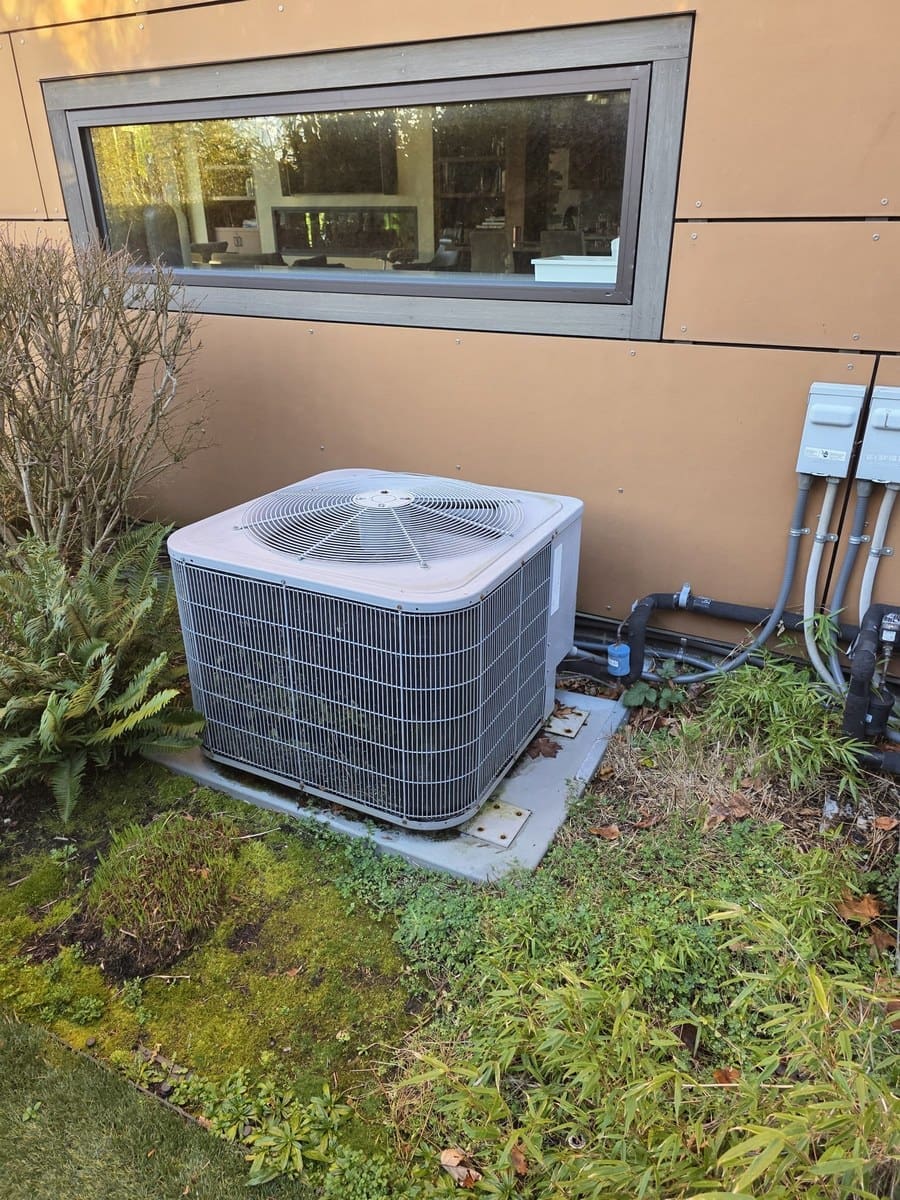
One of the two original Carrier outdoor units, 17 years old, before removal. Mercer Island, WA 98040.
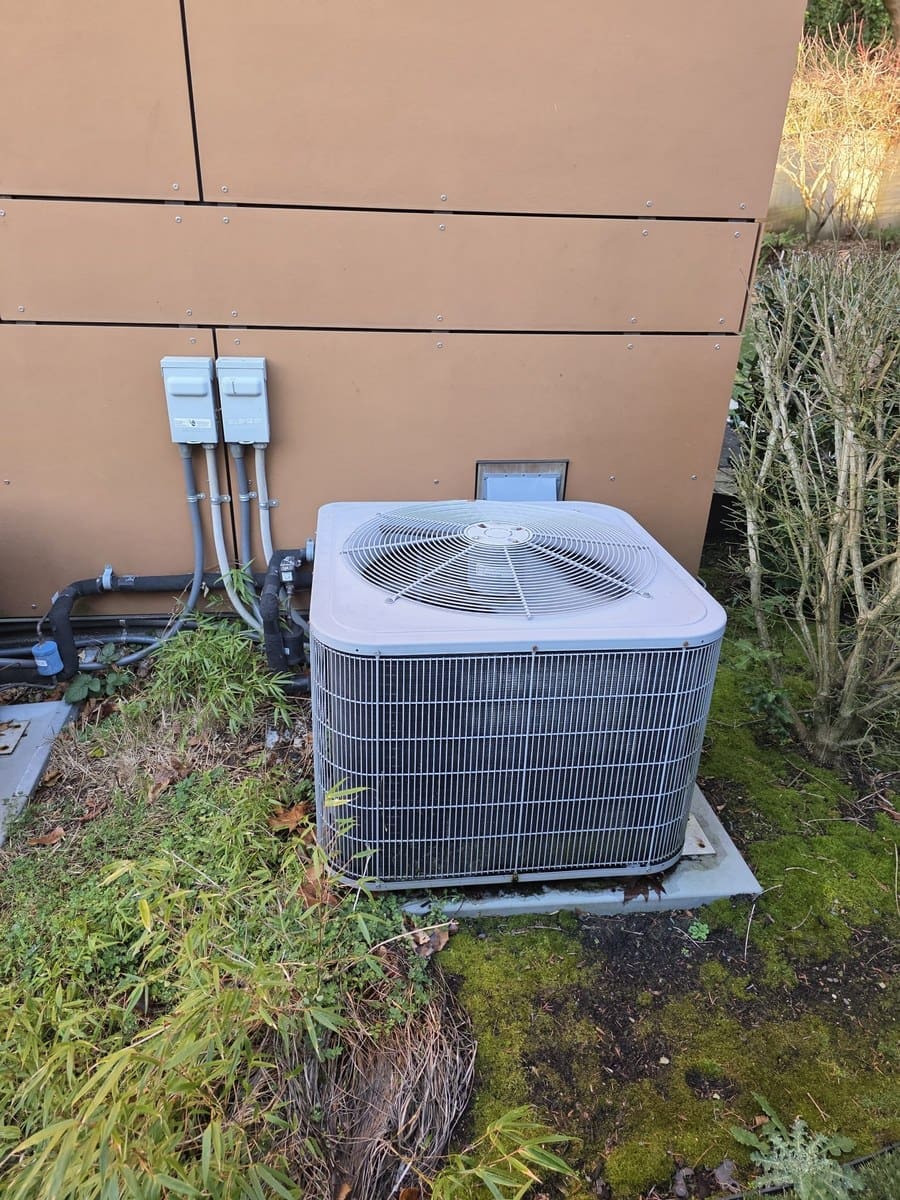
The second of the home’s two original outdoor units, serving the home’s other HVAC zone.
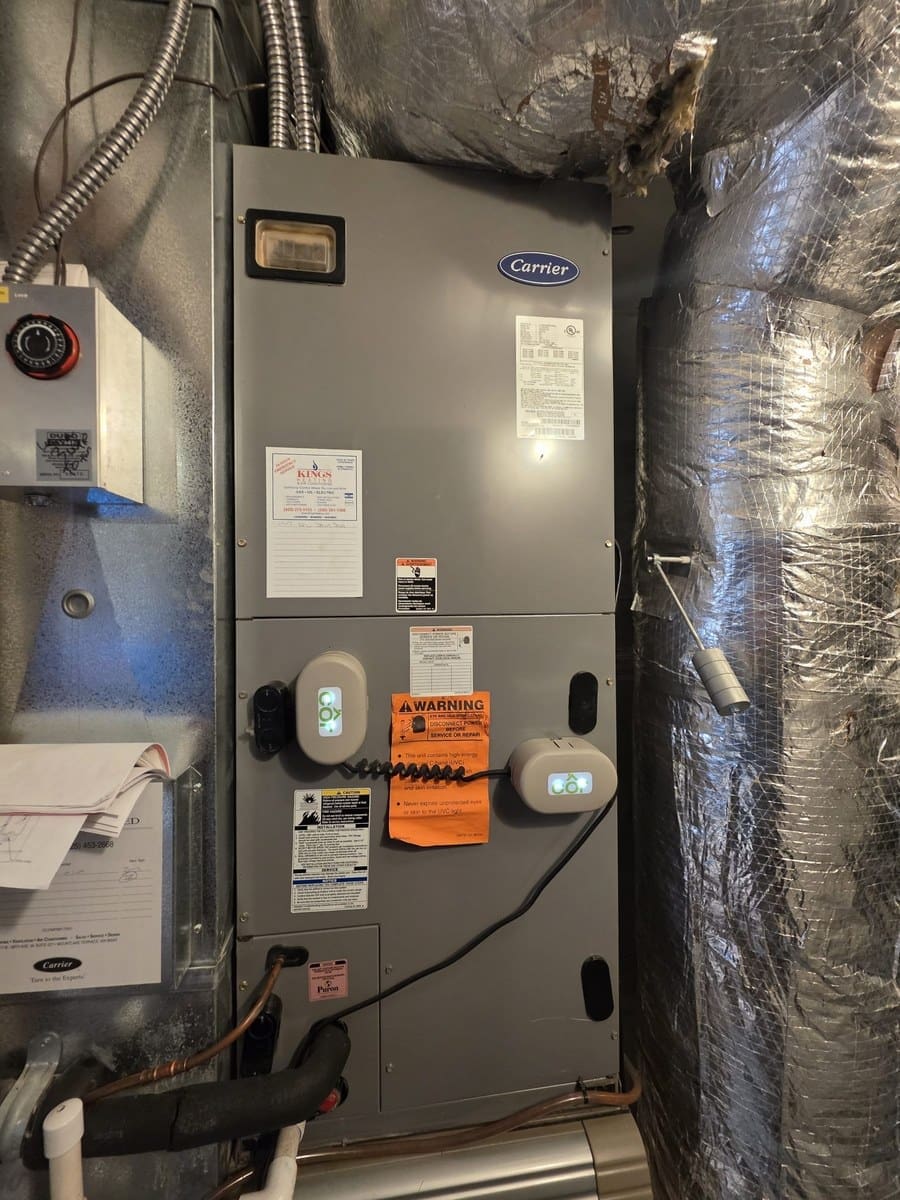
The data plate on one of the original Carrier systems, showing the unit’s age and service history.
The risk here wasn’t dramatic in the way a cracked heat exchanger or a gas leak is dramatic, but it was real. A large home with no reliable way to hold a stable indoor climate creates two kinds of problems at once: a health risk for the people living in a house that can’t stay warm through a Western Washington winter, and a property risk, the kind that shows up later as frozen pipework or moisture damage when a home’s climate control simply isn’t there to prevent it. Christopher had a nice house and, at the moment Eli walked through the door, nothing reliable to heat it with.
How Do We Decide Whether to Repair or Replace Two HVAC Systems?
Eli’s approach to this visit is the kind of thing that’s easy to describe in the abstract and harder to actually do under time pressure with a cold house and a homeowner who wants an answer fast. “It’s not about what is said, it’s what was asked,” is how Eli put it afterward. “What do they need, and what are they not saying? Yes, the issue was a cold home, but what are their future needs? How do they feel now, and what comfort are they looking for? Is it a short-term fix now, or do they not want to have to face this issue again for the next fifteen years at minimum?” Before he ever quoted a number, Eli told Christopher something close to: I can diagnose the issue, but may I ask you a question that might ask you to be a little vulnerable about what you actually want here?
Once the full diagnostic was done, Eli sat down with Christopher and his partner and laid it out plainly: “I heard you when you said that you just bought this home. I heard that you said it would be nice to never have to cross this situation again. I heard that you said your comfort is important to you.” That framing shaped everything that came next, because the options Product Air put in front of them weren’t built around the cheapest way to get heat back on. They were built around what a couple who’d just bought the house and didn’t want to revisit this problem in five years would actually need.
Product Air laid out two tiers of equipment across both systems: a top-tier Trane package and an upper-mid-tier Trane package, with the homeowners looking to replace both systems at the same time rather than patch one and gamble on the other.
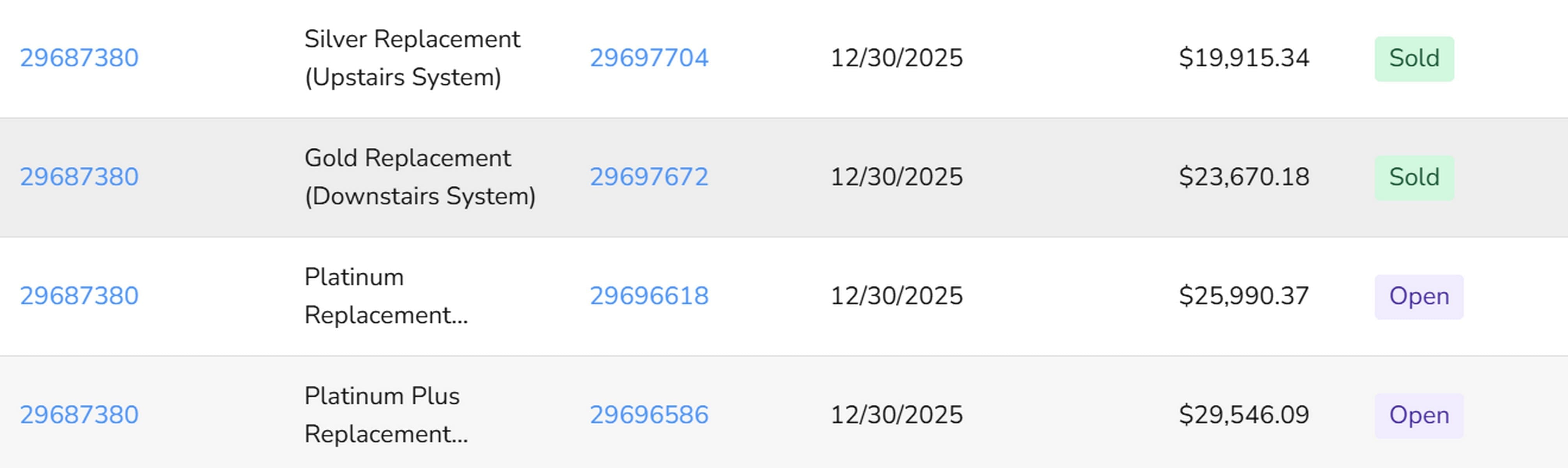
The estimate presented to Christopher, covering both HVAC systems at two equipment tiers, with the upper-mid-tier options for each system marked Sold.
Silver Replacement (Upstairs System): Resolute by Trane 2–3 ton inverter heat pump and air handler: $19,915.34 — Sold
Gold Replacement (Downstairs System): Resolute by Trane 4–5 ton inverter heat pump and air handler: $23,670.18 — Sold
Platinum Replacement: both systems replaced together at Trane’s higher equipment tier: $25,990.37 — Open
Platinum Plus Replacement: both systems replaced together at Trane’s top equipment tier: $29,546.09 — Open
Christopher and his partner chose the upper-mid-tier option, replacing both systems with the Resolute by Trane line rather than stepping up to Trane’s top-of-catalog equipment. It wasn’t the cheapest path available and it wasn’t the most expensive. It was the option that matched what Eli had heard them say they wanted: a house they wouldn’t have to think about for the next fifteen years, at a price that didn’t require chasing the absolute top of the equipment lineup to get there.
Should You Replace Both HVAC Systems at the Same Time?
Homeowners moving into a large two-story home for the first time are sometimes surprised to learn that two separate HVAC systems is the right design, not a sign that something was done wrong. A single system trying to condition 8,110 square feet across two floors typically can’t balance the load evenly: upstairs runs warmer or colder than downstairs depending on the season, and the equipment ends up oversized for one zone and undersized for the other just to compromise on an average. Splitting the home into an upstairs system and a downstairs system, each sized correctly for its own square footage and exposure, is the standard professional answer for a house this size, and it’s exactly the setup Christopher’s home already had with its two original Carrier systems. The fix here was never about consolidating to one system. It was about replacing two aging systems with two correctly sized new ones.
The decision between Trane’s top-tier equipment and the upper-mid-tier Resolute line is a real one, and it’s worth understanding rather than assuming bigger numbers always mean better outcomes. Both equipment tiers Product Air offered here are fully inverter-driven, modulating systems, a meaningful step up from the single-stage Carrier units coming out, which ran in fixed bursts rather than adjusting output to match demand. The difference between the tiers themselves comes down to the finer points of part-load efficiency and a handful of premium features, not a difference in core reliability or warranty length, both carrying the same 10-year manufacturer coverage when installed by a certified contractor. For a couple who told Eli, in not so many words, that they wanted reliability and long-term peace of mind rather than the most premium badge on the equipment, the upper-mid tier delivered exactly what they were after without paying for headroom they weren’t going to use.
There’s a broader lesson in how this estimate was built that applies to any homeowner facing a two-system replacement: get both systems quoted together, not separately, and get them quoted at more than one equipment tier. Replacing two systems in a single coordinated visit, with a single crew and a single round of permitting, is more efficient than splitting the work across two separate calls months apart, and it gives a homeowner the full picture of what the house actually needs before committing to either system in isolation. Christopher and his partner saw both systems and both tiers side by side before they decided anything, which is exactly the kind of full picture a one-system-at-a-time approach never provides.
What Went Into the House on Forest Avenue Southeast
Two complete Resolute by Trane inverter heat pump systems went in, each sized for its own zone of the home. The larger of the two, sized at 4-to-5 tons, pairs the 5HCL5060B1000A heat pump with the 5TDM5D07AC51SA variable-speed electric air handler, a 60,000 BTU unit built for the larger downstairs load. The smaller system, sized at 2-to-3 tons, pairs the 5HCL5036B1000A heat pump with the 5TDM5C04AC31SA air handler, a 36,000 BTU unit matched to the upstairs zone’s smaller footprint.
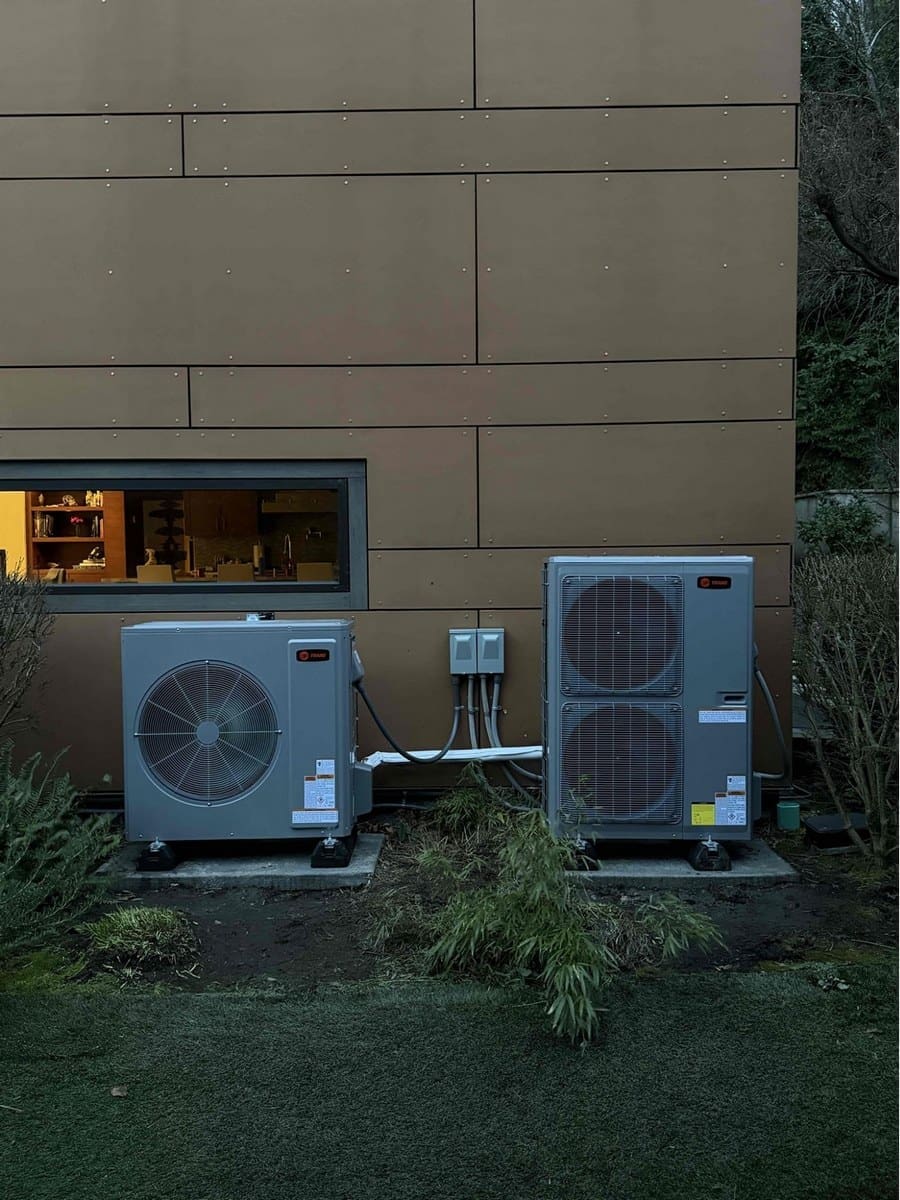
Caption: The two new outdoor heat pump units, installed together on new pads behind the home, Mercer Island, WA 98040.
Both systems are fully modulating and communicating, which Eli described as equipment that studies how the house actually behaves and plans its response ahead of the next demand cycle, rather than simply reacting to a thermostat setpoint after the fact. Both handle cold outdoor temperatures meaningfully better than the single-stage Carrier units they replaced, which translates directly into lower utility bills through the coldest months. The longer, gentler run times that come with a modulating system also mean more air passing through the filter over the course of a day, which adds up to better filtered air quality and a more evenly balanced climate throughout a house this size.
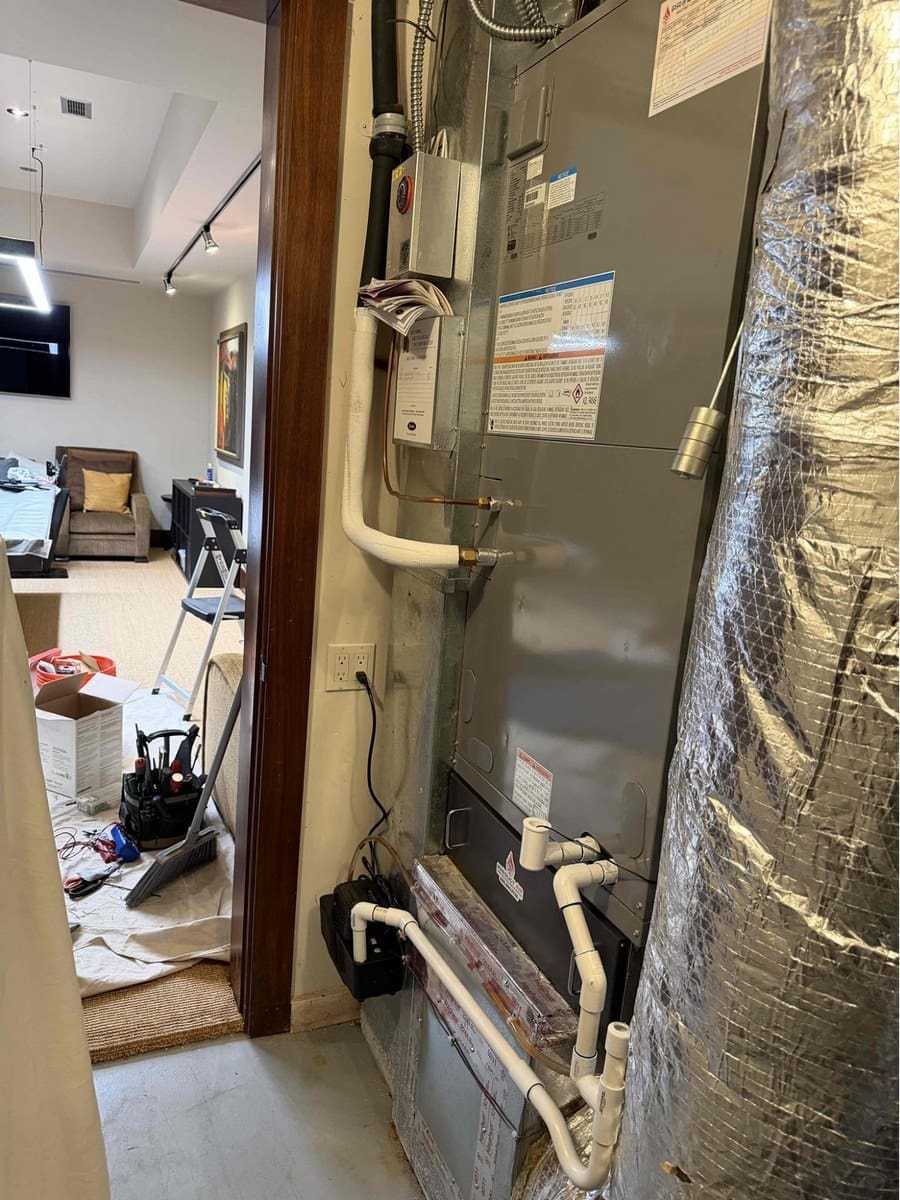
One of the two new Resolute by Trane air handlers, installed in the home’s main-floor utility space.
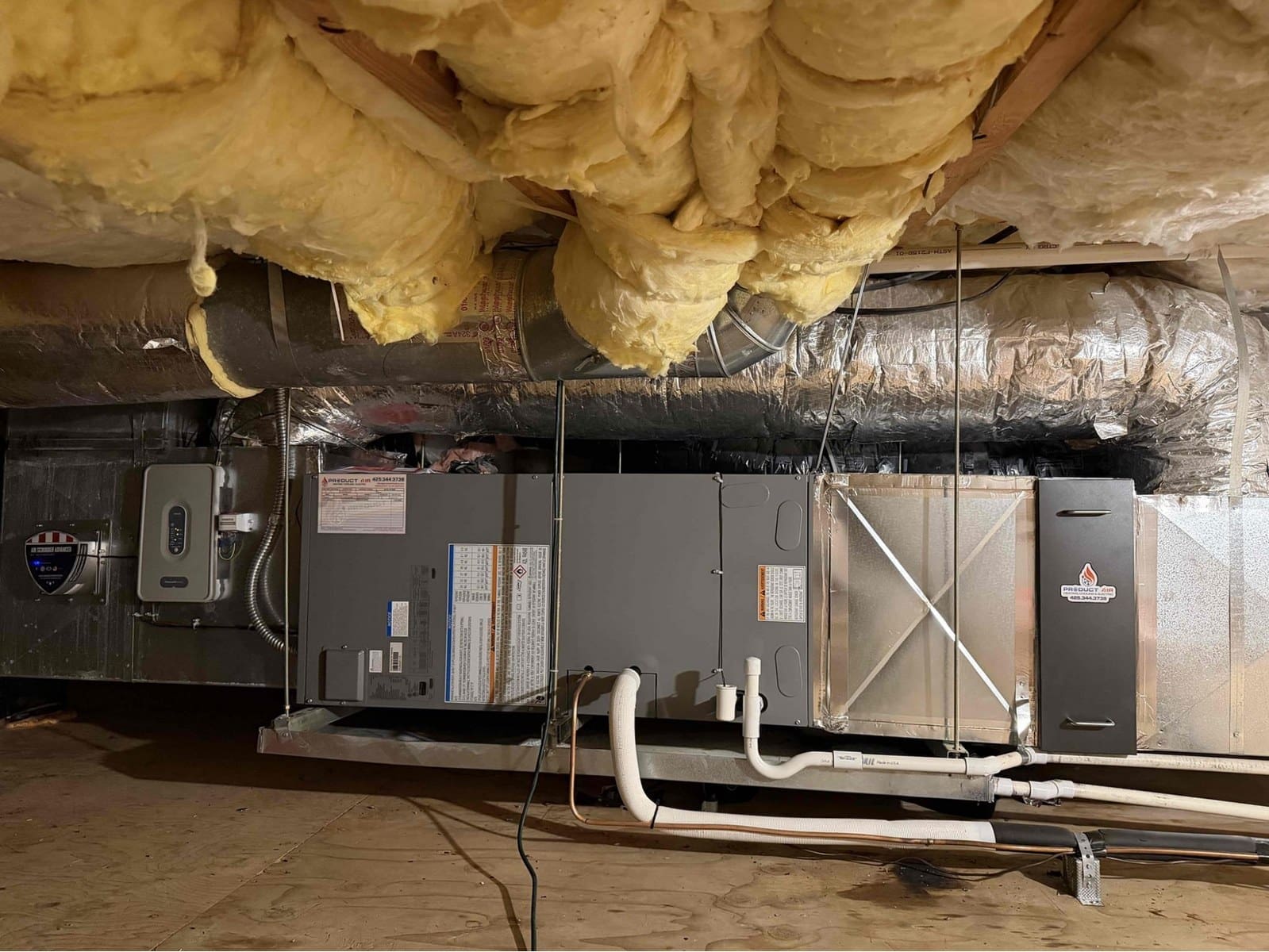
The second new air handler, installed in the home’s crawl space alongside the new communicating control hardware.
| Component | Detail |
| System 1 (Downstairs) Heat Pump | Resolute by Trane, 4–5 Ton, 16–19 SEER2, Quiet Side Discharge Inverter |
| System 1 Heat Pump Model Number | 5HCL5060B1000A |
| System 1 Air Handler | Resolute by Trane, 5 Ton/60k, Variable Speed Electric |
| System 1 Air Handler Model Number | 5TDM5D07AC51SA |
| System 2 (Upstairs) Heat Pump | Resolute by Trane, 2–3 Ton, 16–19 SEER2, Quiet Side Discharge Inverter |
| System 2 Heat Pump Model Number | 5HCL5036B1000A |
| System 2 Air Handler | Resolute by Trane, 3 Ton/36k, Variable Speed Electric |
| System 2 Air Handler Model Number | 5TDM5C04AC31SA |
| Manufacturer Warranty | 10 years |
| Product Air Labor Warranty | 3 years |
How Long Does It Take to Replace Two HVAC Systems? A Coordinated, Single-Day Replacement for Both Systems
Work began and finished on January 8, 2026, with four HVAC technicians and two electricians on site to handle both systems in a single coordinated day rather than splitting the job across separate visits. Each crew worked its own zone: removing the old Carrier equipment, setting the new outdoor units on fresh pads, installing the new air handlers in their respective spaces, running the necessary electrical connections, and commissioning each system before moving to final checks. Inspection followed the next available day, with permits signed off in a single visit.
Product Air handled all permitting on this job as it does on every installation, researching the mechanical and electrical permit requirements for a two-system replacement of this scope, filing the paperwork, and scheduling the inspection so neither Christopher nor his partner had to manage any part of that process directly.
How Much Does It Cost to Replace Two Heat Pump Systems? What About Rebates?
The combined replacement of both systems came to a base price of $42,192.49 before rebates. Two programs applied. A $1,500 rebate covered the hybrid heating configuration on the qualifying system, and a Puget Sound Energy Midstream rebate applied to the equipment rated above HSPF2 8.5, bringing the total rebate value to $1,900.00.
| Program | Amount |
| PSE Hybrid Heating Rebate | $1,500.00 |
| PSE Midstream Rebate (HSPF2 8.5+) | $400.00 |
| Total Rebates | $1,900.00 |
Base price (before rebates): $42,192.49
Final cost after rebates: $40,292.49
A federal tax credit was also discussed during the estimate, one Christopher will need to work through directly with his CPA rather than seeing applied at the point of sale. Worth noting plainly here: the federal Section 25C tax credit expired on January 1, 2026, just days after this estimate was written and just before the January 8 installation date. Anyone in a similar position, with an installation landing right around that boundary, should confirm directly with a tax professional whether a given project still qualifies rather than assuming a credit discussed in December still applies in January.
No financing plan was used. Christopher and his partner paid half by check and half by Visa at completion.
What Results Can Homeowners Expect After Replacing Two Heat Pumps?
Both new Resolute by Trane systems carry a 10-year manufacturer warranty and Product Air’s 3-year labor warranty, and a heat pump installed and maintained properly in this climate has an expected service life of 15 to 20 years, which puts Christopher and his partner well past the point where they’d need to revisit this decision within the timeframe Eli heard them describe as their goal. The two systems that used to run in fixed, single-stage bursts have been replaced by equipment that reads the house continuously and adjusts ahead of demand, which is the difference between a home that swings between too warm and too cold and one that simply holds steady.
For a house this size, the efficiency gain isn’t a marginal line item. Two systems handling Western Washington’s coldest stretches meaningfully better than the 17-year-old Carrier units they replaced shows up directly in the monthly utility bill, and the improved filtration that comes with longer, gentler run times means better air quality throughout a four-bedroom home two new owners are just beginning to settle into.
Christopher’s reaction after the work was done centered less on the equipment itself and more on how it was handled. He appreciated the approach, how well the system was installed, and how clearly it had been tailored to what he and his partner actually needed, not just the problem they’d called about.
Key Takeaways
- A large two-story home splitting its HVAC load across two separate systems, each sized for its own zone, is standard professional design, not a sign that something was done wrong; the fix for two aging systems is usually two correctly sized new ones, not a single consolidated replacement.
- A 17-year-old heat pump failing isn’t always about age alone; equipment that’s aged and never given regular maintenance can fail well before the end of its expected service window, while a well-maintained system of the same age can still be performing fine.
- An “upper-mid tier” equipment choice between two professionally installed, fully inverter-driven systems often carries the same manufacturer warranty as the top tier, with the price difference reflecting finer part-load efficiency rather than a gap in core reliability.
- Getting multiple HVAC systems quoted together, at more than one equipment tier, in a single visit gives a homeowner the full picture of what a house actually needs before committing to either system in isolation.
- A home with no reliable heat source carries real health and property risk beyond simple discomfort, including the potential for frozen pipework and moisture damage when a stable indoor climate isn’t maintained through a Western Washington winter.
- The federal Section 25C tax credit expired January 1, 2026; any heat pump installation landing close to that date should be confirmed directly with a tax professional rather than assumed eligible based on when the estimate was written.
What We Listen For Before We Quote Anything: What Other Homeowners Can Learn From This Project
Product Air Heating, Cooling and Electric serves homeowners across Mercer Island, Issaquah, Seattle, and the rest of Western Washington, and the way Eli approached Christopher’s house is the way every visit is supposed to go: ask what’s actually being asked for before reaching for a price sheet. Christopher and his partner didn’t call about their long-term comfort goals. They called about a cold house. The job was figuring out that those were the same conversation all along.
— Serge Nikolin, Co-Founder, Product Air Heating, Cooling and Electric
Marysville · Issaquah · Seattle · Western Washington
PLAN YOUR NEXT STEP
Need help with your home comfort?
Explore Product Air’s hvac services or contact the team.
Share this guide