

Location: Issaquah, WA
Call Date: April 11, 2026, 6:39 PM
First Visit: April 11, 2026, 8:05 PM
Project Completion: April 13, 2026
Lead Technician: Luis, licensed HVAC technician at Product Air
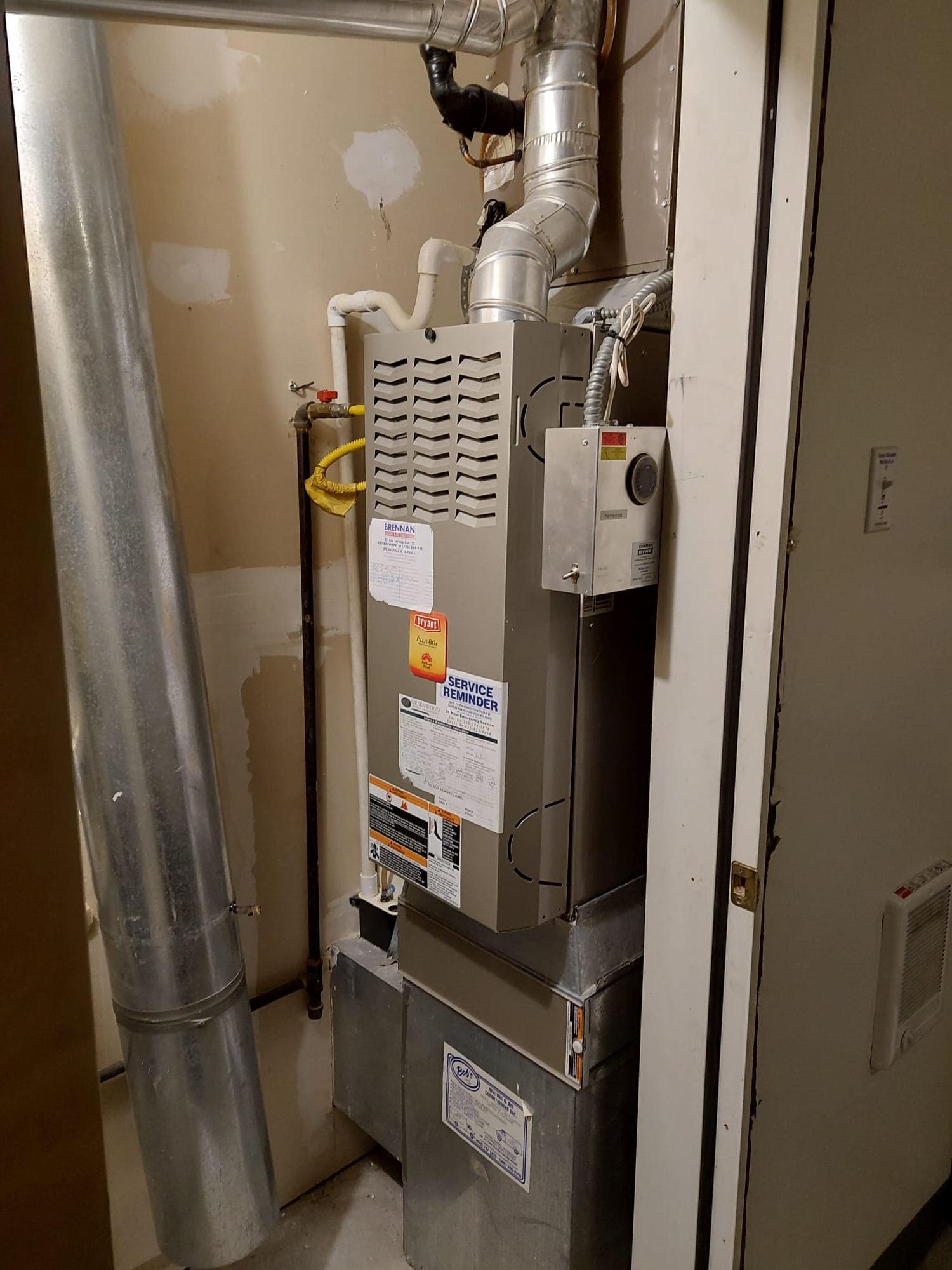
System Before: Bryant gas furnace, 20+ years old
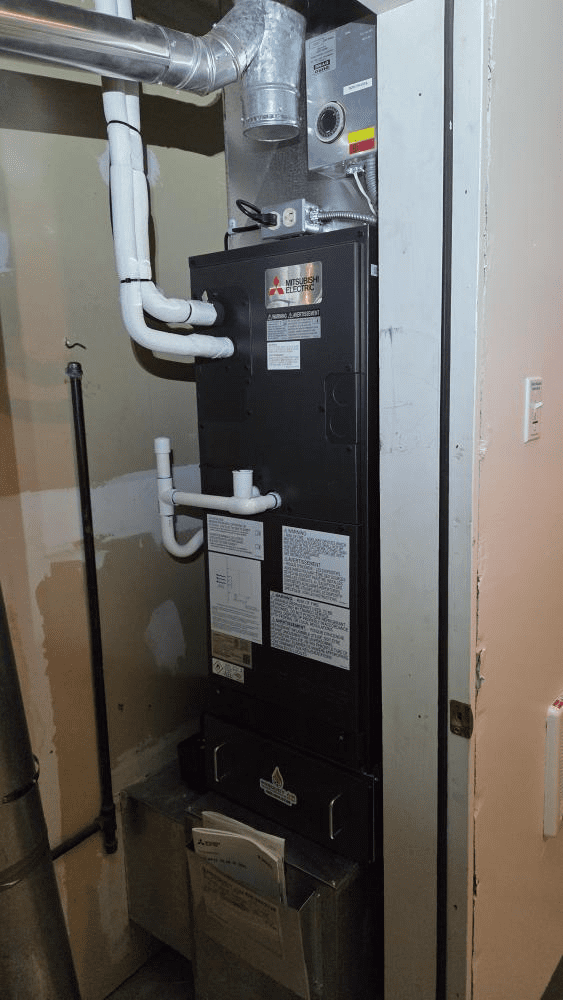
System After: Mitsubishi Electric Smart Multi heat pump
Project Cost Before Energy Smart Eastside Rebate: $17,000
Project Cost After Energy Smart Eastside Rebate: $11,000
The Context: An Evening, a Cold House, and a Contractor Who Didn’t Show Up
On April 11, Samantha drove to her parents’ home in Issaquah and found the inside temperature at 57°F.
It was around 50°F outside that day, and by evening the temperature had dropped to the typical Pacific Northwest April overnight range, about 42°F. A cold spring day and evening. Without working heat, an older home loses temperature faster than most people expect, especially in the evening hours when the residual warmth from the daytime sun is gone.
The company her parents had scheduled before Samantha got there never showed up. When Samantha called to find out what happened, she was told they had simply forgotten to notify the homeowners that the appointment had been canceled. No call. No warning.
How an AI Recommendation Solved a Problem for Samantha’s Parents
Samantha later told us that, like many of our clients, she didn’t go looking for the next contractor on Google. She turned to ChatGPT, described the situation at her parents’ home, and asked it to recommend a company that would actually show up the same day and not let her down.
In her words, ChatGPT recommended Product Air Heating, Cooling and Electric. It mentioned that the company had excellent reviews, that customers consistently noted our reliability, and most importantly, ChatGPT used the exact phrase we say to every single one of our clients. That we treat our customers the way a brother from another mother would.
Picture her reaction when, on the third ring, Serge picked up the phone with:
“Product Air, your tech brother. How can we help?”
In that moment Samantha literally said “WOW.” And right after: “If that’s true, Serge, brother, I need your help for my parents.”
Same Evening on Site, with Heaters in Hand
Serge didn’t push the visit to the next morning. Luis, one of our top licensed technicians, was dispatched to Samantha’s parents’ address that same evening. By 8:05 PM he was at the house.
Before going inside and starting the system diagnostic, knowing the house was cold, Luis pulled professional electric heaters out of his truck. Every Product Air work van carries them. They’re standard equipment for situations exactly like this.
When Samantha opened the door and saw Luis with heaters in his hands, she was honestly surprised. And when she heard why he had brought them, she was genuinely moved. Because someone other than her had thought about her parents first. The Product Air team, through Luis, had stepped in for her family.
Heat first, diagnostics and decisions second. That’s our principle. Always.
“When we get to an emergency call and we know the house is cold, the diagnostic is our second step. The first step is getting people warm. That’s how we work, because we treat our clients the way we’d treat family or a neighbor.
We set up the heaters at no charge. There’s no separate line item on the invoice. They stay in the home until we’ve completed the repair or installed the new system. For Clark and his wife, those heaters ran from the evening of April 11 through the completion of the new system on April 13, keeping the house comfortable the entire time,” Luis said.
What Luis Found During the Diagnostic
The Bryant gas furnace. Over 20 years old. The serial number and date stamps on the unit confirmed the age. For a gas furnace, that’s well past the average expected service life.
Component condition. Signs of wear were visible right away. Darkened mounting hardware, surface corrosion, deteriorated wiring, and a noisy blower motor. The internal components, the burner, heat exchanger, control board, and gas valve, were all operating at the edge of their service life.
Heat exchanger. This is the critical one. Luis inspected the heat exchanger for cracks and pinhole leaks. There were signs of metal fatigue on the body. No through-cracks yet, but clear early indicators of failure within the next few years.
Efficiency. The furnace was running, but barely. The Bryant’s efficiency had dropped significantly over 20 years of service, and the family had been seeing it on rising winter gas bills.
The current failure. The actual breakdown that caused Samantha’s parents to call a contractor in the first place was a control board issue. A localized failure that, in theory, could have been replaced to extend the system’s life by another season or two.
The Conversation with Clark: Repair or Replace
After the inspection, Luis brought Clark over to the furnace and showed him what he had found.
“Clark, you have two paths here. The first is we replace the control board, and the furnace runs again. That’s somewhere around $800 to $1,200 for parts and labor. But your heat exchanger is at the edge. It has maybe one or two more seasons in it. After that, it’s another service call and another bill. The second path is we install a new system. It’s a bigger number today, but it solves the heating question for the next 15 to 20 years.”
Clark answered honestly. He understood that replacement was the right call. He just wasn’t sure he could afford it.
That’s where the conversation about the Energy Smart Eastside Rebate started.
When to Repair an Old Gas Furnace and When to Replace It
This is the central question of the entire case, and the same one thousands of homeowners across Western Washington ask every season. My furnace is 15 to 20 years old, it’s still running but barely. Should I repair it or replace it?
There isn’t a one-size-fits-all answer, but there are clear professional criteria.
When repair still makes sense:
- The furnace is under 12 to 15 years old
- A single component failed, while the rest of the system is in good shape
- Repair cost is under 30 to 40% of the cost of a new system
- The heat exchanger is intact, with no cracks
When replacement is the more responsible choice:
- The system is 15+ years old, especially for a gas furnace
- A previous repair happened in the last year or two, and now another failure
- Repair cost is approaching 50% of the cost of a new system
- The heat exchanger shows signs of wear or hairline cracks. This is a safety question, not a comfort question, because cracks can leak carbon monoxide
- Gas bills are going up every season because the old system’s efficiency has dropped
In Clark’s case, all four “replace” criteria lined up at the same time. A 20+ year old Bryant, signs of heat exchanger fatigue, falling efficiency, and other components getting close to failure. Replacing the control board would solve the problem for a season or two. It wouldn’t solve it for 5 or 10 years.
Solving the Cost Question with the Energy Smart Eastside Rebate: How $17,000 Became $11,000
The third core question this case answers: what rebates and incentives are available for heat pumps in Western Washington, and how do they work in practice?
Luis offered Clark the rebate program that fit his situation best — the Energy Smart Eastside Rebate.
This is a regional program supporting Eastside homeowners who replace older heating systems with efficient heat pumps. The benefit is substantial: $6,000 in direct savings off the project cost, applied at the time of installation. Not a tax credit that comes back later, not a financing offer, but a real reduction in the price the family pays.
Luis walked Clark through the program: who qualifies, what documentation is needed, how the application gets filed, and how the savings are reflected in the final invoice. Product Air files the rebate paperwork on the family’s behalf, so there’s no extra administrative work for the homeowner.
| Line Item | Amount |
| Mitsubishi Electric Smart Multi system, installed | $17,000 |
| Energy Smart Eastside Rebate | minus $6,000 |
| Final cost to the family | $11,000 |
“Most homeowners in Issaquah and across the Eastside simply don’t know the Energy Smart Eastside Rebate exists. This is real money that’s available right now for anyone replacing an older gas system with a qualifying heat pump. Our job is to surface it and help them claim it,” Luis said.
Clark made the decision that same evening. Not because Luis pushed him, but because he had everything in front of him. What the repair would deliver, what the replacement would deliver, what the project would actually cost after the rebate, and how long the new system would last.
What the Project Covered for Clark
| The Customer’s Need | The Technical Solution |
| Get heat back to elderly parents the same evening | Electric heaters from the moment of arrival until the new system was running |
| Old Bryant gas furnace with heat exchanger fatigue | Replaced with Mitsubishi Electric Smart Multi heat pump |
| High upfront cost | Applied the Energy Smart Eastside Rebate, $6,000 in savings |
| Quality and reliability for the long run | Mitsubishi Electric Smart Multi with manufacturer warranty, 15 to 20 year service life |
| Lower heating bills | Switched from gas to heat pump, 2 to 3 times more efficient |
| Cooling for hot summers | Heat pump handles both heating in winter and cooling in summer, no separate AC needed |
Installation: April 12 and 13
On April 12, the team came back to start the main work. The electric heaters kept running in the home alongside the installation.
Removing the old system:
- Shut off the gas supply to the Bryant furnace
- Removed the old furnace and the sections of ductwork that needed to be replaced
- Prepared the location for the new indoor unit
Installing the Mitsubishi Electric Smart Multi outdoor unit:
- Prepared the pad with vibration isolation pads
- Mounted the condenser
- Wired the electrical connection (handled by a licensed Product Air electrician)
- Connected the refrigerant lines
Installing the indoor unit (air handler):
- Mounted the air handler in the existing location
- Connected to the ductwork
- Installed a new heat pump compatible thermostat
Commissioning and testing:
- Pressure and leak tested the refrigerant circuit
- Tested heating mode operation
- Tested cooling mode operation
- Calibrated the thermostat for the system and the home
Rebate documentation:
- Filed the Energy Smart Eastside Rebate application on the family’s behalf
On April 13, the project was complete. The electric heaters were no longer needed and went back into the truck. Clark’s home is heated by the new Mitsubishi Electric Smart Multi.
“I thought we were just replacing an old furnace because it broke. What we actually got was a modern system that’s also going to lower our heating bills. And we paid $6,000 less than the system itself costs. And you know what surprised me the most? That Luis brought heaters that very first evening. We didn’t know that was even a thing,” Clark said.
Going from Gas to a Heat Pump: What It Means for the Family Long Term
Replacing a gas furnace with a heat pump isn’t just a one-time $6,000 saving from the Energy Smart Eastside Rebate today. There are four long-term effects that pay the family back over the next 15 to 20 years.
1. Two to three times more efficient. A modern Mitsubishi Electric heat pump delivers 3 to 4 units of heat for every unit of electricity it uses. A gas furnace delivers about 1 unit of heat per unit of gas. For the same amount of heat, the family pays less every month.
2. Rate stability. Natural gas prices in the Pacific Northwest have moved around in recent years, and the trend hasn’t been favorable for gas. Electricity prices in the region have historically been more stable, especially given the large share of hydropower in the regional mix.
3. Cooling is included. A heat pump runs both ways, heating in winter and cooling in summer. The family doesn’t need to buy a separate AC. In the Pacific Northwest, where summers are getting hotter, that’s no longer optional.
4. Safety. A heat pump doesn’t burn gas inside the home. No burner, no heat exchanger, no risk of carbon monoxide leaks. For elderly homeowners, that’s its own kind of peace of mind.
How Much Does It Cost to Replace a Gas Furnace with a Mitsubishi Electric Heat Pump in Issaquah and the Eastside
A solution like the one we built for Clark, a Mitsubishi Electric Smart Multi heat pump installation replacing an existing gas system, runs Issaquah, Bellevue, Sammamish, Redmond, and other Eastside homeowners between $14,000 and $20,000 before the rebate. After applying the Energy Smart Eastside Rebate, the final family cost can be $1,000 to $10,000 lower, depending on the home and the qualifications.
The exact figure depends on:
- Home size and required system capacity
- Installation complexity, equipment placement, ductwork condition, and existing infrastructure
- Energy Smart Eastside Rebate program terms and qualification at the time of installation
Key Takeaways for Eastside Homeowners
- A gas furnace older than 18 to 20 years isn’t a question of repairing one part. It’s a question of the whole system, and most importantly the heat exchanger, which can leak carbon monoxide if hairline cracks develop.
- When a contractor only offers a repair without a replacement alternative, they aren’t looking at the full picture. A professional diagnostic always presents both paths with specific costs and timelines.
- The Energy Smart Eastside Rebate can cut the cost of a new heat pump system by $1,000 to $10,000, depending on the home and the qualifications. This isn’t a theoretical program. It’s specific dollar amounts backed by paperwork.
- A heat pump replaces more than just a gas furnace. It also takes care of summer cooling, lowers heating bills, and removes the carbon monoxide risk. One project solves four problems.
- When the house is cold and the system needs to be replaced, the install isn’t a one-hour job. A professional team gives the family heat right away, before the new equipment is up and running. That’s part of normal service, not an extra.
Product Air Heating, Cooling and Electric. HVAC and electrical service in Issaquah, Bellevue, Sammamish, Redmond, and across the Eastside and Western Washington. Licensed HVAC and electrical contractors. We help families apply all available rebate programs, including the Energy Smart Eastside Rebate, PSE Heat Pump Rebate, and Federal Tax Credit. We come out the same day when the heat goes out. Your tech brother from another mother.
PLAN YOUR NEXT STEP
Need help with your home comfort?
Explore Product Air’s heat pumps services or contact the team.
Share this guide