

Location: 52nd Avenue NE, Wedgwood, Seattle, WA 98115
Call Date: March 8, 2026
First Visit: March 16, 2026
Project Completion: May 11–12, 2026
Lead Technicians: Eli, 10+ years, licensed HVAC technician; Luis, 25+ years, licensed HVAC technician
System Before: Bryant gas furnace, 8–10 years old, 95% AFUE;
System After: Mitsubishi SUZAK30NLHZ Cold Climate heat pump (2.5 ton, 30K BTU) + SVZAP30NL variable-speed air handler relocated to attic, full new duct system
Final Project Cost: $29,280.76
The Call That Wasn’t About an Emergency
Tyler’s Bryant furnace was eight to ten years old, running at 95% efficiency, and giving him no particular reason to act, at least not about the heat. He wasn’t calling because something broke. Nothing had failed. The furnace still worked, but it was loud, it took up valuable closet space, and it left the home without any real cooling in the summer. Over time, those frustrations stopped feeling minor. They became the reason to look for something better.
Tyler found Product Air through a friend who had used our electrical team the year before. That kind of referral tends to arrive with a clear expectation: that the person who shows up will be straight with you. Tyler’s friend had been. When Tyler called, he described three things that were bothering him, close to word for word: the noise the furnace made, the fact that it was occupying the closet, and that he had no air conditioning. All three together were the reason for the call.
What Eli and Luis Found
The home was a 1,200-square-foot single-story built in 1951, the kind of Wedgwood house that has been through several owners, updated in patches, and carries the texture of its era in every mechanical corner. The Bryant gas furnace sat in a hall closet, 95% AFUE, eight to ten years old, doing its job. Around it ran the electric baseboard heaters: visible along the walls of the main living areas, supplementing the forced-air heat on cold mornings, running at 100% electrical efficiency by definition: one dollar of electricity, one dollar of heat, nothing left over, and audible at night in the rooms closest to the thermostat.
There was no cooling infrastructure at all. No evaporator coil, no refrigerant lines, no outdoor unit. Adding central air conditioning to the house meant starting from the air distribution side and building outward. The existing duct layout had been designed for a heating-only system. Whatever solution Tyler chose would need to move conditioned air through rooms that had never been designed for simultaneous heating and cooling through a modern duct system.
The Bryant had years left in it by any reasonable assessment. At eight to ten years old, a well-maintained 95% AFUE furnace carries an expected service life of 15 to 20 years from installation. This was not a diagnostic finding that pointed to imminent failure. It was a system doing exactly what it was designed to do, in a home that had quietly outgrown what that design could offer.
Fischer Heating had also come out before us. Tyler heard their estimate, looked at what they put on paper, and called Eli.
Four Options, One Conversation
Eli and Luis walked the house on March 16. The estimate they put together covered four distinct options, written and priced, laid on the table without pressure.
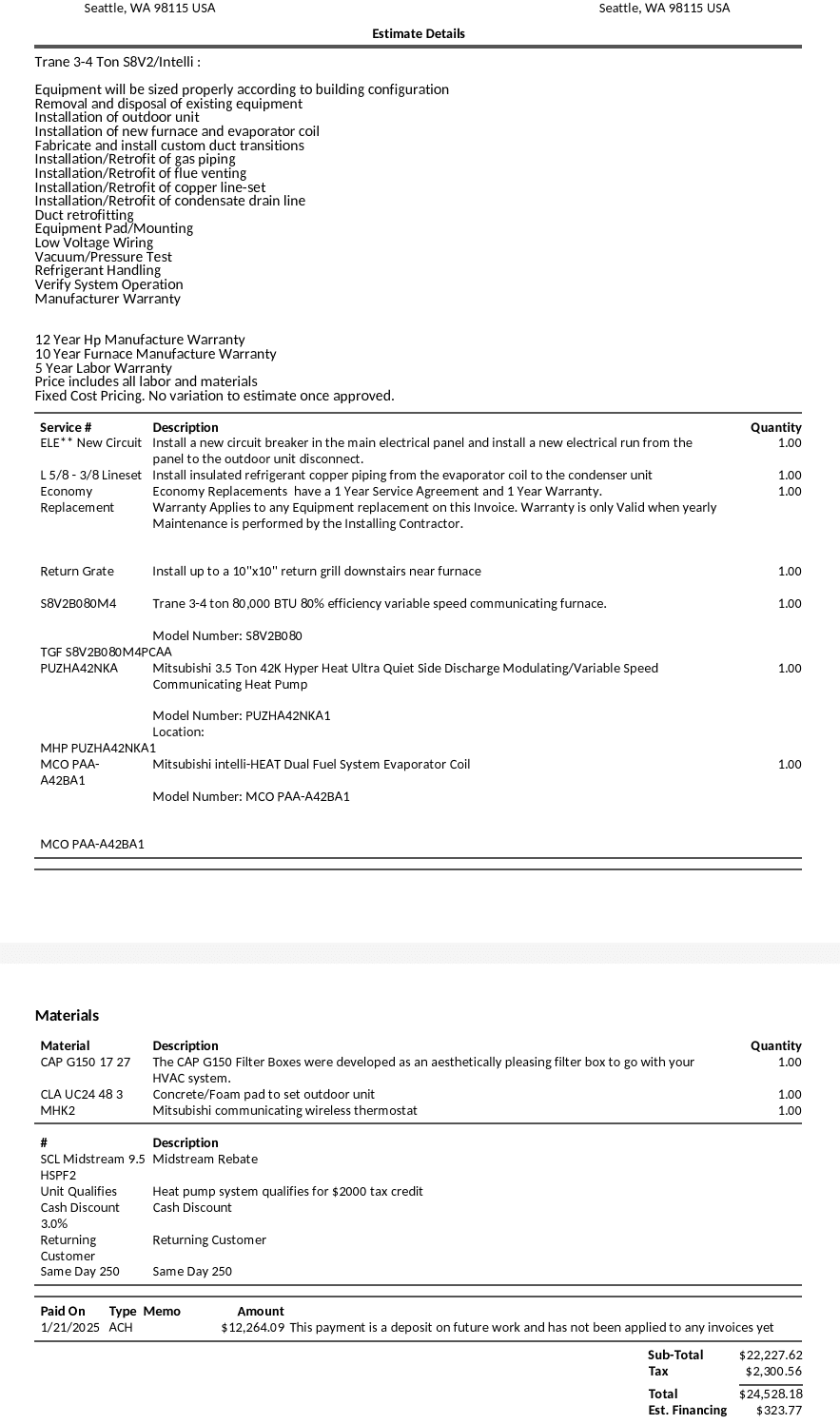
The first was a straight AC add-on: keep the Bryant furnace, add an evaporator coil and outdoor condensing unit, run new refrigerant lines, and have air conditioning through the existing ductwork by summer. The Bryant stays in the closet. The electric baseboards stay on the walls. The heating situation is unchanged. The home is cooler in July. Nothing else moves.
The second was a heat pump add-on in the same configuration, an outdoor heat pump unit rather than a straight AC condenser, giving the system the ability to provide supplemental heat as well as cooling. Entry-level equipment, entry-level price, same floor plan consequences as option one.
The third was a full equipment upgrade: a new furnace replacing the Bryant, paired with a new outdoor AC unit. Better heating equipment, central air conditioning for the first time, but the same structural reality: the closet still occupied by mechanical equipment, the baseboard hardware still running the perimeter of the rooms.
The fourth option, labeled Platinum Plus on the estimate, was different in kind from the first three. Eli walked Tyler through what it meant: pull the Bryant out of the closet entirely, relocate the new air handler to the attic, rebuild the duct system from the ground up with a new supply plenum, new trunk-line, new R-8 insulated flex ducting throughout, and install a Mitsubishi Cold Climate heat pump outside. The closet becomes a closet again. The baseboards come out. The house gets quieter. The system runs from -13°F through a Seattle summer without switching fuel sources or calling for backup.
Tyler chose option four.
What he said came back to the same three things he had opened with: the noise, the closet, and the missing air conditioning. Option four answered all three at once. Options one through three answered one or two.
When Replacing a Working Furnace Is the Right Call
The decision Tyler made is one that comes up regularly in Seattle homes built between 1940 and 1960: a furnace that isn’t failing, a homeowner who wants air conditioning, and a contractor who presents a range of options from “add cooling” to “replace everything.” The standard advice “why replace what isn’t broken?” is reasonable. It doesn’t always apply.
In Tyler’s situation, the Bryant’s working condition was beside the point. The furnace handled roughly six months of the Seattle year, the heating months. It provided nothing during the other six. Adding air conditioning to the existing system would address the cooling gap while leaving the noise, the closet occupation, and the electric baseboard hardware entirely in place. The result would be a home with more of its problems solved than before, but not all of them, and specifically not the one Tyler cared most about.
The economics of doing it in two steps versus one are worth understanding directly. A heat pump add-on to an existing system costs $8,520 to $14,000 in Seattle depending on equipment tier and installation complexity. A complete system replacement with air handler relocation and new ductwork runs significantly more. But the Bryant furnace, even performing well today, would need replacement within the next decade.
When that moment arrived, Tyler would face the same relocation conversation again at future equipment prices, with a different crew, rebuilding the duct system that a full replacement would have addressed now. The closet question doesn’t go away. It gets deferred, and deferred work is rarely cheaper.
There is also an efficiency argument that is often understated when contractors talk about high-AFUE gas furnaces. A 95% AFUE furnace is genuinely efficient at converting gas to heat. But a Mitsubishi Cold Climate heat pump doesn’t convert energy into heat. It moves heat that already exists in the outdoor air into the house. At Seattle’s typical winter temperatures of 25°F to 45°F, the SUZAK30NLHZ operates at an effective coefficient of performance of 2.5 to 3.5, meaning two to three and a half dollars of heat delivered per dollar of electricity consumed.
Tyler’s electric baseboard heaters were running at 100% efficiency, the theoretical maximum for resistance heat. The heat pump that replaced them runs at 250% to 350% efficiency in the same weather. The baseboards are gone. The closet is empty. The gas line to the furnace has been capped.
The attic relocation deserves specific explanation for homeowners who have never seen it done. Moving an air handler from a main-floor closet to an unconditioned attic space sounds like it would create duct losses: colder air, more heat bleeding into unfinished space. The engineering reality is that an attic-mounted air handler with properly insulated ductwork (R-8 flex duct, fiber-sealed connections at every joint, insulated supply plenum) loses minimal heat in transit, and the acoustic benefit is immediate and substantial.
A closet-mounted air handler sits in the living space, separated from the bedroom by a single wall. An attic-mounted system puts the blower behind the ceiling, above insulation, with the full structural mass of the floor assembly between the mechanical noise and the rooms below. Homeowners who have lived with a closet-mounted system and then replaced it with an attic-mounted one consistently describe the change as something close to silence. The Mitsubishi SVZAP30NL modulates rather than cycles, which compounds the effect: the system doesn’t kick on at full blast and rattle back down. It ramps up gradually and holds.
What We Installed
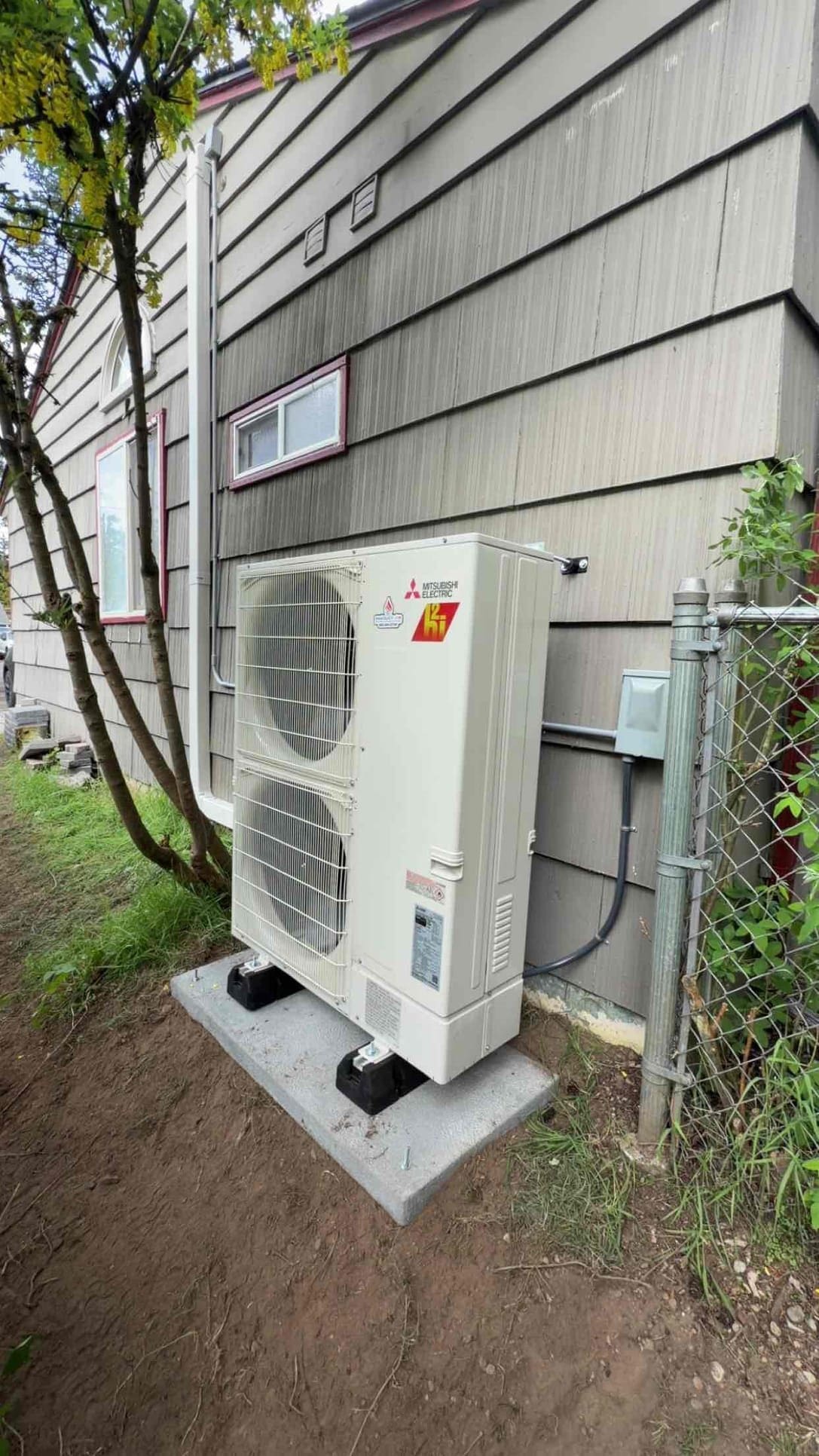
The SUZAK30NLHZ is Mitsubishi’s Hyper Heat Cold Climate outdoor unit, a side-discharge design that allows placement in tighter side-yard configurations, rated at 2.5 tons and 30,000 BTU, capable of operating at 100% heating capacity down to 5°F with continued operation to -13°F. For a Wedgwood home in Seattle’s typical winter band of 25°F to 45°F, this is not a system that will ever ask the homeowner to turn on backup heat.
The SUZAK30NLHZ communicates directly with the SVZAP30NL air handler through Mitsubishi’s communicating control protocol, modulating continuously between 30% and 100% capacity to maintain a set temperature rather than cycling on and off. The supply air temperature holds steady. The rooms hold their set point. The compressor is not audible from the interior of the house.
The SVZAP30NL air handler (21″ W × 21-5/8″ D × 43-7/8″ H) was installed in the attic with an entirely new duct system: new supply air plenum, new central trunk-line duct, new 6″ supply air saddles with adjustable dampers at each register, 4×10×6 supply air floor boots, R-8 insulated flex ducting fiber-sealed at every connection, and a new centrally located return air ceiling box. A Mitsubishi MHK2 Smart Wireless Thermostat was installed in the living area, communicating directly with the system.
A new dedicated circuit was run from the main electrical panel to the outdoor unit disconnect up to 45 feet of electrical work, handled by our licensed electricians as part of the same installation. The Bryant furnace was disconnected, removed, and disposed of responsibly.
| Component | Detail |
| Outdoor Unit | Mitsubishi SUZAK30NLHZ Cold Climate Heat Pump |
| Capacity | 2.5 Ton / 30,000 BTU |
| Cold-Weather Rating | Full capacity at 5°F, operates to -13°F |
| Air Handler | Mitsubishi SVZAP30NL Variable Speed (attic installation) |
| Air Handler Dimensions | 21″ W × 21-5/8″ D × 43-7/8″ H |
| Thermostat | Mitsubishi MHK2 Smart Wireless |
| Duct System | Full replacement: R-8 insulated flex, fiber-sealed at all joints |
| Electrical | New dedicated circuit, main panel to outdoor disconnect |
| Model Number (Outdoor) | SUZAK30NLHZ |
| Model Number (Air Handler) | SVZAP30NL |
| Manufacturer Warranty | 12 years (Mitsubishi Diamond Elite Contractor) |
| Product Air Labor Warranty | 5 years, no conditions |
How the Installation Ran
Eli and Luis completed the site visit and full written estimate on March 16. The estimate covered four options with pricing, scope, and equipment details for each. Tyler reviewed them and made his decision.
The installation was scheduled for May 11. The gap between estimate and installation start is normal for a job of this scope in Seattle’s spring season: permit applications, equipment ordering through Gensco, and crew scheduling all run on realistic timelines rather than artificial ones.
Day 1. May 11: The Bryant furnace was disconnected and removed from the closet. Old ductwork came out. The SVZAP30NL air handler was staged and installed in the attic. New supply air plenum fabricated and set. Central trunk-line ductwork run. Supply saddles and floor boots installed at each register location throughout the house. R-8 insulated flex ducting installed between every saddle and the trunk-line, fiber-sealed at every connection. Return air ceiling box installed, centrally located in the main living area. New dedicated circuit run from the main electrical panel to the outdoor unit disconnect location.
Day 2. May 12: The SUZAK30NLHZ outdoor unit was set on a concrete and foam condenser pad on the side of the house. Insulated copper refrigerant line-set was run from the outdoor unit into the attic to connect with the SVZAP30NL air handler. The system was pressure-tested and evacuated. Refrigerant was charged to Mitsubishi’s specification. The MHK2 thermostat was installed in the living space and commissioned. System startup, testing at each register, and airflow balancing completed.
Permit inspection was scheduled for the morning after installation was completed. Product Air handles all permit applications (mechanical, refrigeration, and electrical) as part of every installation in Seattle. Seattle SDCI permit costs for a project of this scope typically run $149 to $500 depending on declared project value. Permits are pulled in most cases within 4 to 24 hours. The inspector signed off the following morning.
What the Project Cost
| Program | Amount |
| Seattle City Light Midstream Rebate (HSPF2 8.5) | $400 |
| Mitsubishi Spring Manufacturer Rebate | $950 |
| Total Rebates | $1,350 |
Base price: $30,630.76
Final cost after rebates: $29,280.76
Tyler paid out of pocket. No financing was used. The Seattle City Light midstream rebate applies because the SUZAK30NLHZ qualifies at HSPF2 8.5, the higher-efficiency threshold that earns $400 from SCL on qualifying Mitsubishi equipment.
The Mitsubishi spring manufacturer rebate was a promotional program active at the time of installation. Both rebates were applied directly to Tyler’s invoice. He did not submit forms, wait for reimbursement, or manage any part of the rebate process. The invoice number he paid reflected the final price after both programs had been deducted.
What the Next 15 Years Look Like
A Mitsubishi Cold Climate heat pump professionally installed and regularly maintained in Seattle’s climate carries an expected service life of 15 to 20 years. The 12-year manufacturer warranty, available only through Mitsubishi Diamond Elite Contractors, a designation held by a small number of contractors in the Pacific Northwest, covers parts for the full term. Product Air’s five-year labor warranty covers the installation itself, with no fine print attached to that commitment.
The efficiency difference between what Tyler was running and what he now has is measurable at the monthly utility statement. The Bryant at 95% AFUE was doing its job: extracting 95 cents of usable heat for every dollar of gas burned. But it couldn’t cool the house. And the electric baseboard heaters supplementing it were running at 100% electrical efficiency, the theoretical ceiling for resistance heating, which means one watt of electricity becomes one watt of heat, with no multiplication possible.
The SUZAK30NLHZ in Seattle’s typical heating season operates at an effective COP of 2.5 to 3.5. The baseboard heaters are gone. The closet is empty. The gas line has been capped. What Tyler is paying to heat the same square footage is a fraction of what the combined gas-and-baseboard system was costing him.
The new duct system compounds this. A fiber-sealed, R-8 insulated duct installation loses a fraction of the conditioned air that an original 1950s duct system (with dried mastic, disconnected joints, and uninsulated runs) loses in transit. Tyler’s house is now moving air through a sealed system designed for the equipment it serves.
What Tyler has in the attic now is not heard from the living space. The Bryant in the closet (along with the startup surge, the cycling noise, the mechanical presence in the middle of the house) is gone. The SVZAP30NL modulates rather than cycles, and its position above the ceiling puts the full structural mass of the floor assembly between the blower and the rooms where Tyler sleeps. He got the closet back. He got air conditioning for the first time. The house is quieter than it has been since he moved in.
Key Takeaways
- A working furnace is not always the right furnace to keep: when a Seattle home has no air conditioning, a closet-mounted air handler creating noise and space problems, and electric baseboard heaters running on resistance heat, replacing everything at once costs less over a ten-year horizon than addressing the problems one at a time in separate projects.
- The Mitsubishi SUZAK30NLHZ Cold Climate heat pump operates at full heating capacity down to 5°F and continues to function to -13°F, making it appropriate for Seattle winters without backup heat in all but the most unusual cold events.
- Relocating an air handler from a main-floor closet to the attic is a meaningful acoustic upgrade: a modulating attic-mounted system with properly insulated ductwork is not heard from the living space in normal operation, where a closet-mounted system running at full-stage capacity is.
- Seattle City Light’s midstream rebate program pays $400 for heat pump systems qualifying at HSPF2 8.5 or above; Mitsubishi manufacturer promotional rebates stack on top of this; both were applied directly to Tyler’s invoice with no customer paperwork required.
- The 12-year Mitsubishi manufacturer warranty, two years longer than the standard 10-year term, is available only when the equipment is installed by a Diamond Elite Certified contractor; it is not available through an unlicensed installer or a contractor without that certification, regardless of what equipment is purchased.
- Two contractors visited this home and submitted estimates; Tyler chose Product Air. The four-option written estimate, the willingness to propose the attic relocation that solved the full problem rather than a portion of it, and a referral from a neighbor who had already been through the experience were the reasons the decision went the way it did.
What We Are Building Here
Product Air Heating, Cooling and Electric serves Western Washington from Seattle through Snohomish County, the Eastside, and Skagit County. We are a Mitsubishi Diamond Elite Contractor, a Home Depot Trusted Partner, and a licensed electrical contractor in every jurisdiction we work.
Eli, Luis, and the rest of the team working Wedgwood, Sandpoint, Lake City, the University District, and Windermere are the same people who have been doing this work in these neighborhoods for over a decade. The 52nd Avenue NE corridor is a street we know.
The goal has never been to sell the biggest job. It has been to put every option on the table, explain each one plainly, and let the homeowner decide. Tyler saw four options. He chose the one that answered every one of his three complaints at the same time. We installed it, pulled the permits, stayed through the inspector’s sign-off, and left the closet empty.
That is what the work is supposed to look like.
— Serge Nikolin, Co-Founder, Product Air Heating, Cooling and Electric
Marysville · Issaquah · Seattle · Western Washington
PLAN YOUR NEXT STEP
Need help with your home comfort?
Explore Product Air’s heat pumps services or contact the team.
Share this guide