


Location: W Mercer Way corridor, Mercer Island, WA 98040
Call Date: February 9, 2026
First Visit: February 10, 2026
Project Completion: February 27, 2026
Lead Technician: Robert, licensed HVAC technician, 7+ years of industry experience
System Before: Coleman 2-stage high-efficiency gas furnace, 12 years old; no air conditioning
System After: Mitsubishi Hyper Heat PUZAK42NLHZ (3.5 ton / 42,000 BTU) + Mitsubishi intelli-HEAT Dual Fuel evaporator coil + Trane TGF S9X2B080D4PSBB 2-stage high-efficiency furnace
Final Project Cost: $18,312.34 after rebates
He Wasn’t Looking for a Contractor. He Was Walking Past One.
Connor’s call came in on February 9, and the way he found us is about as direct as it gets. He was near his father’s house on W Mercer Way when he noticed one of our vans and our crew, Dima and Nate, mid-installation next door. He walked over, started asking questions, and by the end of the conversation he’d asked them to get him on the schedule for his own house.
He wasn’t in a crisis. The Coleman furnace at his 1989 home, 3,260 square feet, four bedrooms, two stories, was still running. But he’d been sitting with the same thought a lot of people in larger homes on Mercer Island eventually arrive at: how long do you go without air conditioning before the lack of it stops feeling like a lifestyle choice and starts feeling like a gap the house was never meant to have?
Connor also had a timeline. He and his partner were expecting their first child in a couple of months. He didn’t want a major HVAC project hanging over a newborn’s arrival. If there was a moment to get this done cleanly, February was it.
How He Made the Decision
To his credit, Connor didn’t stop at one estimate. He called three contractors: Belred, Gene Johnson, and Product Air. He went through all three conversations, all three proposals, and made his decision based on what he heard, what he was offered, and how each company presented itself.
He came back to Product Air.
Robert met with him on February 10. The first thing Robert does in those conversations (before prices, before model numbers, before rebates) is find out what the customer is actually looking for. Not what’s broken. Not what the minimum fix would be. What they actually want, and what matters to them. Robert asked Connor how he thought about efficiency. Whether he cared about modulating systems versus single-stage. Whether air quality was something he’d thought about alongside comfort.
It was. Connor wanted a system with real efficiency, not something that would need to be revisited in five years. He wanted to understand the technology, not just hand over a check and hope for the best. And once Robert sat down and walked him through what a hybrid dual-fuel configuration could do for a home of this size in this climate, how it would handle the full range of a Mercer Island year, from the mild, damp winters through to the increasingly serious summers, the decision came into focus.
“Once we sat down with Connor,” Robert said, “it was important to get higher efficiency, a good quality system with the maximum amount in savings. I showed him how this unit and setup best meets his needs and all the rebates available.”
What the Existing System Showed Us
The Coleman furnace at Connor’s home was 12 years old, 2-stage, high-efficiency: not a bad unit, and still operational when Robert arrived. A 12-year-old Coleman 2-stage carries the kind of wear you’d expect from a decade of continuous work: the heat exchanger has run through thousands of thermal cycles, the blower shows the slow accumulation of reduced airflow from filter changes that don’t always happen on schedule, and the ignition system is the kind of component that tends to introduce itself to homeowners at the least convenient moment, in the middle of February, when the alternative to a working furnace is a very cold house.
Robert’s read was direct: the furnace could probably run another five years. But “could” is different from “should,” and it is certainly different from “would” for a household about to add a new person and a new set of demands on the house. The more significant data point was that the home had never had air conditioning at all. No outdoor unit. No refrigerant lines. No coil. Whatever the last several Mercer Island summers brought and they have been bringing progressively more, this house was handling them with open windows and whatever cross-ventilation the layout allowed.
That is the actual problem this project solved: not a worn furnace facing the end of its service life, but a 3,260-square-foot home that had always been only half a climate system.
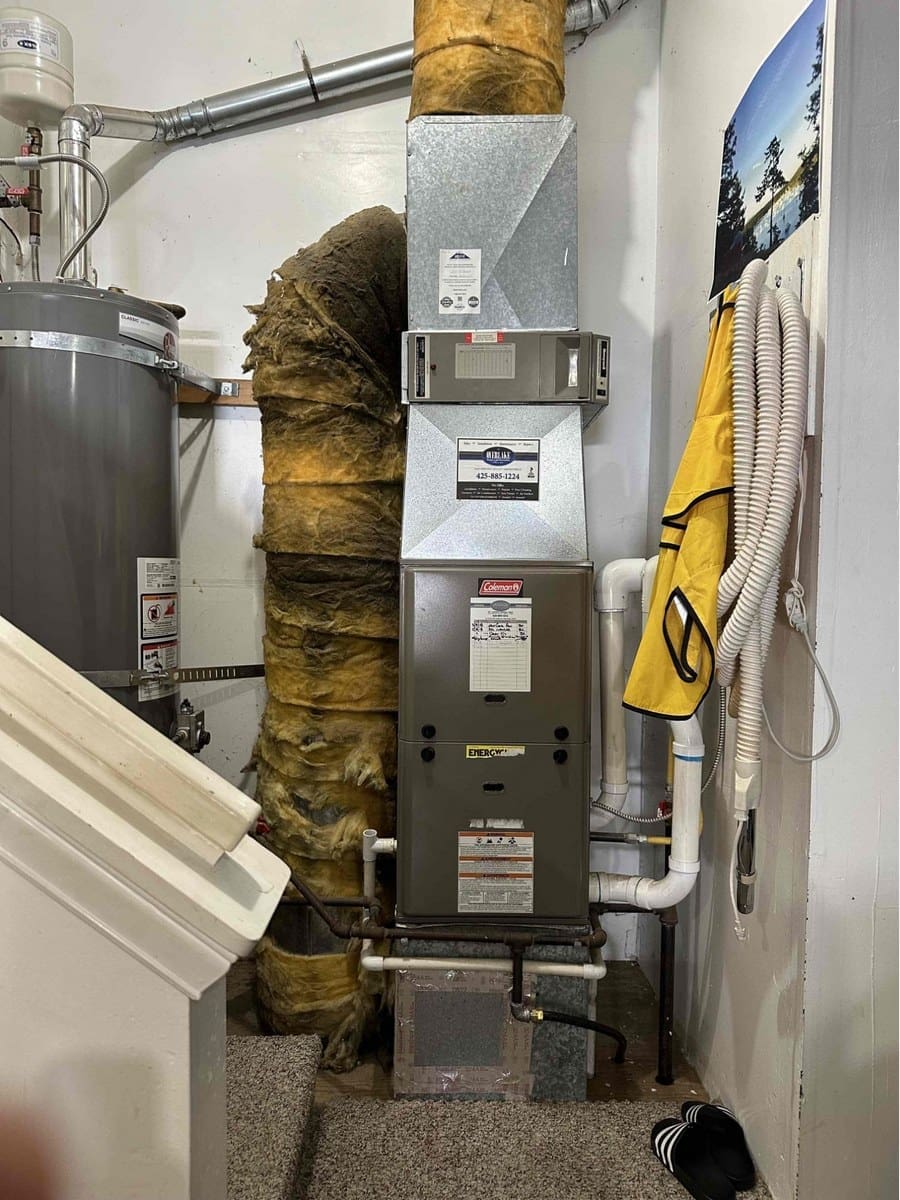
The original Coleman 2-stage high-efficiency furnace in Connor’s garage, February 2026. Operational but aging, and paired with no cooling equipment of any kind. Cramped between the water heater and the storage shelving, is where both the old furnace and the new dual-fuel system would live.
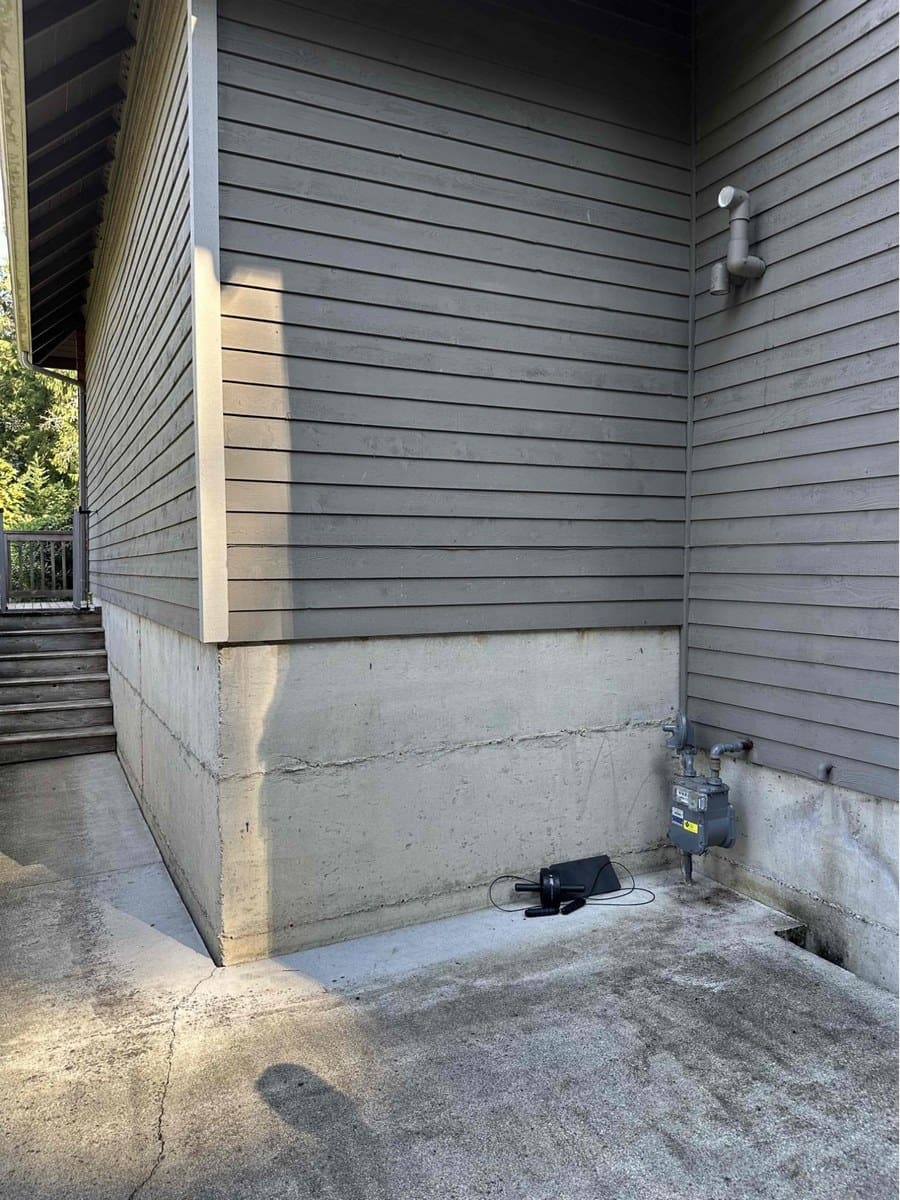
The side of Connor’s W Mercer Way home before installation, February 2026. Gas meter visible to the right; no outdoor HVAC equipment anywhere. The concrete pad where the Mitsubishi unit now sits was empty. This is what ‘no AC’ looks like from the outside.
What a Hybrid Dual-Fuel System Actually Is and When It Makes Sense
The word “hybrid” gets used a lot in HVAC conversations right now, and it deserves a precise explanation rather than a marketing one.
A hybrid dual-fuel heat pump system pairs an electric heat pump with a gas furnace. They share the same air distribution system: the same ducts, the same registers, the same thermostat, but each handles the conditions the other is better suited to avoid. In mild weather, which in the greater Seattle area means anything from roughly 35°F to 65°F and covers most of a Mercer Island winter and all of its shoulder seasons, the heat pump runs. It is dramatically more efficient than gas combustion at those temperatures.
A modern Mitsubishi Hyper Heat at 40°F typically delivers three to four units of heat energy for every unit of electrical energy consumed. Gas combustion, no matter how high-efficiency the furnace, cannot exceed 1-to-1 by the laws of thermodynamics. The furnace takes over when outdoor temperatures drop below the range where the heat pump’s efficiency advantage erodes, usually in the low 20s to high teens Fahrenheit, which in Western Washington covers a small handful of nights per year, not a season.
For cooling, the heat pump runs all summer. That is the capability Connor’s house had never had.
The result, across a full year, is a system that costs meaningfully less to operate than a gas-only system, is significantly more comfortable in the shoulder seasons where most of the heating load actually lives, and provides proper air conditioning from the first warm week in June through September. It also qualifies for the most complete rebate stack available in Western Washington right now, PSE’s hybrid heat pump incentives, the Mitsubishi-specific efficiency tier bonus, and the Energy Smart Eastside program because the incentive structure is designed to move exactly this kind of home in exactly this direction.
What a hybrid system is not the right choice for: a home with very low gas rates and very high electricity costs, a customer who already has functioning AC and no reason to replace it, or a situation where the ductwork cannot support centralized air distribution. Connor’s home hit none of those disqualifiers. The gas infrastructure was already in place, the duct system was designed around a central air handler, and there was no cooling equipment to work around. Hybrid was the right configuration.
The Option Robert Presented
The proposal came down to a complete hybrid dual-fuel system: the Mitsubishi outdoor Hyper Heat unit, the Mitsubishi intelli-HEAT dual-fuel evaporator coil that bridges the heat pump and the furnace, and a new Coleman furnace to replace the aging original. All permits, all electrical work, removal of the old furnace, refrigerant lines, and commissioning were included.
Hybrid Dual-Fuel System: Mitsubishi PUZAK42NLHZ + Mitsubishi intelli-HEAT Coil + Coleman TGF Furnace Replacement: $21,412.34
Connor chose it. The rebate stack Robert laid out made the long-term picture clear, and the combination of a variable-speed, communicating system with a 12-year manufacturer warranty and the air conditioning his house had never had was the outcome he was looking for.
What We Installed
The Mitsubishi PUZAK42NLHZ is not a standard residential heat pump. The Hyper Heat designation means it maintains full heating capacity at outdoor temperatures down to -13°F (a meaningful specification when a Pacific Northwest winter decides to be serious) and modulates continuously rather than cycling on and off in discrete stages. At 3.5 tons and 42,000 BTU, it is properly sized for a 3,260-square-foot two-story home with the thermal profile of a 1989 build on Mercer Island. Its HSPF2 rating exceeds 9.5, which is the threshold that triggers PSE’s top-tier Mitsubishi-specific rebate, not incidentally, but because the rating reflects the equipment’s actual cold-weather heating efficiency.
The Trane TGF S9X2B080D4PSBB that replaced the original furnace is an 80,000 BTU 2-stage unit, matched to the existing duct system and sized to provide backup heat when temperatures drop into the range where the heat pump’s efficiency advantage levels out. The Mitsubishi intelli-HEAT evaporator coil is the communicating component that allows both systems to coordinate: it signals the heat pump when the furnace is taking over, and vice versa, so the transition is automatic and the system manages itself without requiring Connor to run thermostat schedules.
The upgraded filtration system Robert specified alongside the installation was something Connor specifically wanted. Heat pumps cycle air more frequently than gas-only systems (longer, lower-intensity runs rather than short, high-output blasts) and the right filtration setup makes that an asset for indoor air quality rather than just a circulation difference. For a household about to welcome an infant, that wasn’t an afterthought.
| Component | Detail |
| Outdoor Heat Pump | Mitsubishi PUZAK42NLHZ, 3.5 ton / 42,000 BTU, Hyper Heat |
| Configuration | Ultra Quiet Side Discharge, Modulating/Variable Speed, Communicating |
| HSPF2 Rating | Above 9.5 (qualifies for PSE top-tier rebate) |
| Dual Fuel Coil | Mitsubishi intelli-HEAT Dual Fuel Evaporator Coil |
| Replacement Furnace | Trane TGF S9X2B080D4PSBB, 80,000 BTU, 2-stage, high-efficiency |
| Filtration | Upgraded filtration system |
| Manufacturer Warranty | 12 years |
| Product Air Labor Warranty | 5 years |
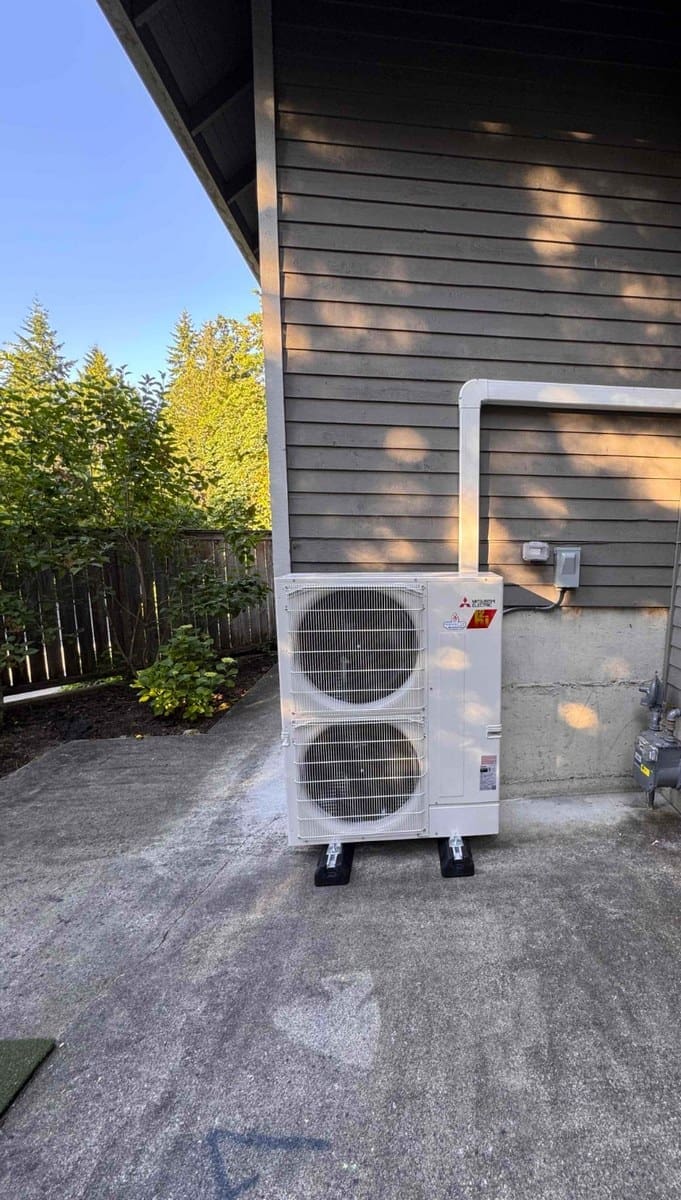
The Mitsubishi PUZAK42NLHZ Hyper Heat unit installed on the concrete pad at Connor’s W Mercer Way home, February 2026. Refrigerant lines and electrical conduit run clean up the gray siding. This unit carries the cooling load all summer and handles the majority of the heating load from October through April.
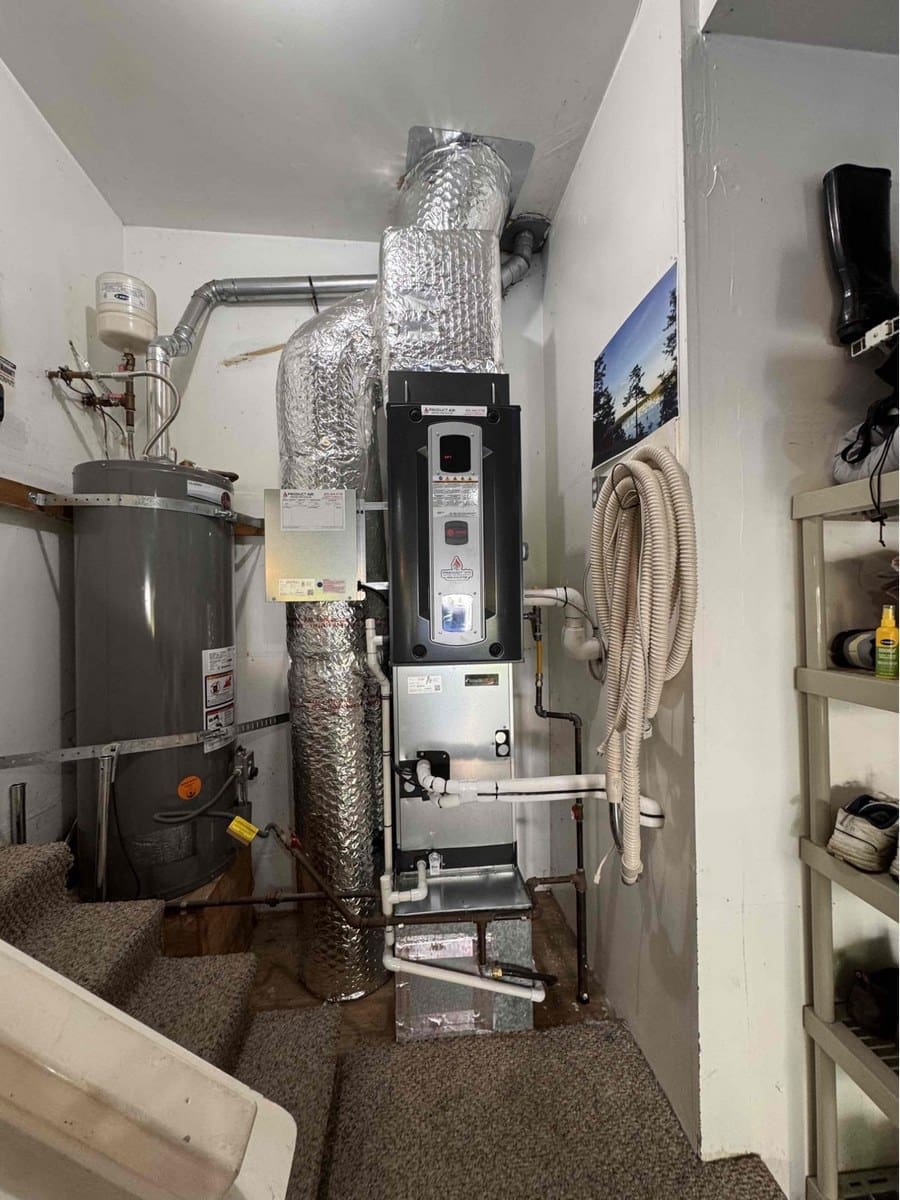
The completed installation in Connor’s utility closet: Mitsubishi intelli-HEAT evaporator coil at top with new plenum and ductwork, new Trane TGF furnace below, water heater to the left. The same footprint that held the original furnace now contains a full dual-fuel climate system with 12 years of manufacturer coverage.
Installation Timeline
Product Air handles all permitting on projects of this type. In the greater Seattle area, permits for a heat pump installation of this scope run between $149 and $500 depending on project value and permit type, and are typically pulled within 4 to 24 hours.
February 27 — Installation Day
The HVAC crew and the electrician arrived together in the morning. The original Coleman furnace came out first: disconnected from the gas line, pulled from the utility closet, removed for disposal. The new Coleman TGF went in in the same position. The Mitsubishi intelli-HEAT evaporator coil was installed above the new furnace in the same utility closet, and the new plenum fitted and sealed above it. Outside, the Mitsubishi PUZAK42NLHZ outdoor unit was positioned on the concrete pad, refrigerant lines run through the wall and up to the connection point, and the electrical disconnect and conduit installed cleanly against the siding.
The electrician worked in parallel on the dedicated circuit for the outdoor unit and the line voltage connections for the dual-fuel system controller. The system was charged, commissioned, and tested the same afternoon.
February 28 — Inspection
Permits were signed off the following day. No corrections required.
The full project, from the initial call to signed permits, ran nineteen days. The installation itself took two.
Price, Rebates, and What Connor Actually Paid
Base price for the complete hybrid dual-fuel system, all equipment, installation, removal of the old furnace, refrigerant, electrical work, permits, and commissioning: $21,412.34
| Rebate Program | Amount |
| PSE Hybrid Heat Pump Rebate | $1,500 |
| PSE Mitsubishi Rebate — HSPF2 Above 9.5 | $600 |
| Energy Smart Eastside | $100 |
| Total Rebates Applied | $2,200 |
Final cost to Connor after rebates: $18,312.34
Connor paid by check. No financing.
On the federal side: the Mitsubishi Hyper Heat system qualifies for the Section 25C federal tax credit of 30% of qualifying costs, up to $2,000, which Connor files on his federal return for the installation year. That credit does not flow through us or the rebate programs; it is claimed directly and is separate from the rebates above. Depending on his tax situation, the effective total incentive across all programs can bring the out-of-pocket cost meaningfully below the post-rebate figure.
The PSE and Energy Smart Eastside rebates were handled entirely by Product Air. Connor did not fill out a form.
The Long-Term Picture
A properly installed Mitsubishi Hyper Heat hybrid system in a home the size of Connor’s, in the climate Mercer Island actually experiences, carries a realistic service life of 15 to 20 years. The Coleman furnace component (new, on a clean installation, properly matched to the coil and the ductwork) runs the same projected lifespan. What Connor is not doing, at any point in that window, is patching a 12-year-old furnace and hoping it holds through another winter with a newborn in the house.
The efficiency picture across the year is concrete. In the shoulder seasons that define Western Washington’s climate (October through November, March through May), the Mitsubishi PUZAK42NLHZ at the temperatures Mercer Island typically sees operates at a coefficient of performance between 2.5 and 4. That means for every dollar spent on electricity during those months, the home receives the equivalent of $2.50 to $4.00 in heat. The original Coleman gas furnace, regardless of its high-efficiency rating, operated at less than 1-to-1 by definition: combustion cannot exceed the energy in the fuel. The efficiency gap at moderate outdoor temperatures is structural, and Mercer Island spends the majority of its heating season in exactly that moderate range.
Summer is the simpler story. The house has never had air conditioning. It does now: a 3.5-ton variable-speed unit sized for the full square footage, calibrated to modulate rather than blast, quieter and more consistent than conventional cycling equipment, and gentler on the electrical draw.
The 12-year manufacturer warranty on all Mitsubishi components and the 5-year Product Air labor warranty cover Connor for the period when a well-installed system is most likely to surface any issue at all. Most problems on a properly commissioned system appear in the first year or two. The warranty structure means that window is completely covered, on the equipment and on the labor.
When the work was done, Connor’s reaction was straightforward: he was glad it was done right, and he was glad Product Air handled the rebate paperwork. A household with a baby arriving in a matter of weeks does not have bandwidth for utility forms.
Key Takeaways
- A hybrid dual-fuel heat pump system pairs an electric heat pump with a gas furnace on the same air distribution system, in Connor’s case, it gave a 3,260-square-foot Mercer Island home its first-ever air conditioning alongside meaningfully more efficient heating.
- Homes in the 98040 ZIP code qualify for PSE’s hybrid heat pump rebate ($1,500), PSE’s Mitsubishi-specific high-efficiency tier bonus ($600 when the system’s HSPF2 rating exceeds 9.5), and Energy Smart Eastside ($100), a combined $2,200 that Product Air manages directly, with no forms for the customer to file.
- A 12-year-old 2-stage gas furnace that is still running is not automatically worth keeping: when the alternative is a complete dual-fuel hybrid with 12-year manufacturer coverage, immediate cooling capability, and a rebate stack that offsets a significant portion of the cost, the math of “it could last five more years” looks very different.
- The Mitsubishi PUZAK42NLHZ Hyper Heat maintains full heating capacity at outdoor temperatures down to 5°F, which means the gas furnace only runs when temperatures drop below the range where the heat pump’s efficiency advantage becomes marginal: a range that covers a handful of nights per year in Western Washington, not a season.
- Three bids is a reasonable and responsible approach to a $20,000+ home system decision; Connor compared Belred, Gene Johnson, and Product Air, went through each proposal seriously, and made the choice that fit what he was actually looking for.
- Product Air handles all permitting on projects of this type, including Mercer Island filings, and coordinates PSE and Energy Smart Eastside rebate applications so the customer receives the incentives without managing the process themselves.
The Standard We Hold Ourselves To
Connor found us the way we’d prefer most of our work to find us: not through a sponsored listing, not through a review that said we were “amazing,” but by watching our crew work at his father’s house on W Mercer Way and deciding the conversation was worth having. He then did the right thing and compared three companies before making his decision, which is exactly what someone should do when the stakes are real and a child is on the way.
We like that he compared. We like even more that the comparison held up.
The system on W Mercer Way will run through summers Connor’s family hasn’t had yet, through winters that have been growing less predictable, and through the early years of a child growing up in a house that now has both heat and air conditioning worth relying on. The 12-year warranty covers the entire period when any question about the installation would likely surface. After that, the system should simply continue to do its job quietly, automatically, without a thought from Connor.
That is what a well-done installation looks like from the outside. Not something memorable. Something that just works, for a long time, in the background of a life that has other things to think about.
— Serge Nikolin, Co-Founder, Product Air Heating, Cooling and Electric
Marysville · Issaquah · Seattle · Western Washington
PLAN YOUR NEXT STEP
Need help with your home comfort?
Explore Product Air’s heat pumps services or contact the team.
Share this guide