


Location: NE 120th Street, Lake City, Seattle, WA 98125
Call Date: January 3, 2026
First Visit: January 5, 2026
Work Completed: January 7–9, 2026
Lead Technician: Robert, licensed HVAC technician, 7 years of experience
System Before: Payne gas furnace 20+ years old, original 100-amp panel from 1958, no AC, no exhaust fans, undersized electrical service
System After: Mitsubishi Smart Multi Hyper-Heat 36K BTU outdoor unit + Trane S8V2B080 furnace + Eaton 200-amp panel with surge protection + EV charger + lighting upgrades + bathroom exhaust fans
Base Estimate: $41,020.67
Final Cost After Rebates: $37,173.24
The House Was Theirs, But It Wasn’t Ready Yet
Erik bought the house on NE 120th Street in early January. Three bedrooms, two stories, 2,810 square feet, built in 1958. A solid Lake City home, the kind that stays in a neighborhood for generations. The closing had gone through, but the family wasn’t moving in for another month. That window, the time between owning it and living in it, was exactly what he needed.
He called Product Air on January 3. The request was specific. He needed the electrical panel upgraded from 100 amps to 200 amps to support an EV charger. That was the stated reason for the call. It was also only the beginning of the conversation.
“Looking to make the house move-in ready and support my electric car,” he said when Robert arrived on January 5.
He Had Already Called Three Other Shops
Erik hadn’t come to Product Air first. Before calling, he had reached out to three other electrical contractors: As You Wish Electric, Greenwood, and Seatown. He collected their estimates. He did what a careful buyer does when they’re about to spend real money on a house they just purchased.
He found Product Air on Angi and added a fourth opinion to the stack.
Robert showed up on January 5 and did something that tends to separate Product Air visits from other contractor visits: before he looked at a single panel or furnace, he asked Erik to walk him through the house and tell him what he was thinking about.
Not just the panel. Everything.
Room by Room, the Real List Emerged
As they moved through the 1958 home, Erik kept talking. The panel, yes, 100-amp service, original to the house, worn out and undersized for anything modern. But also, he had an electric car and needed a Level 2 charger.
The bathrooms had no exhaust fans, which struck him as something that should have been there all along. Several rooms were darker than they should be. The switches and outlets throughout the house were the originals. And somewhere in the basement, a Payne gas furnace that was over 20 years old and, in Robert’s words, not far from breaking down.
There was no air conditioning anywhere in the 2,810-square-foot home.
Robert took notes and didn’t rush the walkthrough. What he was building, mentally, was not a scope of work. It was a picture of what this family’s life in this house would look like and what they’d be dealing with six months from now if he only fixed the panel.
What the Diagnostic Confirmed
The electrical panel was original to the house: 1958 vintage, 100-amp service, the kind of setup that made sense when the home was built and had been accumulating limitations ever since. A 100-amp panel in a 2,810-square-foot home with a gas furnace, no AC, and no EV charger is already at capacity. Adding a Level 2 EV charger to it without upgrading the service isn’t a conversation worth having. It can’t be done responsibly.
The wiring throughout had the profile of a house that hadn’t been touched since original construction in the areas Robert inspected. No AFCI protection where modern code requires it. Bathrooms without exhaust fans are a moisture problem accumulating slowly over decades: by the time you notice it, you’re dealing with mold remediation, not ventilation.
The Payne furnace was the other concern. Over 20 years old, single-stage, no AC, running on borrowed time in a house where a family was about to move in. Robert noted the age and condition and flagged it as a system that could fail in the next season or two. The heat exchanger on a gas furnace this age warrants close inspection. A cracked heat exchanger means carbon monoxide risk, not just a comfort problem.
What the house needed, taken honestly: a full electrical service upgrade, modern panel, EV charging capability, updated lighting in the dark rooms, exhaust ventilation in the bathrooms, and a decision about the furnace before winter had the chance to make that decision for them.
Four Options, One Honest Pitch
Robert went back to the truck and built the quotes. He came back with four of them.
Silver. Panel and Service Upgrade Only: New Eaton 200-amp panel with surge protection, electrical service upgrade to 200 amps. The minimum to support the EV charger Erik came in asking about. $15,811.33.
Gold. Panel, Service, EV Charger, Lighting, Exhaust Fans, and Furnace: Everything in the Silver option, plus EV charger installation, lighting upgrades in the dark rooms, exhaust fans in the bathrooms, and replacement of the aging Payne furnace with a high-efficiency unit. $25,008.13.
Basement Exhaust Fan Add-On: A standalone option for basement ventilation, available as a separate scope if needed. $3,949.43.
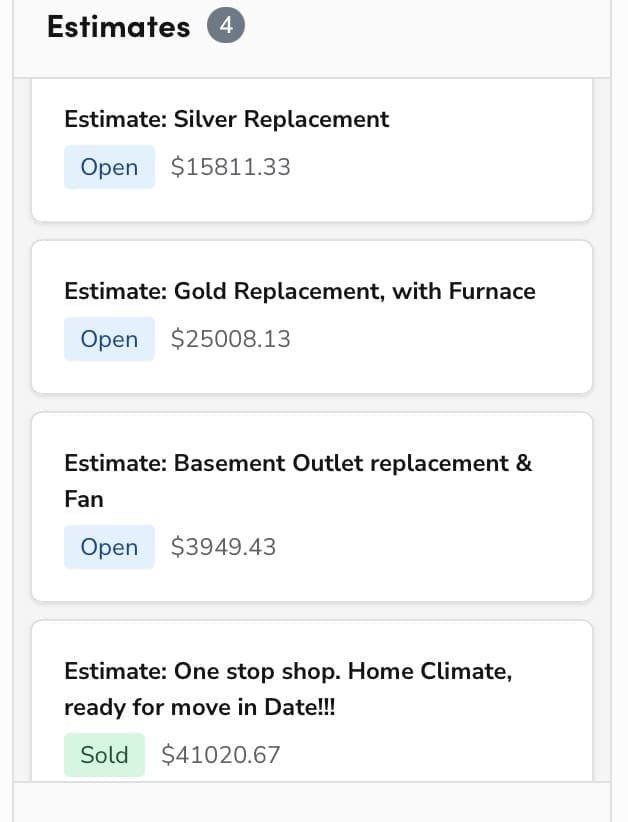
One Stop Shop. Ready for Move-In Date: Everything. Panel, service, EV charger, updated lighting, exhaust fans, new switches and outlets throughout, high-efficiency Trane furnace, and a Mitsubishi Hyper-Heat pump added to the system. The house, finished. $41,020.67.
Then Robert said, “Wouldn’t it be nice to just take care of all of your needs now? That way, when you move in, you’re not dealing with contractors again in six months to finish the same list.”
Erik looked at the four options and chose the top one because he had spent the last hour walking through his own house naming exactly what was in that fourth estimate. The list was his. Robert had just put prices on it.
What We Installed
The project covered three distinct scopes (electrical, HVAC mechanical, and the heat pump addition), requiring two separate crews working across three days.
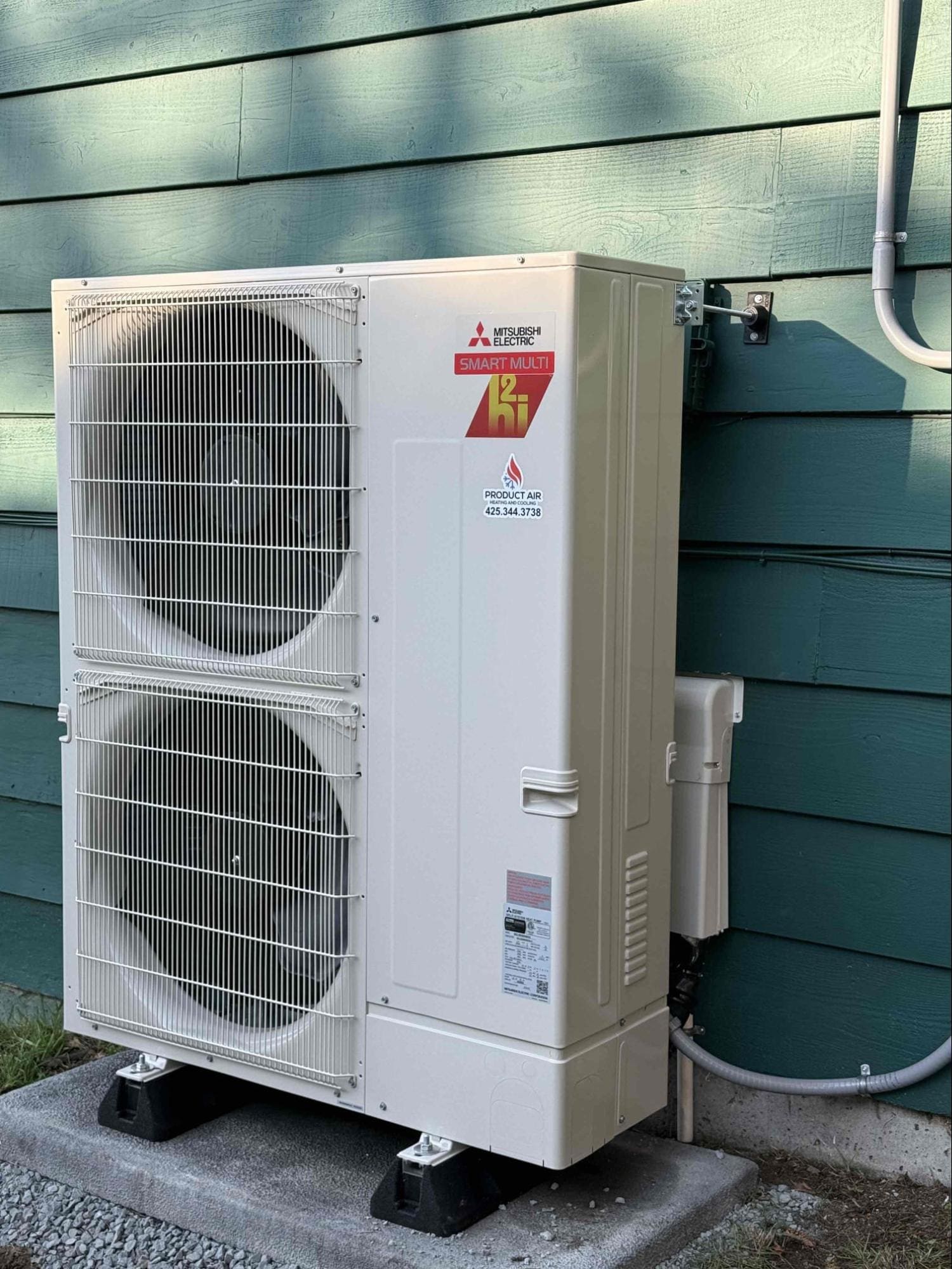
HVAC: Mitsubishi Smart Multi Hyper-Heat 36,000 BTU outdoor unit, model MXZSM36NLHZ, paired with a Trane S8V2B080 gas furnace, 80,000 BTU, 80% AFUE, 4-ton, variable speed.
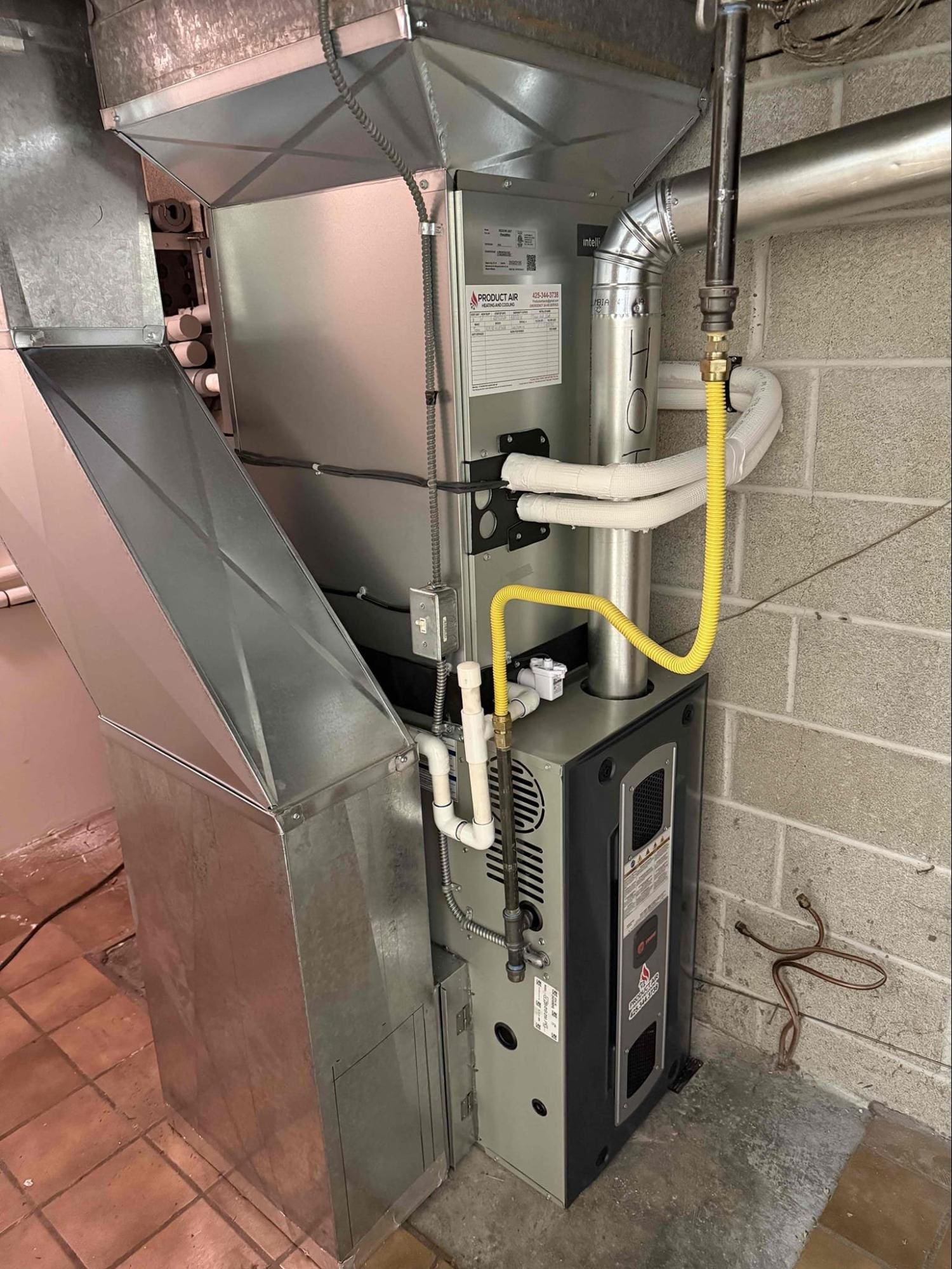
The Mitsubishi Hyper-Heat is a cold-climate system rated to operate down to -13°F, relevant to anyone who’s been through a Seattle cold snap and knows what a heat pump that can’t keep up feels like. The hybrid configuration means the heat pump handles the bulk of the heating and all of the cooling, with the Trane furnace as backup gas heat for the coldest periods and for the supply air warmth that some homeowners prefer.
Electrical: Eaton 200-amp panel with whole-home surge protection. New Level 2 EV charger. Lighting was upgraded throughout the dark rooms. Bathroom exhaust fans installed where there had been none. Switches and outlets were replaced throughout.
| Component | Detail |
| Heat Pump ODU | Mitsubishi Smart Multi Hyper-Heat 36K BTU |
| HP Model | MXZSM36NLHZ |
| Furnace | Trane S8V2B080, 80,000 BTU, 80% AFUE, variable speed |
| Electrical Panel | Eaton 200-amp with whole-home surge protection |
| EV Charging | Level 2 charger installed |
| Additional Electrical | Lighting upgrades, bathroom exhaust fans, switches and outlets |
| Heat Pump Warranty | 10 years manufacturer |
| Furnace Warranty | 10 years manufacturer |
| Product Air Labor Warranty | 5 years |
Why Doing Everything at Once Is Almost Always Cheaper Than Doing It Twice
This case makes a point that comes up on every new homeowner project we work on, and it’s worth stating plainly.
When Erik called for a panel upgrade, he was asking for the minimum. He would have gotten his EV charger, moved in, and discovered sometime in the next winter that his 20-year-old Payne furnace had failed. That would have been another visit, another crew, another permitting cycle, another stretch of days without a working system in a house where his family was already living. The exhaust fans would have been year three’s project. The lighting, whenever someone finally got around to it.
Each of those visits costs more than it would have cost as part of a combined project. Not because anyone is charging extra, but because of how contracting work is priced: truck roll, setup, permitting, coordination with inspectors, scheduling with the utility. Every separate project pays those costs independently. One combined project pays them once.
Robert’s “One Stop Shop” estimate wasn’t a sales play. It was arithmetic. Everything on Erik’s list, done as a single project in January, cost $41,020.67. If he’d done them separately (the panel now, the furnace next winter, the lighting the year after), he would have paid significantly more in aggregate, plus the overhead of scheduling and living through each disruption separately. And with a family moving in in a month, there was exactly one window to do all of it with nobody home.
That window was January 7 through 9.
Three Days. Two Crews. One House Ready to Move Into.
January 7. HVAC crew. The Payne furnace was removed and taken out. The Trane S8V2B080 was installed in the basement. The Mitsubishi Hyper-Heat outdoor unit was set on a new pad outside the house. Refrigerant lines were run, the system was commissioned, and the hybrid configuration (heat pump primary, gas furnace backup) was tested and calibrated.
January 7–8. Electrical crew. The 100-amp service was replaced with 200-amp service. The Eaton panel was installed with surge protection. EV charger wired and mounted. Lighting installed in the rooms that needed it. Exhaust fans cut in and wired in the bathrooms. Switches and outlets were replaced throughout the house.
January 9. Inspectors. Permits were pulled by Product Air ahead of the project start. For a job this scope in Seattle (mechanical, refrigeration, and electrical permits), the cost runs $149 to $500 per permit type. Product Air coordinated the permitting directly with SDCI and scheduled inspectors for January 9. Everything was signed off on the final day.
The family had not yet moved in. There was no disruption to daily life. No nights without heat, no weekends without power. They walked into a finished house.
Rebates Applied
Three separate incentive programs applied to this project and were reflected in the final invoice.
| Program | Amount |
| Seattle City Light Heat Pump Rebate | $600 |
| Mitsubishi Manufacturer Rebate | $1,350 |
| Seattle City Light EV Charger Rebate | $400 |
| Total Rebates | $2,350 |
Base project cost: $39,523.24
Final cost to Erik after all rebates: $37,173.24
Product Air identified and applied all three programs. Erik didn’t file paperwork or chase down any rebate forms. The deductions were reflected in what he paid. He wrote one check, for
$37,173.24, and the house was done.
What This Looks Like Over the Next 20 Years
The Mitsubishi Hyper-Heat handles the vast majority of the home’s heating and all of its cooling. It does both at a fraction of the operating cost of the gas furnace it supplements. Heat pumps deliver 3 to 4 units of heat for every unit of electricity consumed. For a 2,810-square-foot house that previously had no cooling at all, the heat pump also solves a problem that would have needed solving eventually regardless.
The Trane furnace provides what hybrid systems are specifically built to provide: a reliable gas backup for the sub-freezing days when a heat pump alone would have to work harder, and the full-force heat output from vents that some homeowners prefer on the coldest mornings. The two systems coordinate. The thermostat decides which one the house needs at any given moment.
The 200-amp Eaton panel, the Level 2 EV charger, the exhaust ventilation, the updated wiring. All of it is infrastructure that the family will live with for decades without thinking about it. That’s what infrastructure is supposed to do.
Erik paid cash. He was moved in by February. The house was ready before he arrived.
“He was amazed at what we accomplished,” Robert said afterward. “All of it was completed before he moved in.”
Key Takeaways for New Homeowners in Seattle Buying a Pre-1970s House
- A 100-amp panel in a home where you plan to run an EV charger, heat pump, and modern appliances is undersized before you plug anything in. Upgrading to 200-amp service is the foundation everything else requires.
- A gas furnace over 20 years old in a house you just purchased should be evaluated on its heat exchanger condition, not just whether it’s running. A cracked heat exchanger leaks carbon monoxide. The furnace running doesn’t mean it’s safe.
- The “one thing at a time” approach to home upgrades almost always costs more than doing it as a single project. Permitting, truck rolls, crew scheduling, and utility coordination each have a fixed overhead that compounds with every separate visit.
- The window between closing and moving in is the best window you will ever have to do comprehensive work on a house. Nobody is inconvenienced. No disruptions to daily life. The house is empty and accessible.
- Three separate rebate programs applied to this project: $600 from Seattle City Light for the heat pump, $1,350 from Mitsubishi, and $400 from Seattle City Light for the EV charger. Product Air applied all three. The homeowner filed no paperwork.
- A hybrid heating system (heat pump primary, gas furnace backup) gives you the efficiency of an electric heat pump for 90% of your heating hours and the reliability of a gas furnace for the coldest days. For a Seattle home without AC, it also solves the cooling question in the same installation.
Product Air Heating, Cooling and Electric. HVAC and electrical service in Seattle, Marysville, Issaquah, Mercer Island, and across Western Washington. Licensed HVAC and electrical contractors. When we walk into a home, we look at the full picture, not the single item that prompted the call. If there’s a smarter way to solve multiple problems at once, we put it on the table. The choice is always yours.
— Serge Nikolin, Co-Founder, Product Air Heating, Cooling and Electric
Marysville · Issaquah · Seattle · Western Washington
PLAN YOUR NEXT STEP
Need help with your home comfort?
Explore Product Air’s electrical services or contact the team.
Share this guide