


Location: 8th Ave NE corridor, Seattle, WA 98115
Call Date: June 26, 2026
First Visit: June 26, 2026
Project Completion: June 26, 2026
Lead Technician: Brandon J., 10 years of experience in troubleshooting, certified 02 electrician, specializing in rewires and adding circuits in finished homes
System Before: Aged, failing kitchen GFCI outlets in a 1948 Seattle home, one failed device cutting power to multiple downstream outlets, including the refrigerator
System After: Two new Leviton GFCI outlets installed, full kitchen circuit restored
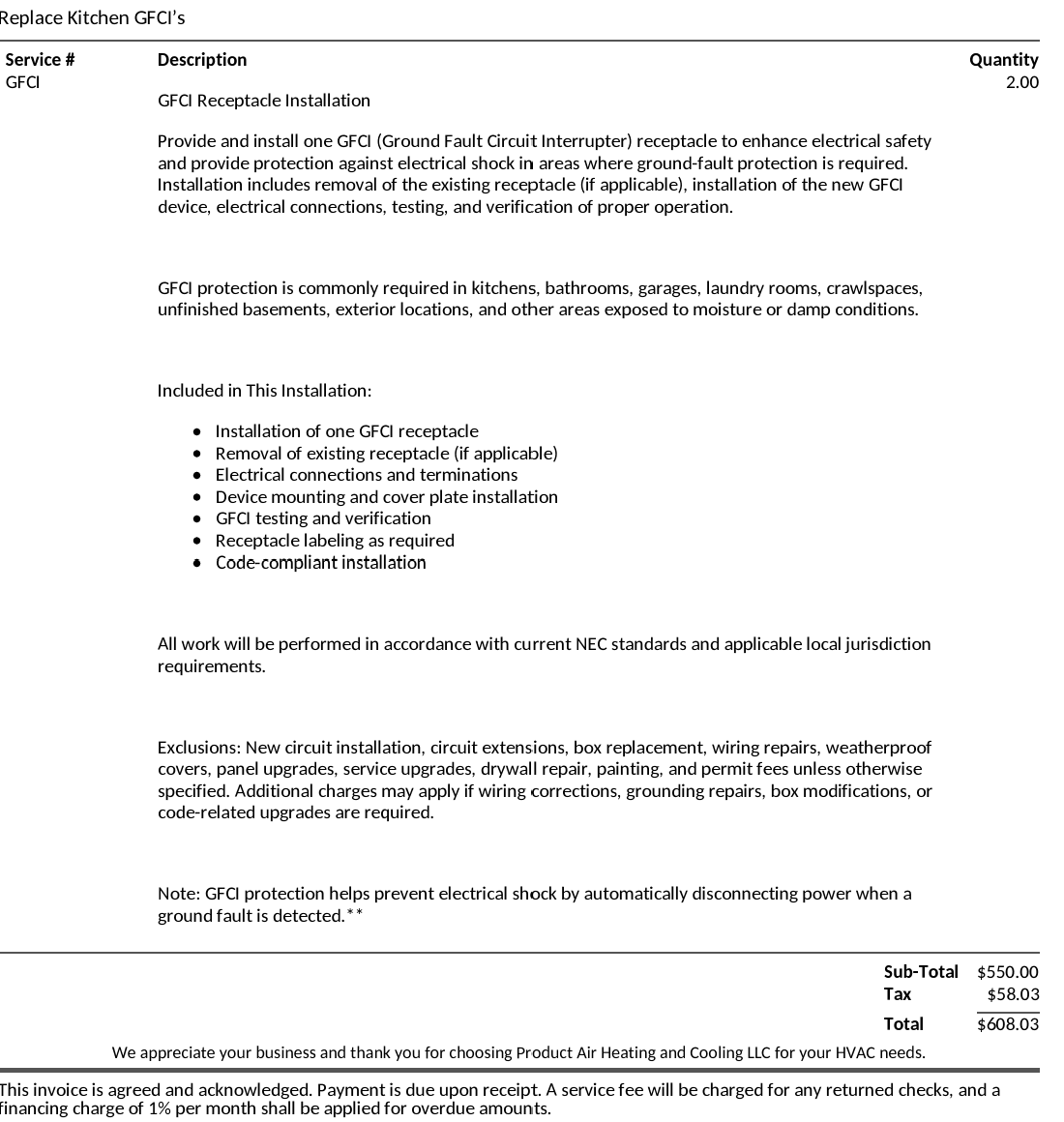
Final Project Cost: $608.03 ($550.00 before tax)
Theresa made toast on a Friday afternoon in June, and somewhere between the toaster popping down and the bread browning, her refrigerator went dark. Not the toaster’s outlet, the fridge, on the other side of the kitchen, plugged into what looked like a completely unrelated circuit. Half her kitchen had lost power over an appliance that had nothing visibly to do with it, and the outlet holding her groceries cold was one of the casualties. She called Product Air the same day.
Why Theresa Called an Electrical Diagnostic Service in Seattle, WA
Theresa found Product Air through the company’s Seattle Google Business Profile, and this was her first call: no previous contractor, just a kitchen that had partially gone dead in the middle of an ordinary afternoon. There wasn’t a bigger story behind the timing. No remodel in progress, no family circumstance driving urgency beyond the obvious one: a working refrigerator matters, and a house built in 1948 doesn’t always give much warning before something like this happens.
GFCI Outlets Sharing One Circuit, Explained: Why One Failed Device Killed Power to the Fridge
Brandon J. arrived that same Friday. Ten years of troubleshooting experience, a certified 02 electrician, with a specialty in rewiring and adding circuits inside finished homes, exactly the kind of background suited to tracing a fault that doesn’t announce itself with an obvious cause. He confirmed what Theresa had described: the toaster had been running, and shortly after, a separate outlet across the kitchen, the one serving the refrigerator, had lost power entirely.
This is one of the most common sources of confusion in kitchen electrical work, and it comes down to how GFCI protection is typically wired. A single GFCI receptacle doesn’t just protect itself. In many kitchens, one GFCI outlet is installed as the first device on a circuit, and it “feed-through protects” every standard outlet wired after it on that same circuit, meaning those downstream outlets have no test or reset buttons of their own, but they’re still entirely dependent on that one GFCI functioning correctly. When that GFCI fails or trips, every outlet wired behind it loses power at the same time, even outlets on the opposite side of the room that look completely unrelated. That’s exactly what had happened at Theresa’s house. The toaster’s load was enough to trip the protection, and because the fridge outlet was wired downstream of the same failing GFCI, it went dark right along with it.
Signs of an Aged, Failing GFCI Outlet in a 1948 Seattle Home
Theresa’s house was built in 1948, a single-story, 3,080-square-foot home with three bedrooms and three bathrooms, but the age of the house and the age of the failure aren’t quite the same story. GFCI receptacles weren’t standard code requirements when the home was originally built; they’re a later addition, retrofitted into older kitchens as electrical codes evolved to require shock protection in areas exposed to water. What Brandon found wasn’t 1948-era wiring failing. It was the GFCI devices themselves, worn out from age and years of use.
GFCI outlets have moving internal components (the mechanical test and reset buttons, the sensing circuitry that monitors for ground faults) and those components degrade over time in a way that standard wiring generally doesn’t. A GFCI outlet doesn’t run indefinitely just because the wiring behind it is sound. Eventually, the internal mechanism itself wears out, and when it does, the outlet can fail to reset, trip unpredictably, or in Theresa’s case, lose the ability to reliably pass power through to the outlets depending on it. That’s an age-related device failure, not a wiring problem, a distinction that matters because it changes the fix from something invasive to something straightforward.
The Fix Brandon Offered: Two New Leviton GFCIs
Brandon didn’t need to propose multiple tiers of pricing or walk Theresa through a menu of options. The kitchen GFCIs needed to be replaced, and he told her plainly what that meant. “I understand the importance of your kitchen usage, and we’d love to help you out,” he told her. “Good news, we have the parts on our van. Bad news, it’s going to cost some money. Would you like us to take care of the issue?”
The estimate covered installing two new GFCI receptacles, removing the existing failed devices, making the electrical connections and terminations, mounting the new devices with cover plates, testing and verifying proper operation, and labeling the receptacles as required, all performed to current NEC standards and Seattle’s local code requirements. Theresa didn’t hesitate. “Thank you, and yes, please get them installed,” she told him.
What a Kitchen Outlet Repair in Seattle, WA Actually Involves
Brandon installed two Leviton GFCI receptacles in place of the failed originals, restoring feed-through protection to the downstream outlets that had gone dark alongside the fridge. Once the new devices were wired in, he tested each one to confirm it tripped correctly under a simulated fault and reset cleanly afterward the verification step that actually confirms the safety function is working, not just that the outlet has power.
Two Hours, No Permit: How the Repair Came Together
The entire visit (diagnosis, explanation, and outlet repair) took about two hours, start to finish, all on the same Friday Theresa called. Replacing two existing outlets like this doesn’t require a permit in Seattle, since the work involves swapping devices on an existing circuit rather than adding new wiring, extending a circuit, or modifying the panel. That’s a meaningfully different scope than a rewire or a new circuit installation, and it’s part of why a repair like this can move from phone call to finished job in a single afternoon.
The Real Number: $550 for a Problem That Felt Much Bigger
| Item | Amount |
| GFCI Receptacle Installation (2 units) | $550.00 |
| Tax | $58.03 |
| Total | $608.03 |
Theresa paid by Visa, with no financing needed and no rebate programs applicable. GFCI outlet replacement is a safety repair, not an efficiency upgrade, and doesn’t qualify for the kind of utility incentives available on equipment installations.
Why Theresa Was Relieved, Not Just About the Outlets
A non-functioning GFCI isn’t simply an inconvenience. Its entire job is to detect a ground fault and cut power fast enough to prevent a serious electrical shock, and when it fails, that protection disappears silently, nothing about a dead GFCI announces that the safety function behind it is gone too. Getting Theresa’s kitchen back to two working, verified GFCI receptacles meant restoring that protection, not just restoring convenience.
But what Theresa said after the work was finished wasn’t really about electrical safety in the abstract. “Thank you so much,” she told Brandon. “I was worried we would have to go out for dinner. Thanks for taking care of this.” That’s the real, human stakes behind a case like this one, not a technical concern about ground-fault protection, but a refrigerator full of food and an evening that didn’t need to be interrupted by it.
Frequently Asked Questions: GFCI Outlet Repair in Seattle, WA
Why did my fridge lose power when I used the toaster?
This usually happens because multiple kitchen outlets are wired on the same circuit, protected by a single GFCI receptacle positioned first in the chain. That one GFCI provides feed-through protection to every standard outlet wired after it, so when it fails or trips, all of those downstream outlets lose power together, even ones that look unrelated. In a Seattle case, a homeowner’s toaster tripped an aging kitchen GFCI, which cut power not just to the outlet in use but to the refrigerator outlet wired downstream on the same protected circuit.
Is a non-working GFCI outlet dangerous?
Yes. A GFCI outlet’s entire purpose is to detect a ground fault and cut power fast enough to prevent a serious electrical shock, and when the device fails, that protection disappears without any obvious warning sign beyond a loss of power. It’s a life-safety device, not just a convenience feature, which is why a failed GFCI should be treated as something to fix promptly rather than something to work around. In a Seattle case, an electrician flagged the non-functioning kitchen GFCIs as a genuine safety concern, not simply an inconvenience tied to a dead outlet.
How do I know if my GFCI outlet needs replacing instead of just resetting?
If pressing the reset button doesn’t restore power, or if the outlet trips repeatedly without an obvious cause like a faulty appliance, the device itself has likely reached the end of its working life rather than just tripped from normal use. This is especially common in older homes where the GFCI receptacles are aging even if the home’s underlying wiring is sound. In a Seattle case, kitchen GFCI outlets in a 1948 home had failed due to age rather than a wiring problem, and needed full replacement rather than a simple reset to restore power.
Does replacing a GFCI outlet require a permit?
No, not for a straightforward device replacement. Swapping out existing GFCI receptacles for new ones on an existing circuit is considered routine repair work, distinct from adding a new circuit, extending wiring, or modifying an electrical panel, which do typically require permits. In a Seattle case, replacing two failed kitchen GFCI outlets took about two hours and didn’t require any permitting, since the scope was limited to device replacement on an existing circuit.
How much does it cost to fix a tripped GFCI outlet?
Costs depend on whether the outlet simply needs replacing or whether the underlying issue is more involved, such as a wiring problem or the need for an additional circuit. In a Seattle case, diagnosing the issue and replacing two failed kitchen GFCI receptacles with new Leviton units came to $550.00 before tax, or $608.03 total. A single outlet replacement is typically less, since pricing scales with the number of devices and the complexity of the diagnostic work involved.
How long do GFCI outlets last before failing?
GFCI receptacles contain mechanical and electronic components that wear out over time, independent of how long the underlying home wiring lasts, and many begin showing signs of failure after roughly a decade or more of regular use, sometimes sooner in high-moisture areas like kitchens. Age-related failure doesn’t necessarily mean anything is wrong with a home’s wiring itself. In a Seattle case, GFCI outlets in a home built in 1948 had failed simply due to the age of the devices, not any deeper wiring issue in the house.
What happens during an electrical diagnostic visit?
An electrical diagnostic visit typically starts with the technician confirming the customer’s reported symptoms, then tracing the circuit to identify exactly where and why power is being lost, checking devices like GFCI receptacles, breakers, and connections along the way. Once the cause is identified, the technician explains what’s actually wrong and what it would take to fix it before any repair work begins. In a Seattle case, a technician confirmed a customer’s report of lost kitchen power, traced it to failed GFCI receptacles, and completed both the diagnosis and the repair within a single two-hour visit.
Is it worth calling an electrician for one tripped outlet, or should I try a DIY reset first?
Trying the reset button is a reasonable first step, since a genuinely tripped GFCI will often restore power immediately once reset. But if the outlet won’t reset, trips again shortly after, or the failure is affecting other outlets on the same circuit, that points to a device failure or a deeper issue that a reset can’t fix. In a Seattle case, a homeowner’s kitchen GFCI issue wasn’t a simple trip that a reset could resolve: the devices themselves had failed due to age and needed full replacement by a licensed electrician.
Key Takeaways
- Multiple kitchen outlets are often wired on a single GFCI-protected circuit, so one failed or tripped GFCI can cut power to several outlets at once, including ones that look completely unrelated, like a refrigerator across the room.
- A non-functioning GFCI outlet is a genuine safety concern, not just an inconvenience, since its job is to prevent serious electrical shock.
- GFCI receptacles wear out over time independent of a home’s underlying wiring age, and a failure in an older home doesn’t automatically mean the wiring itself is at fault.
- Replacing existing GFCI outlets on a current circuit typically doesn’t require a permit, unlike adding new circuits or modifying an electrical panel.
- A two-outlet GFCI diagnostic and replacement visit in Seattle came to $550.00 before tax, completed within a two-hour visit the same day it was reported.
- If a GFCI outlet won’t reset or keeps tripping without an obvious cause, that’s usually a sign the device itself needs replacing rather than something a homeowner can resolve on their own.
Theresa called about toast and a dark refrigerator, and that’s most of what electrical work actually looks like day to day: small, specific problems that matter enormously to the person living with them, even when the fix itself takes less time than the meal she was worried about losing.
— Serge Nikolin, Co-Founder, Product Air Heating, Cooling and Electric
Marysville · Issaquah · Seattle · Western Washington