


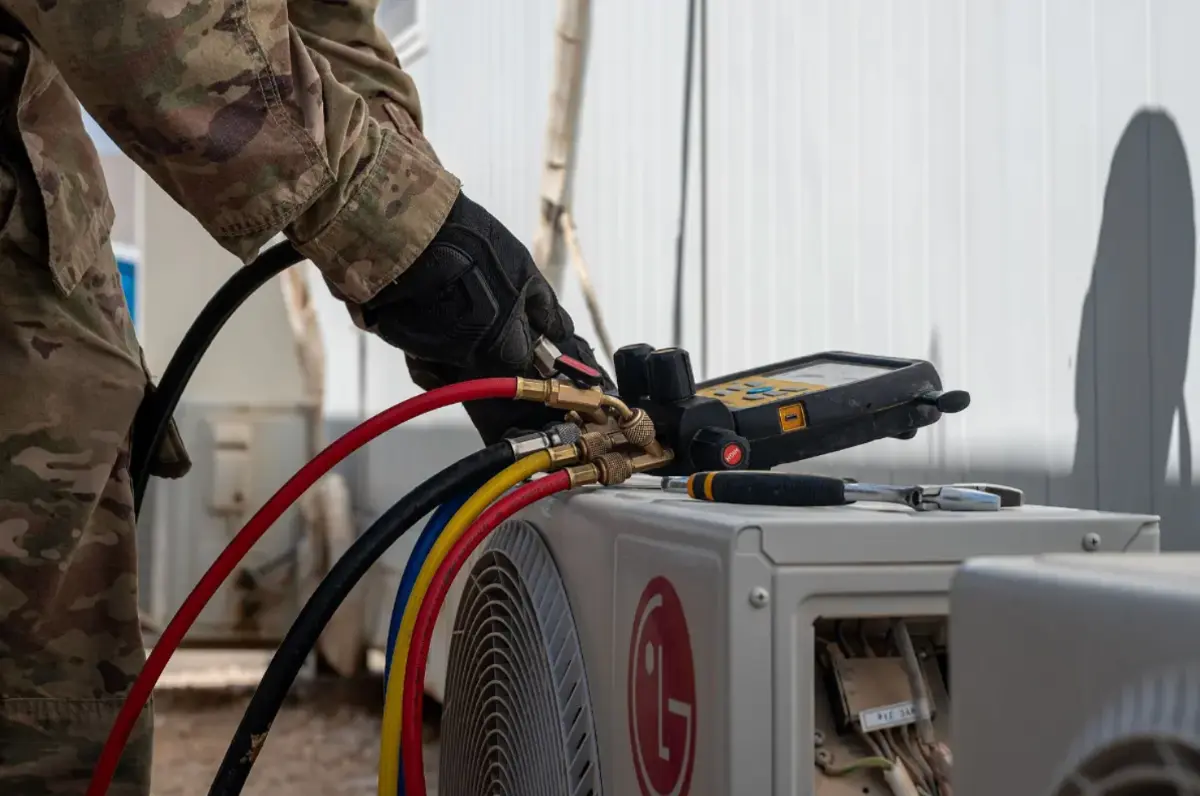
Call me and say, “Serg, I think my AC is out of refrigerant,” and my first question is going to be: where did it go? Refrigerant doesn’t normally run out. We run into this on AC calls across Seattle, Bellevue, Marysville, Everett, and the other communities we serve in King, Snohomish, Skagit, and Island counties. There are different signs that can point to a refrigerant leak. I’ll give you five that we see most often.
Quick Takeaways:
- Weak cooling, ice, persistent hissing, or oily residue can point to a refrigerant problem
- If the AC is iced over or no longer cooling properly, turn it off instead of forcing it to keep running
- Don’t touch frosted refrigerant lines or oily residue around the equipment
- Low refrigerant needs a diagnosis, not just another refrigerant charge
First, What Is Refrigerant?
Refrigerant, sometimes called AC coolant, is basically what moves heat from inside your house to the outside, and because it keeps circulating through a sealed air conditioning system, your AC shouldn’t use it up.
You may also hear people call refrigerant “Freon.” That name gets used a lot for older refrigerants such as R-22. R-22 is common in older AC equipment, but the U.S. stopped new production and import in 2020. Existing R-22 systems can still be repaired with reclaimed or previously produced refrigerant, so owning one does not automatically mean you need a new AC.
Is an AC Refrigerant Leak Dangerous?
I wouldn’t panic because you suspect a refrigerant leak, but I also wouldn’t tell you to ignore it. The main thing I don’t want you doing is touching frosted tubing or oily residue around the equipment. Escaping refrigerant can get cold enough to injure your skin. If there has been a significant leak in a small enclosed space, get out of that space instead of trying to investigate it yourself.
Newer systems add one more reason not to DIY this. Some use refrigerants such as R-454B, which are mildly flammable. A properly working AC is safe, but if you suspect a refrigerant leak, don’t open the system or try to refill it yourself.
The bigger danger is to the system, and to your wallet. A badly undercharged system can run with poor cooling and excessive compressor temperatures, and the compressor is one of the most expensive parts in the system. Keep running a badly undercharged system long enough, and a leak repair can turn into a much more expensive compressor problem. Refrigerant also does not run out on its own. If a system was properly charged and is now low, the refrigerant escaped somewhere. If it was undercharged during installation or earlier service, that is a different problem, but either way I want the cause confirmed before anybody adds more. Opening or servicing the refrigerant circuit is EPA Section 608 work. In normal-person language, this is the point where the DIY part ends and a certified tech takes over.
Sign 1: Your Air Conditioner Isn’t Blowing Cold Air
An AC that runs all day without getting the house cold can be low on refrigerant. I still wouldn’t call that the diagnosis. Airflow can cause weak cooling too, so I want to see what the rest of the system is doing before I tell you it needs refrigerant. Weak cooling tells me we need to look at the AC; it doesn’t tell me by itself what failed.
We had a good example of this with Anish in Seattle. His family had no cooling, the outdoor fan wasn’t spinning, and the breaker kept tripping. From inside the house, it just looked like the AC had died. Luis tested the system and found the compressor had shorted to ground. It was an electrical failure, not a refrigerant leak or low charge.
Sign 2: A Hissing or Bubbling Sound
A refrigerant leak can hiss, but I wouldn’t diagnose one from the sound alone. AC systems make pressure and refrigerant-flow noises during normal operation too. A persistent hiss gets more interesting when the AC is also cooling poorly, icing up, or showing oily residue around a line or fitting. A tiny crack in a coil or refrigerant line can be enough, and sometimes years of vibration are all it takes to create one.
Sign 3: Frost or Ice on the Evaporator Coil
Ice on your AC usually means something is wrong, not that it’s cooling extra well: low refrigerant, poor airflow, a dirty filter or coil, or a weak blower can all freeze the coil, so turn the AC off instead of pushing it harder.
Sign 4: Oily Residue Around a Coil or Refrigerant Line
Refrigerant evaporates quickly, but a leak may leave compressor oil around a coil, valve, fitting, or damaged section of tubing. Oily residue does not prove there is a leak by itself, but it gives me a very specific place to start looking.
Sign 5: Higher Energy Bills
A refrigerant problem can make the AC run longer, so yes, it can show up on your electric bill. One ugly electric bill isn’t enough for me to point at the AC and yell “refrigerant leak.” The bill gets more interesting when the AC also starts cooling worse or running much longer than it used to.
How Does a Technician Find a Refrigerant Leak?
A low charge is where the detective work starts. I don’t care whether the tech finds the leak with an electronic detector or bubbles on a fitting. Sometimes a pressure test makes more sense. UV dye has its place too. You don’t need to care which tool wins; you need an actual leak location before another charge of refrigerant goes into the system.
Why “Just Add More Freon” Is Not a Fix
Topping off a leaking system only buys time. The leak is still there, so the new refrigerant can escape and you’re paying for the same problem again. Federal rules also prohibit a tech from intentionally venting refrigerant during service. I want the leak found and fixed before the system gets its final charge. Somebody adding refrigerant and walking away leaves me with the same question: where did the old charge go?
What Matters Before a Tech Gets There?
You don’t need to figure out where the leak is yourself. I just want you to avoid making the problem worse before a tech gets there:
- Shut the AC off if it is iced over or no longer cooling properly. Don’t keep lowering the thermostat and hoping it pushes through.
- Don’t touch frosted refrigerant lines or oily residue around the equipment.
- Remember what you noticed. Ice, a persistent hiss, oily residue, or unusually weak cooling can all help us know where to start looking.
- If you suspect a significant leak in a small enclosed space, leave that space rather than investigating it yourself.
- Refrigerant circuit work requires an EPA Section 608-certified technician.
- A refrigerant top-off should come with an explanation of why the charge was low. Otherwise you may just be paying to refill something that is still leaking.
Marysville Refrigerant Leak: The Coil Wasn’t the Problem
We had a good example of this in Marysville with Carla. Another company had already told her the AC needed a new coil. She called us because the diagnosis and the price didn’t make sense to her.
Devon did the leak search instead of starting with the expensive part. The coil was fine. The actual refrigerant leak was in the suction line outside the air handler, and he also found a TXV sensing bulb that had been installed in the wrong position.
You can see the full diagnosis and repair in our Marysville refrigerant leak case.
That’s why I keep saying the same thing here: “low refrigerant” is not a complete diagnosis. I want to know where it went before I tell you what needs replacing.
A Tech Brother Lesson From the Field
Carla called us after another company told her the coil had to be replaced, then dropped the price without giving her a better explanation. I’d be uncomfortable with that too. Devon started the diagnosis over, found the leak in the suction line, and the perfectly good coil stayed right where it was. If someone is asking you to spend thousands on a major HVAC repair, you should understand what actually failed before you say yes.
Think Your AC May Be Losing Refrigerant?
I hope my explanation helped you understand why a refrigerant leak isn’t something to panic about, but also why it’s something you should take seriously.
Product Air provides AC repair and refrigerant leak diagnostics across King, Snohomish, Skagit, and Island counties, including Seattle, Bellevue, Marysville, Everett, Arlington, Lake Stevens, and nearby communities.
Call 425-340-3576 or schedule online. We’ll come out, take a look at the problem, explain what can be done, and give you a few options. From there, you can decide what works best for you.
FAQ
Q: Can the smell of Freon or refrigerant be harmful to your health?
A: Smell is not a reliable way to identify a refrigerant leak. Many HVAC refrigerants are colorless and may have little noticeable odor, so a sweet or chemical smell does not prove that refrigerant is escaping.
The health risk depends on the refrigerant, the amount released, ventilation, and how long someone is exposed. A significant release in an enclosed space can displace breathable air, while direct contact with liquid or rapidly escaping refrigerant can cause a cold-contact injury or frostbite. If you suspect a significant leak in a confined space, leave the area rather than trying to find it yourself. Seek medical attention if anyone develops breathing difficulty, dizziness, confusion, fainting, or other concerning symptoms.
Q: Can a homeowner repair a refrigerant leak, or should they call a professional?
A: Finding the leak is only half the job. Once the refrigerant circuit is open, we may need to recover what is left, repair the actual leak, pressure-test the system, pull a proper vacuum, and then put the correct charge back in. That is refrigerant work, not a homeowner repair.
In the United States, anyone servicing a stationary AC, heat pump, or refrigeration system in a way that could release refrigerant must hold the appropriate EPA Section 608 certification. Adding refrigerant without repairing the leak is not a proper fix, and an incorrect charge can reduce efficiency or damage the compressor.
Q: How much does it typically cost to repair a refrigerant leak?
A: There isn’t one useful flat price for a refrigerant leak because the location of the leak changes the repair completely. A leaking connection is not the same job as a damaged refrigerant line or a failed coil.
As of July 2026, Carla’s Product Air project in Marysville totaled $4,364 before tax. But that was not just “adding refrigerant.” It included the leak search, suction-line repair, refrigerant work, a new filter drier, and a separate cracked attic drain-pan replacement. I would not use that number to tell you what your repair costs before we know where your system is actually leaking.
Q: What are the common signs of a refrigerant leak in a home AC system?
A: Weak cooling gets my attention. Ice on the coil does too. A hiss or oily spot gives me another clue, especially when more than one of those things shows up together. I still wouldn’t call any one of them proof of a refrigerant leak. Bad airflow can create some of the same symptoms, and so can other AC problems. That’s why I want to test the AC unit before I tell you where the refrigerant went.
Q: Where do refrigerant leaks occur in a residential HVAC system?
A: Refrigerant can escape from a coil, valve, connection, filter drier, or a section of tubing that has been damaged or rubbed against something for years. The location changes the repair completely. Fixing one damaged section of line is not the same job as replacing an evaporator coil, which is exactly why I want somebody to show me the leak before we start talking about expensive parts.
Q: What health and environmental risks are associated with refrigerant leaks?
A: The immediate health risk depends on the refrigerant, concentration, ventilation, and exposure time. High concentrations can displace oxygen and affect the nervous and cardiovascular systems. Liquid refrigerant can freeze skin or eye tissue on contact.
Environmental impact also varies by refrigerant. R-22 damages the ozone layer and contributes to climate change. HFC refrigerants such as R-410A and R-134a do not deplete ozone, but they are potent greenhouse gases. Some newer refrigerants have a lower global warming potential but are classified as mildly flammable, so open flames and ignition sources must be avoided around a suspected leak.
Q: What causes refrigerant leaks in home AC systems?
A: Age can do it. So can corrosion, vibration, a bad connection, or a refrigerant line rubbing against another part for years. I’ve seen very small mechanical problems eventually wear a hole in the tubing that looked fine when it was installed. The important part is that the AC does not burn through refrigerant during normal operation. A system that was correctly charged and is now low lost that refrigerant somewhere.
Q: What methods do technicians use to detect a refrigerant leak?
A: Refrigerant leak detection can take a little detective work because one test doesn’t catch everything. An electronic leak detector can pick up refrigerant around a coil or fitting. Bubbles work well when we can get to the suspect spot. A stubborn leak may need a nitrogen pressure test, and UV dye can help with a slow one. I care less about which tool finds it than whether we can actually show you where the system is leaking.
Q: How can refrigerant leaks be prevented?
A: Some leaks are just age and bad luck. Installation matters, though. A refrigerant line that rubs against the cabinet for years can eventually wear through, and a bad connection can come back to haunt the system later. Airflow and equipment conditions matter too. Corrosion or an oily spot can give you an early clue that something is changing before the system loses a bigger charge. Annual maintenance gives us a chance to catch those little warning signs before they turn into a bigger leak.
Q: What should I do if I suspect a refrigerant leak?
A: An iced-over AC or one that has stopped cooling is a good reason to shut the equipment down until somebody knows what is going on. A badly undercharged system can run hot enough to hurt the compressor, so forcing it to keep going can turn one repair into a much uglier one. Keep people and pets away from the equipment, and don’t touch frosted tubing or oily residue. If you suspect a significant leak in an enclosed space, leave the area. Keep flames and other ignition sources away from a suspected refrigerant leak. Call an HVAC technician with EPA Section 608 certification. Leave the building and seek medical assistance if anyone experiences dizziness, breathing difficulty, confusion, fainting, or heart palpitations.
PLAN YOUR NEXT STEP
Need help with your home comfort?
Explore Product Air’s air conditioning services or contact the team.
Share this guide