

Location: 61st Dr NE corridor, Marysville, WA 98270
Call Date: June 24, 2026
First Visit: June 24, 2026, 4:00 PM
Project Completion: July 1, 2026, 1:00 PM
Lead Technician: Devon, 8 years of experience, trained in both electrical and HVAC, with more than 6,000 hours of electrical diagnostics
System Before: 2021 Goodman straight air conditioner, model GSX140361KG, 3-ton, R-410A refrigerant, leaking at the suction line outside the air handler, with a cracked drain pan in the attic
System After: Suction line repaired, new liquid line filter drier installed, system evacuated and recharged, drain pan replaced, original coil retained: no replacement performed
Final Project Cost: $4,774.22 ($4,364.00 before tax)
Carla had owned her Marysville rambler for exactly one week when she found out something was wrong with the air conditioning. The house sat on 61st Dr NE, built within the last five years, with a Goodman system installed new in 2021, young enough that nobody moving in should have expected to be troubleshooting a refrigerant leak before the first month was out. But that’s what she found at the air handler tucked into the attic: signs of a system leaking refrigerant, and a growing concern about whether the unit she’d inherited with the house was actually reliable or just quietly failing on a timeline she hadn’t chosen.
She did what most new homeowners would do first. She called the original service company, the one connected to the system already in the house, and asked them to take a look.
Why Carla Didn’t Trust the First Company’s Diagnosis
The visit didn’t leave her with confidence. The original contractor told her the coil needed to be replaced, that it wasn’t covered under warranty, and quoted a price Carla described as extreme. Then, without much explanation for what had changed, they cut that price down significantly. No new diagnostic information, no revised finding, just a lower number, delivered the way a negotiation gets delivered rather than the way a technical conclusion does. Combined with what she described as an experience that felt “all over the place,” Carla walked away from that visit with a specific, well-founded instinct: something about this didn’t add up.
She searched Google for a second opinion and found Product Air. When Devon arrived, her opening line wasn’t a description of a noise or a symptom. It was a direct instruction: “I need you to check out some other companies’ work. I don’t feel like they know what they’re doing, or are trying to scam me.”
That’s a serious thing for a new homeowner to say about a contractor, and it’s also a genuinely useful signal for anyone else wondering how to know if an HVAC contractor is overselling a repair. A steep, unexplained price cut with no clear diagnostic reasoning behind it is exactly the kind of pattern worth being skeptical of. A legitimate diagnosis doesn’t usually get cheaper by half without a legitimate reason attached to it.
What an AC Diagnostic Service in Marysville, WA 98270 Actually Found
Devon’s background matters here. Eight years in the field, trained across both electrical and HVAC systems, with more than 6,000 hours specifically in electrical diagnostics, the kind of technician whose default instinct is to trace a problem to its actual mechanical cause rather than jump to the most expensive fix available. He went up into the attic to look at the Goodman air handler directly, rather than taking the previous company’s conclusion as a starting point.
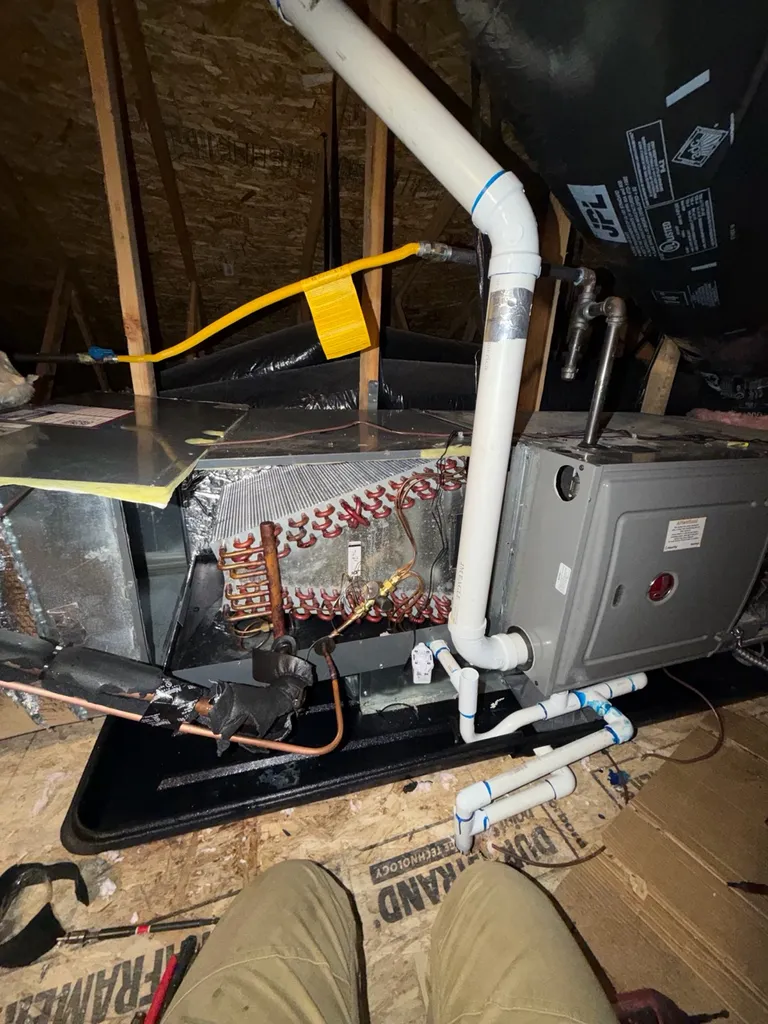
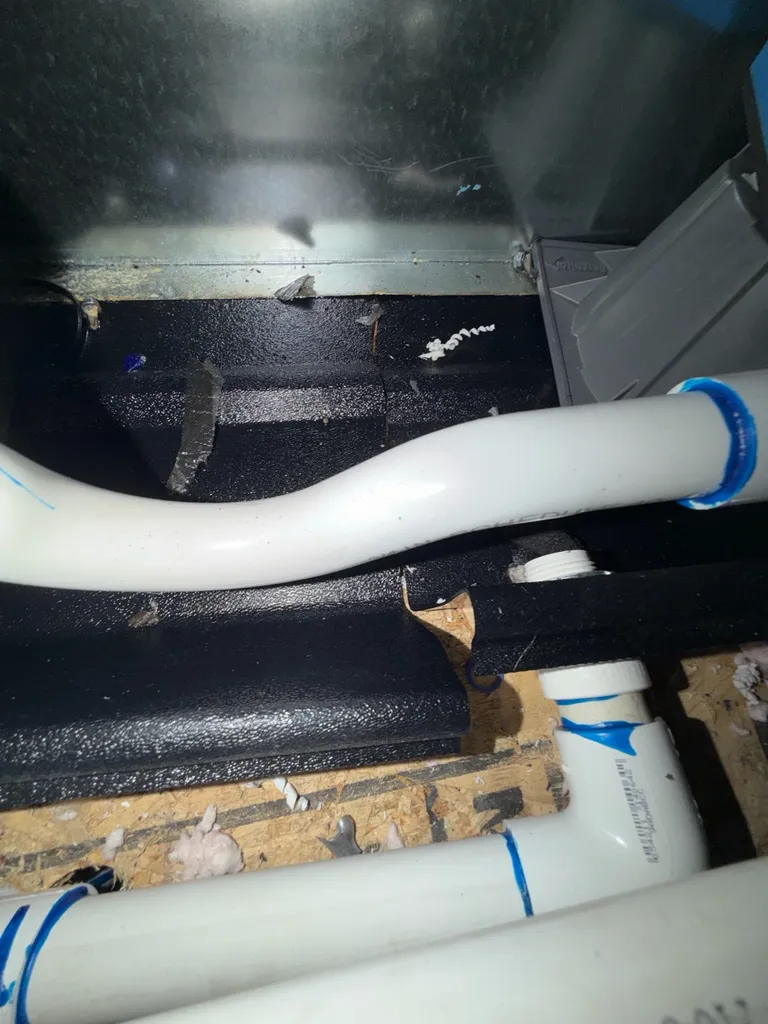
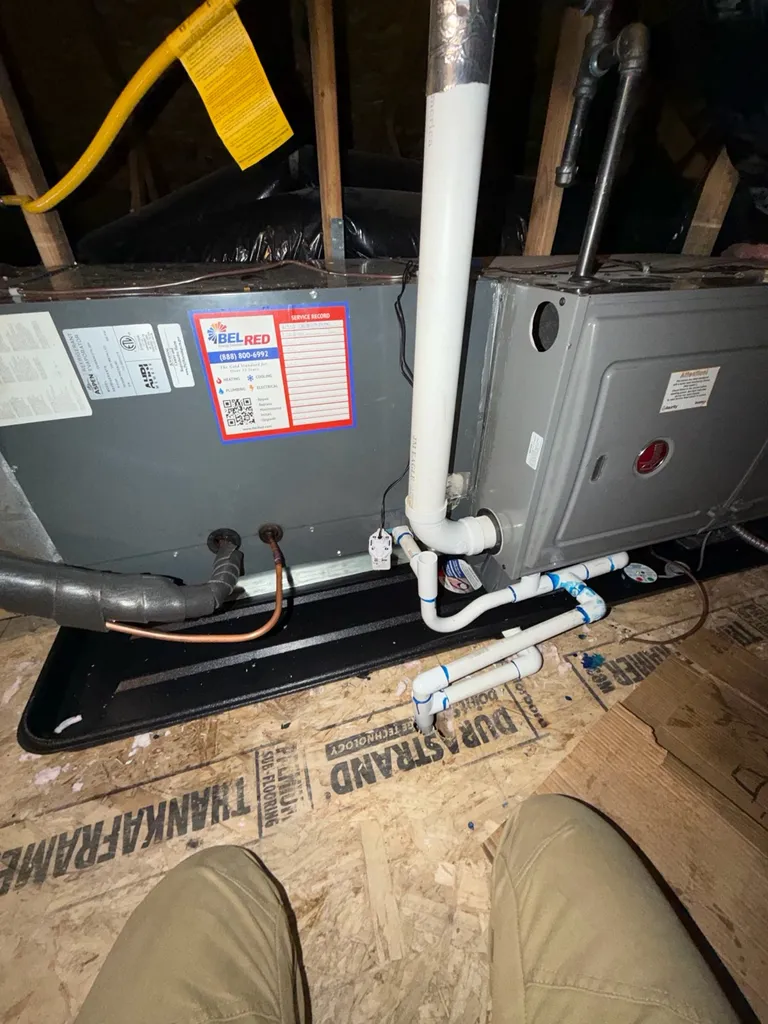
What he found had nothing to do with the coil. The actual leak was in the suction line outside the air handler, a section of lineset that had failed, not the coil itself. Alongside that, he identified a contributing factor: the TXV sensing bulb, the component responsible for reading refrigerant temperature and regulating flow into the evaporator coil, had been mounted in an incorrect position. A sensing bulb needs solid, consistent contact with the suction line at a specific point near the coil outlet to read temperature accurately; when it’s placed incorrectly, it can misread conditions and put uneven stress on the system’s refrigerant cycle over time, the kind of installation detail that quietly sets a system up for future problems even while it appears to be running fine. On top of both of those, the attic drain pan had a crack in it: a separate issue, unrelated to the refrigerant leak, but one carrying its own risk of water damage if it went unaddressed.
None of that pointed toward a failed or damaged coil. Devon’s full read on the system, once he’d gotten past the surface: everything else (compressor, coil, blower, the core components) was in good condition. The problem was two specific, repairable issues, not a system in need of major surgery.
Does a Refrigerant Leak Always Mean the AC Coil Needs to Be Replaced?
It doesn’t, and Carla’s case is a clean example of why that assumption deserves scrutiny before anyone commits to a coil replacement. A refrigerant leak can originate in several different places along the system: the coil itself, but also the suction line, the liquid line, fittings, or connections elsewhere in the lineset. Coils do fail, and when they do, replacement is often the right call. But a leak showing up somewhere else in the refrigerant circuit, at a joint or a section of line rather than inside the coil’s own tubing, is a fundamentally different repair with a fundamentally different price tag.
This is also where a second opinion on HVAC diagnostics earns its value. The original contractor’s finding (replace the coil) would have meant tearing into a five-year-old system to swap out a component that, on closer inspection, wasn’t actually the source of the failure. Getting that diagnosis wrong doesn’t just cost more money. It leaves the actual problem, the leaking suction line and the misplaced TXV bulb, completely unaddressed, which means the leak comes back regardless of how much was spent on a new coil.
The honest answer to when you actually need an AC coil replacement is: when the coil itself is confirmed as the leak source, or when its condition has degraded to the point that repair isn’t practical. Neither applied here. Confirming that took an actual leak search, not a guess.
The Repair Plan Devon Actually Proposed
After walking Carla through what he’d found, Devon offered a single, clear path forward: a proper leak search to confirm the exact failure point, repair of the damaged suction line section, and replacement of the cracked attic drain pan. No coil replacement, because the coil didn’t need one.
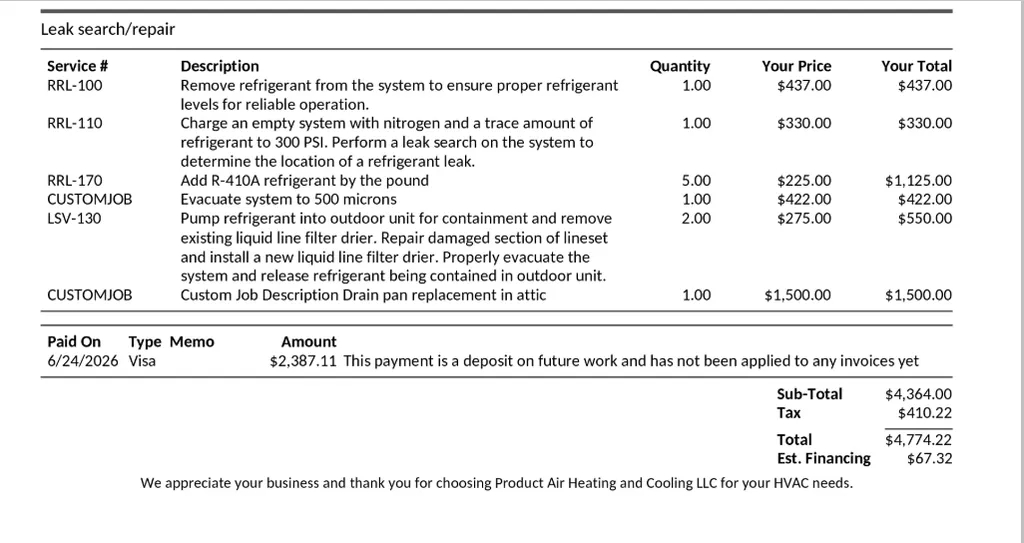
The estimate broke the work into its real components rather than bundling it into a vague flat fee: refrigerant recovery, a nitrogen and trace-refrigerant leak search to pinpoint the failure, the actual lineset repair and new liquid line filter drier, a full system evacuation, and the drain pan replacement in the attic. Carla chose to move forward with the full scope. Her reasoning wasn’t complicated. This was the first explanation of her system that actually matched what a technician had found, rather than a number that moved for reasons nobody explained.
What Product Air Actually Did to Fix the Leak
The repair started with removing the remaining refrigerant from the system, then charging the empty lines with nitrogen and a trace amount of refrigerant to 300 PSI to run a proper leak search, the diagnostic step that confirms exactly where a system is losing refrigerant rather than guessing based on symptoms alone. That search located the damaged section of the suction line outside the air handler. Devon’s team pumped the remaining refrigerant into the outdoor unit for containment, removed the damaged lineset section, repaired it, and installed a new liquid line filter drier, a component that catches moisture and debris in the refrigerant circuit and is standard practice to replace any time a system’s lines have been opened.
| Component | Detail |
| System Serviced | 2021 Goodman GSX140361KG, 3-ton straight A/C, R-410A refrigerant |
| Leak Source | Damaged section of suction line outside the air handler |
| Contributing Issue | TXV sensing bulb mounted in an incorrect position |
| Repair Performed | Damaged lineset section repaired, new liquid line filter drier installed |
| Drain Pan | Cracked attic drain pan replaced |
| System Recharge | Evacuated to 500 microns, recharged with R-410A refrigerant |
| Product Air Warranty | Lifetime craftsmanship warranty on labor performed |
Once the lineset was repaired, the system was evacuated down to 500 microns, pulling the refrigerant circuit to a deep vacuum to remove moisture and non-condensable air before recharging, and recharged with R-410A refrigerant to the manufacturer’s specification. The cracked drain pan in the attic was replaced separately, closing off the water damage risk that had nothing to do with the refrigerant issue but needed fixing regardless.
One Day, Two Technicians, Four Hours on 61st Dr NE
The repair happened in a single visit on July 1, starting at 8:00 AM and wrapping up by 1:00 PM: two technicians working the job together, roughly four hours of hands-on time to complete the leak search, the lineset repair, the drain pan replacement, and the full evacuation and recharge. Because this was a repair to an existing system rather than new equipment or a service change, it didn’t require the permitting layer that an installation or panel upgrade would call for.
The Real Numbers: $4,364 for a Repair That Wasn’t a Coil Replacement
| Line Item | Amount |
| Remove refrigerant from system | $437.00 |
| Charge system with nitrogen + trace refrigerant, leak search | $330.00 |
| R-410A refrigerant, 5 lbs | $1,125.00 |
| Evacuate system to 500 microns | $422.00 |
| Lineset repair, new filter drier, evacuate and release | $550.00 |
| Drain pan replacement (attic) | $1,500.00 |
| Sub-Total | $4,364.00 |
| Tax | $410.22 |
| Total | $4,774.22 |
Carla paid a deposit of $2,387.11 by Visa on June 24, the same day as the first visit, with the balance paid by Visa upon completion. No utility or manufacturer rebates applied, since this was a repair rather than an equipment replacement. Rebate programs are built around new installations, not diagnostic and repair labor. What the number does reflect is the actual cost of fixing the problem that existed, rather than the cost of replacing a component that didn’t need it.
What This Means for Carla’s New Home Going Forward
Carla now owns a five-year-old Goodman system with its original coil intact, a repaired suction line, a correctly diagnosed refrigerant charge, and a drain pan that won’t crack and leak into the attic space below it. That’s a materially different outcome than paying for a coil replacement on a unit that was never the actual point of failure, money that would have been spent without ever fixing the lineset leak or the misplaced TXV bulb that contributed to it.
Devon’s repair work carries Product Air’s lifetime craftsmanship warranty, which matters more here than it might on a routine job, given how much Carla’s confidence had already been shaken by one contractor’s inconsistent story. A five-year-old system with healthy core components has the majority of its expected service life still ahead of it, and now that life isn’t compromised by an unresolved leak point or a drain pan waiting to fail again.
Her reaction after the work was finished said as much: she was excited to hear the coil hadn’t needed replacing at all, that the actual leaks had been repaired, and that the drain pan was installed successfully. Not relief that a big expense had been avoided for its own sake, relief that someone had finally told her, accurately, what was actually wrong with her new home.
Frequently Asked Questions: AC Repair and Second Opinions in Marysville, WA
Does a refrigerant leak always mean the AC coil needs to be replaced?
No. A refrigerant leak can originate at several points in a system’s refrigerant circuit (the coil itself, but also suction lines, liquid lines, fittings, and other connections) and each of those failure points calls for a different repair. In a Marysville case, a homeowner was told her coil needed replacing, but a second technician’s leak search found the actual leak was in the suction line outside the air handler, with a poorly placed TXV sensing bulb contributing to the issue. The coil itself was confirmed in good condition and never needed to be touched.
How do I know if an HVAC contractor is overselling a repair?
One reliable warning sign is a price that changes dramatically without a clear technical explanation attached to it. In one Marysville case, a homeowner’s original contractor quoted an extreme price for a coil replacement, then cut that price significantly with no new diagnostic finding behind the change, a pattern that reads more like negotiation than a legitimate technical conclusion. A trustworthy diagnosis should come with specific findings: what was tested, what was found, and why that particular repair follows from it. If the story doesn’t change but the price does, that’s worth a second opinion.
What is a TXV sensing bulb and why does its placement matter?
A TXV, or thermostatic expansion valve, controls how much refrigerant flows into the evaporator coil, and it relies on a sensing bulb clamped to the suction line to read refrigerant temperature accurately. If that bulb is mounted in the wrong position on the line, it can misread temperature conditions, throwing off the valve’s regulation of refrigerant flow and putting uneven stress on the system over time. In a Marysville repair, a poorly placed TXV sensing bulb was identified as a contributing factor to a suction line leak, alongside the physical damage to the line itself.
How much does refrigerant leak repair cost compared to coil replacement?
Costs vary by system and by what the leak search actually finds, but repairing a specific leak point is typically far less invasive, and often less expensive, than a full coil replacement. In a Marysville case, a complete leak search, suction line repair, new filter drier, system evacuation and recharge, plus a separate drain pan replacement, totaled $4,364 before tax, a repair that addressed the actual problem, compared against an “extreme” price quoted by another contractor for a coil replacement that turned out not to be necessary at all.
Is it worth getting a second opinion before an expensive AC repair?
Yes, particularly when the recommended repair is a major component replacement and the diagnosis or pricing doesn’t feel fully explained. In a Marysville case, a homeowner sought a second opinion specifically because she didn’t trust the first contractor’s shifting price and vague reasoning, and that second look found the real problem was a repairable suction line leak and a misplaced sensing bulb. A second opinion costs the time of another visit, but it can prevent paying for a major replacement that isn’t actually needed.
How much does AC leak repair cost in Marysville, WA?
Pricing depends on where the leak is located, how much refrigerant needs to be recovered and replaced, and whether any additional components like a filter drier need replacing. In one recent Marysville repair, a full leak search and suction line repair on a 3-ton Goodman system, including refrigerant recovery, a nitrogen leak search, five pounds of R-410A refrigerant, system evacuation, and a separate attic drain pan replacement, came to $4,364 before tax, or $4,774.22 with tax included.
What causes a leaking suction line at the air handler?
Suction line leaks can result from physical damage to the line, poor installation practices, vibration over time, or stress at connection points that were never properly secured. In a Marysville case, the suction line outside the air handler had failed and needed a section repaired, and the issue was compounded by a TXV sensing bulb that had been mounted incorrectly during the original installation, adding uneven stress to the refrigerant circuit near the leak point.
Is it normal for a refrigerant leak to happen in a home built within the last five years?
It’s not common, but it does happen, and it usually points back to an installation or servicing issue rather than simple equipment age. In a Marysville case, a homeowner discovered a refrigerant leak just one week after buying a rambler with a 2021 Goodman system already installed: within the years a system like that should be running without trouble. The eventual diagnosis traced the leak to a suction line and a poorly placed sensing bulb, both installation-related issues rather than a sign the equipment itself was failing from age.
Key Takeaways
- A refrigerant leak doesn’t automatically mean the coil needs to be replaced. Leaks can originate at suction lines, liquid lines, and fittings, each requiring a different and often less expensive repair.
- A price that drops sharply without a clear technical explanation is a legitimate warning sign that a diagnosis may not be as solid as it sounds.
- A poorly placed TXV sensing bulb can misread refrigerant temperature and contribute to stress on a system’s refrigerant lines over time, even in equipment that’s only a few years old.
- A full leak search, suction line repair, filter drier replacement, system recharge, and drain pan replacement on a Marysville Goodman system totaled $4,364 before tax with no coil replacement required.
- Getting a second opinion before committing to a major HVAC component replacement can confirm whether the recommended repair actually matches what’s mechanically wrong with the system.
- A cracked drain pan and a refrigerant leak can occur in the same system without being related, and both need to be addressed independently to eliminate their separate risks.
Carla didn’t need a lecture about refrigerant chemistry or a sales pitch about why one company is better than another. She needed someone to open the panel, find the actual problem, and tell her the truth about what it would take to fix it. That’s the job, every time: not talking a homeowner into the more expensive repair, but giving them an accurate enough picture of their own system that the decision makes itself.
— Serge Nikolin, Co-Founder, Product Air Heating, Cooling and Electric
Marysville · Issaquah · Seattle · Western Washington
PLAN YOUR NEXT STEP
Need help with your home comfort?
Explore Product Air’s air conditioning services or contact the team.
Share this guide