


Location: 208th St SE, Bothell, WA 98021
Call Date: July 23, 2026
First Visit: July 23, 2026
Work Start: July 23, 2026
Project Completion: July 23, 2026
Service Type: AC diagnostic
Lead Technician: Robert, 8 years of experience
System Before: AC unit, approximately 1 year old, in great overall condition
System After: Same AC unit, failed capacitor replaced
Quoted Repair Price: $498.67 for the capacitor replacement
AC Diagnostic in Bothell, WA: A Failed Capacitor
Sue ran into an AC problem at about the worst time for it. It was July, her home near 208th St SE in Bothell, WA 98021 was getting warm, and the AC was not cooling. She had worked with Product Air before, so when the AC stopped cooling, she already knew who to call.
What made this call a little unusual was the age of the equipment. We were not looking at an old AC that had been limping along for 15 or 20 years. Sue’s system was only about a year old. A system that new should have a lot of life ahead of it, so the question was not whether Sue needed another AC. We needed to find out what had failed inside an otherwise nearly new system.
The House in Bothell
Sue’s home is a 2,736-square-foot single-family house built in 1977, with one story and three bedrooms. In a house this size, losing cooling in July is noticeable quickly, especially when the system is not moving the indoor temperature in the right direction at all.
Can a New AC Stop Working After Just One Year?
A one-year-old AC should be cooling the house. So no, losing cooling this early is not something I would call normal. But it also does not automatically mean the system itself is bad or that the homeowner ended up with a defective unit.
A newer AC can stop cooling because one electrical or mechanical component fails while the rest of the system is still in good condition. Here are some of the things we may find on a no-cooling call:
| Component or problem | What can happen |
| Capacitor | The component that helps the compressor or fan motor start and run can fail |
| Contactor | Electrical contacts can fail and keep power from reaching the outdoor equipment correctly |
| Condenser fan motor | The outdoor fan motor can stop operating |
| Thermostat or control issue | The system may not receive the correct cooling command |
| Condensate drain or float switch | A clogged drain can trigger a safety switch that shuts the system down |
| Refrigerant leak or connection issue | Refrigerant can escape from a fitting or another part of the sealed system |
Sue’s Trane XR: System Condition and Capacitor Failure
Sue’s outdoor unit is a Trane XR. At roughly a year old, it was still very new equipment, and Robert recorded the system as being in great overall condition. That meant there was no reason to start with a replacement conversation. Robert needed to find out what had failed inside an otherwise healthy AC.
What Product Air Did: Robert’s Diagnostic
Robert handled Sue’s diagnostic and repair. He started outside at the condenser, checking whether the compressor was getting power and attempting to start at all. The outdoor unit was pulling power and the compressor was trying to start, but it wasn’t spinning up the way it should. That’s the tell that usually points away from the compressor itself and toward the electrical side of the circuit instead, specifically the capacitor that gives the compressor and fan motor the jolt they need to get moving. A dead compressor typically won’t draw current at all. One that’s drawing current and still not starting is fighting something upstream of it.
Robert pulled the capacitor and checked it against its rated microfarad value, printed right on the case along with its voltage rating. The reading came back well outside the tolerance the part is built to hold, confirming what the compressor’s behavior had already suggested. He also gave the can a visual check, since a capacitor working past its limit for a while often shows it before it fails outright, a slight bulge in the top of the case where it’s supposed to sit flat.
The capacitor is what lets the compressor and condenser fan motor start and keep running once they’re up, and a failure there can take down an otherwise perfectly healthy system. Robert didn’t find anything else on the unit that pointed toward a bigger problem, so this stayed a capacitor job. He had the correct part on the truck, matched to the system rather than grabbing whatever was closest to the right size, swapped it, and confirmed the compressor started clean and held a normal run cycle before calling it done.
From diagnosis to a working system again, the visit ran about an hour.
What a Failed Capacitor Can Do to an AC System
A capacitor is a small electrical component that stores a charge and releases it in a controlled burst, exactly what a compressor or fan motor needs at the moment it starts. Without that burst, an electric motor built for this kind of load can’t get past the initial resistance of getting its rotor spinning from a dead stop. Most residential outdoor units use what’s called a dual run capacitor, one part handling the compressor, another handling the condenser fan, both housed in the same can with separate terminals.
When a capacitor weakens rather than fails outright, the symptoms show up gradually before the system quits completely. A compressor might hum for a second or two longer than normal before catching, or the outdoor fan might spin noticeably slower on start-up than it does once it’s running. By the time a homeowner notices the system isn’t cooling at all, the capacitor has usually crossed from “weakening” to “done,” no longer holding enough charge to get either motor moving.
The compressor, the coil, the refrigerant charge, all of that can be completely fine, sitting inside a system that’s otherwise in great condition. The capacitor doesn’t care how good the rest of the equipment is. It’s one part with its own service life, shorter than the compressor’s, shorter than the coil’s, and when it goes, it takes the whole system’s ability to start with it, regardless of how new or well-built everything around it is.
Why a No-Cooling Problem Is Worth Diagnosing Quickly
When an AC stops cooling, continuing to run it does not tell you what actually failed. The better move is to have the system diagnosed instead of guessing at the cause or continuing to run equipment that is not operating normally. In Sue’s case, Robert found the failed capacitor and completed the repair during the same visit, so she had her AC back that day.
How Much Does an AC Capacitor Replacement Cost?
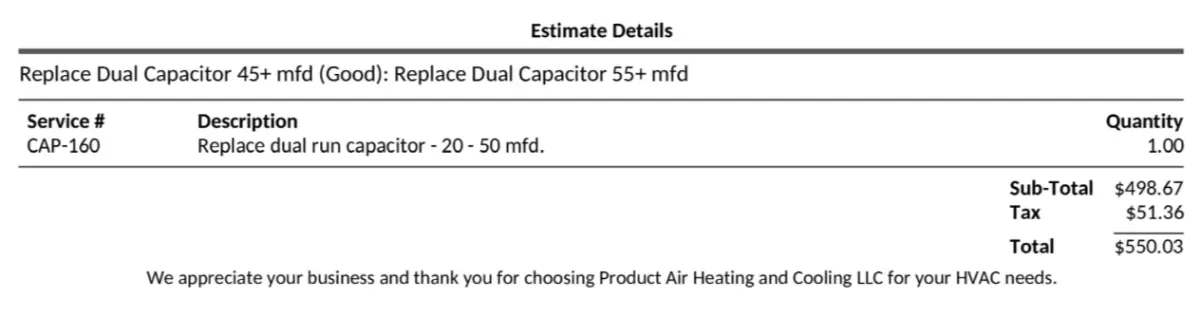
The capacitor itself is usually not the expensive part of the visit. The part itself typically costs around $15 to $80. What you are paying for in a professional repair is also the diagnostic work that tells us the capacitor is actually the problem, getting the correct replacement for the equipment, installing it safely and checking that the system is operating properly afterward.
Sue’s final number was much better than $498.67. Her system was still under warranty, and the parts and labor for this failure were covered, so her out-of-pocket cost was $0. This is why we check warranty coverage on newer equipment instead of treating the quoted repair price as the number the homeowner automatically has to pay.
How Warranty Coverage Brought Sue’s Cost to $0
A newer AC may still be covered even when an individual component fails. Manufacturer warranties usually follow the equipment rather than the price of the repair, so the first thing worth checking is the system’s age, model, and registration status before assuming the homeowner has to pay for the failed part.
For Trane residential equipment, the Base Limited Warranty typically covers replacement parts for five years, while a Registered Limited Warranty typically extends parts coverage to 10 years when the equipment is registered within 60 days of installation. The exact term depends on the product, and the manufacturer coverage applies to qualifying parts that fail because of a manufacturing defect.
Once Robert confirmed that the capacitor had failed, the repair was covered under warranty. The capacitor replacement was quoted at $498.67, but parts and labor were covered, bringing Sue’s out-of-pocket cost to $0.
What Sue Got From the Repair
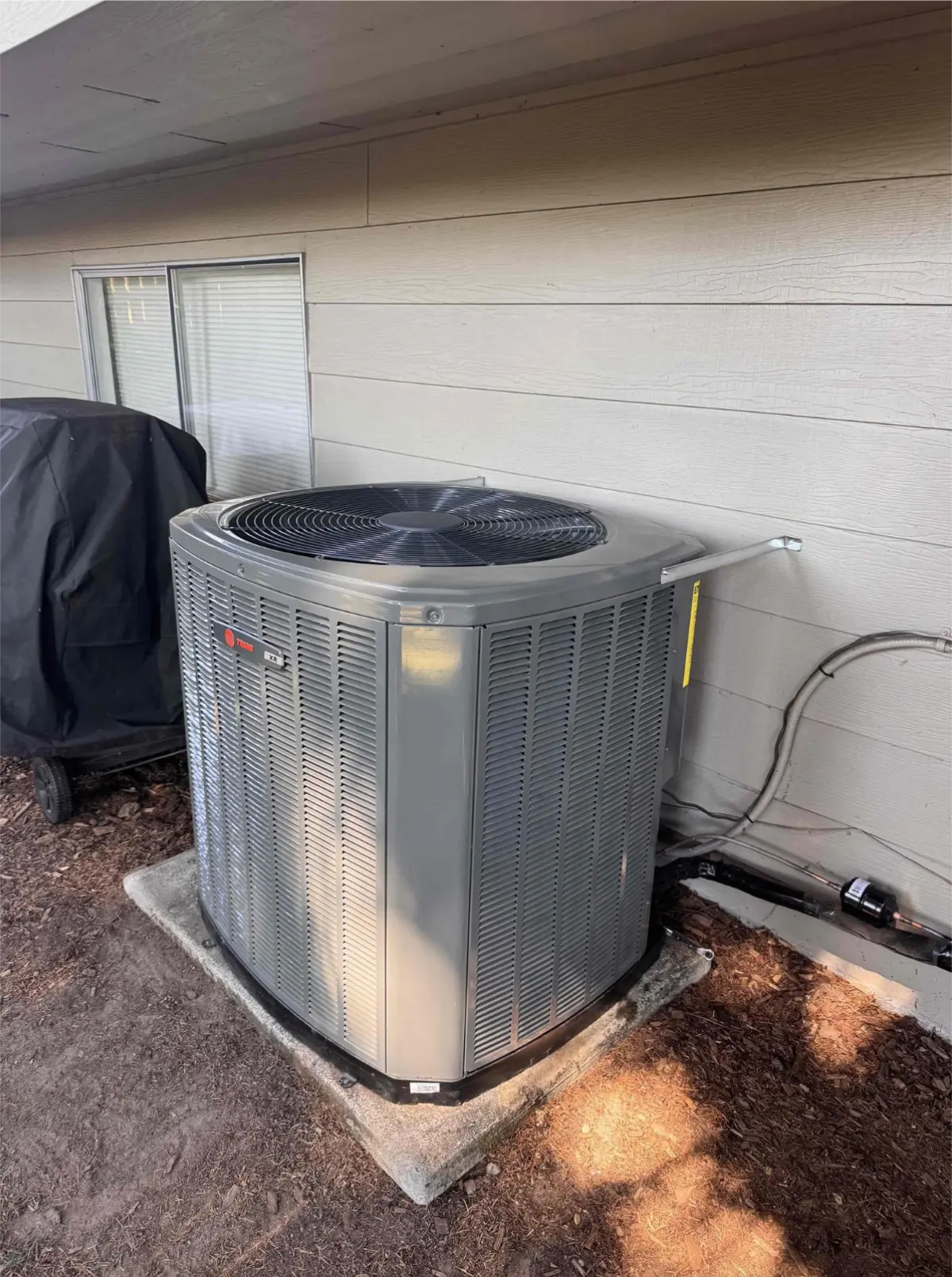
The result for Sue was simple: her AC was back up and running the same day, and the repair cost her nothing out of pocket. Robert had the needed capacitor on his truck, which meant she did not have to wait for a part order before getting the system running again.
Sue later described the experience in a review on our Marysville Google Business Profile, the same Product Air location associated with this service call:
“So thankful for the help to discern what caused the heat pump to go off. Robert had the needed part available in the truck so no wait for an order and everything was up and running in a short amount of time! Thank you!”
Sue did not need a long explanation of everything that could theoretically be wrong with a heat pump. She needed someone to find the actual failure and get the system running again without making her wait for a part order.
Frequently Asked Questions: AC Capacitor Repair in Bothell, WA
Why would a capacitor fail in a nearly new AC system?
A capacitor can fail earlier than the rest of the equipment. Heat is hard on electrical components, and manufacturing defects or electrical stress can shorten a capacitor’s life even when the AC system itself is still in good condition. A failure this early is not something I would call normal, but it also does not prove that the entire system has a problem.
Are there warning signs before an AC capacitor fails completely?
Sometimes. You may notice the outdoor unit struggling to start, intermittent cooling, or a system that seems to take longer than usual to come on. But capacitors can also fail with very little warning. That is why I would not try to diagnose one from symptoms alone. Several AC problems can look similar from inside the house.
Can hot weather cause an AC capacitor to fail?
Heat can contribute to capacitor wear because the component already operates inside outdoor equipment that gets hot during normal summer use. A hot day by itself does not mean a capacitor will fail, but prolonged heat and electrical stress can be hard on one that is already weakening.
What is the difference between a start capacitor and a run capacitor?
They do different jobs. A start capacitor provides extra help when a motor starts, while a run capacitor remains part of the circuit while the motor is operating. Many residential outdoor units use a dual run capacitor that serves both the compressor and the condenser fan motor. The correct replacement depends on the equipment, which is one reason we match the capacitor to the system rather than installing whatever happens to fit.
Can I replace an AC capacitor myself?
I would not recommend it. A capacitor is an electrical component that can retain a charge even after power to the equipment has been switched off. The bigger issue is that a no-cooling symptom does not prove the capacitor is the problem. Replacing one without diagnosing the system first can leave the real failure untouched.
Does replacing a failed capacitor mean something else in the system is about to fail?
Not necessarily. One failed component does not mean the rest of the AC system is on its way out. The useful question is what the diagnostic shows about the rest of the equipment. On a newer system that is otherwise in good condition, replacing the failed capacitor may be all the repair that is needed.
What should be checked after an AC capacitor is replaced?
The important part is not simply installing a new capacitor and leaving. The technician should confirm that the system starts and operates normally after the repair and that the original no-cooling complaint has been resolved. If the system still is not operating correctly, the diagnostic needs to continue rather than assuming the new capacitor solved everything.
Key Takeaways
- An AC system that is only about a year old can still stop working because one component fails even when the rest of the equipment is in great condition.
- “No cooling” is a symptom, so the real value of the diagnostic is finding out whether the problem comes from one failed part or the system as a whole.
- A failed capacitor can stop an AC system from operating without meaning the homeowner needs to replace nearly new equipment.
- Robert had the replacement capacitor on his truck, which allowed him to complete the diagnostic and repair during the same visit in about an hour.
- Sue’s capacitor replacement was quoted at $498.67, but warranty coverage for parts and labor brought her final out-of-pocket cost to $0.
- Warranty coverage is worth checking on newer HVAC equipment before the homeowner pays for a repair that may already be covered.
— Serge Nikolin, Co-Founder, Product Air Heating, Cooling and Electric
Marysville · Issaquah · Seattle · Western Washington
PLAN YOUR NEXT STEP
Need help with your home comfort?
Explore Product Air’s air conditioning services or contact the team.
Share this guide