


Location: SE Cedar Falls Way, North Bend, WA 98045
Call Date: June 24, 2026
First Visit: June 26, 2026
Work Start: June 26, 2026
Project Completion: June 26, 2026
Service Type: Heat pump maintenance
Lead Technician: Robert, 8 years of HVAC experience
System Before: Multi-zone Mitsubishi heat pump system installed by Product Air about 1.5 years earlier, with no cooling in the guest bedroom
System After: Same Mitsubishi system, maintenance completed with no equipment replacement needed
Final Project Cost: $149
Heat Pump Maintenance in North Bend, WA: No Cooling in One Room on a 1.5-Year-Old Mitsubishi System
Jane had a deadline that made this one feel more urgent than a normal maintenance call. Her daughter was coming to stay, and the guest bedroom was the one room in the house that would not cool. Product Air had installed Jane’s multi-zone Mitsubishi system about a year and a half earlier, so she already knew the equipment and knew who had worked on it. The system was still relatively new, which made a major equipment failure less likely than it would be on an older heat pump, but one dead zone still needed to be traced back to its cause.
The House in North Bend
Jane’s home is a 3,300-square-foot, two-story house in North Bend with three bedrooms, built in 1995. Product Air had installed the Mitsubishi multi-zone heat pump system about 18 months earlier, so this was still relatively new equipment rather than an aging system reaching the end of its life. That mattered during the diagnosis because one guest bedroom losing cooling did not automatically point to a failed heat pump or a major system problem.
Can One Room Stop Cooling Even When the Heat Pump Is Still New?
Yes. One warm bedroom is a symptom, not proof that the compressor or another expensive part has failed. A multi-zone system still depends on basic things like power and unrestricted airflow before any zone can cool properly. A dirty filter can reduce airflow across the indoor equipment, while a breaker left off can keep part of the system from operating at all. Neither problem means the heat pump itself is worn out.
Jane’s system was only about 18 months old, and Robert found the equipment itself in solid condition. The visit turned up a dirty filter and a breaker that had been switched off, so there was no reason to start talking about major component replacement. The useful order is simple: confirm the system has power, make sure air can move the way it should, and only then start looking for a deeper mechanical problem if the room still will not cool.
Jane’s Mitsubishi Multi-Zone System
The system Product Air maintains at Jane’s home includes Mitsubishi equipment:
- Outdoor heat pump: Mitsubishi MXZSM42NAMHZ2-U1
- intelli-HEAT coil: Mitsubishi PAA-A36BA1
- Indoor wall-mounted unit: Mitsubishi MSZ-FS12NA
The PAA-A36BA1 is an intelli-HEAT coil that mounts in-line with the home’s existing ductwork and furnace, automatically switching between the heat pump and gas backup depending on outdoor temperature. The MSZ-FS12NA, by contrast, is a wall-mounted zone running independently off the same outdoor unit. That combination matters here: each zone on a multi-zone system typically has its own point of electrical connection, which is exactly why a breaker issue could take out cooling in one specific room, the guest bedroom, without affecting the ducted side of the house running through the furnace coil.
What Robert Found During the Maintenance Visit
Robert found two problems that could interfere with normal operation without pointing to a failed heat pump. The first was a dirty air filter. As a filter loads up with dust, resistance through the return side increases and the blower has a harder time moving the designed amount of air across the indoor coil. Lower airflow can reduce how much heating or cooling the system can actually deliver to the house, even while the refrigeration equipment itself is still healthy. The second issue was electrical: a breaker associated with the Mitsubishi system had been switched off, which meant part of the equipment could not operate as intended until power was restored.
Those findings matter because they point in a completely different direction from a failed compressor or a refrigerant problem. Jane’s Mitsubishi equipment was only about 18 months old and was in solid condition, so Robert did not start replacing parts just because one bedroom was warm. He restored the conditions the system actually needs to work, including proper airflow and power, and treated the visit as maintenance rather than turning a small operating problem into an unnecessary equipment repair.
Why a Dirty Filter Still Matters on a Newer Heat Pump
New equipment still needs airflow. A dirty filter adds resistance to the air moving through the part of the HVAC system it serves. As the filter loads up with dust and debris, the blower has a harder time moving the amount of air the system was designed around. That can hurt comfort and system performance. It does not mean every dirty filter will shut down a heat pump, and Jane’s case does not prove that either. The equipment can be perfectly capable of heating and cooling the house while a maintenance issue gets in the way of how well it performs.
What Happens When an HVAC Breaker Is Off?
A heat pump system cannot cool normally when part of it has lost electrical power. The outdoor unit needs power for the compressor and fan, while the indoor equipment needs power for the blower, controls, and other components that move conditioned air through the home. A breaker left in the OFF position can therefore make a healthy system look like it has a much bigger problem.
The thermostat may still be calling for cooling, but the equipment it is trying to control may never start. From the bedroom, all Jane sees is warm air and a room that will not cool. The same symptom could also come from a control failure or another electrical problem, so checking power is one of the basic diagnostic steps before anyone starts talking about compressors or refrigerant. Robert found that a breaker associated with Jane’s Mitsubishi system had been switched off, which was one of the operating issues he corrected during the maintenance visit.
What Product Air Did
Robert handled Jane’s maintenance visit on his own and spent about an hour to an hour and a half working through the Mitsubishi multi-zone system. The equipment itself was still in solid condition, so the job stayed focused on finding what was interrupting normal operation rather than replacing parts. He found a dirty air filter restricting airflow and a breaker associated with the system that had been switched off. Both can interfere with cooling even when the compressor, refrigerant circuit, and Mitsubishi equipment are still healthy.
Once those basic operating conditions were corrected, there was no evidence in the project notes that Jane needed new equipment or a major repair. Robert also explained why a newer heat pump can still have a comfort problem without suffering a mechanical failure. Power and airflow have to be right before the system can do what the thermostat is asking it to do, so those are worth checking before anyone starts blaming an expensive component. The whole visit stayed in the maintenance lane because that was where the actual problem was.
How Much Did This Heat Pump Maintenance Visit Cost?
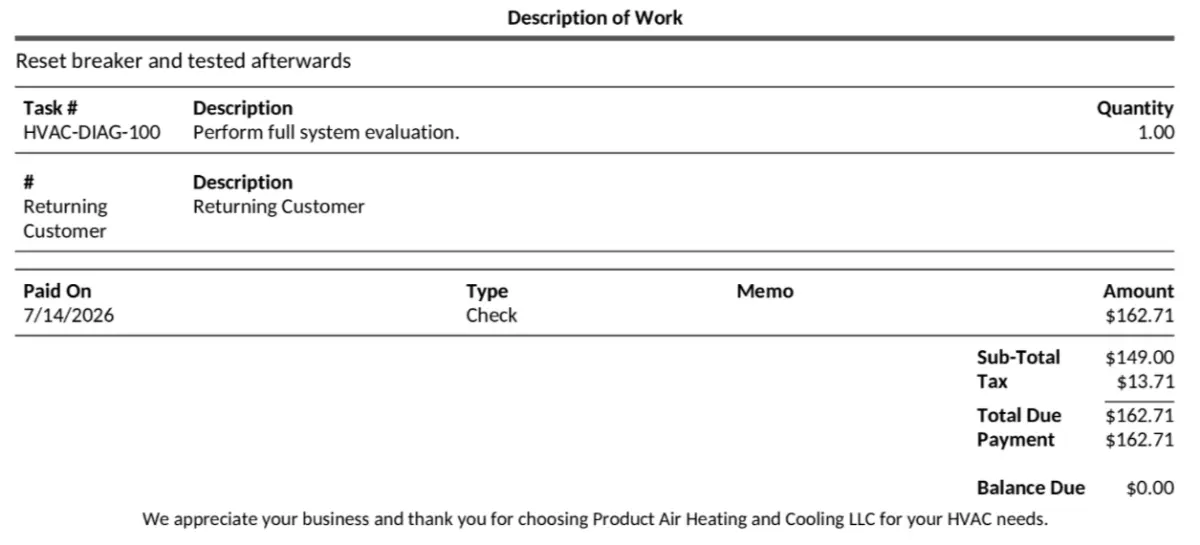
Jane paid $149 for the visit. This stayed a maintenance and diagnostic visit. Robert found issues worth addressing around a Mitsubishi system that was only about a year and a half old and still documented in solid condition.
Why Maintenance Still Matters on a 1.5-Year-Old System
A newer heat pump still depends on basic operating conditions just as much as an older one does. Jane’s Mitsubishi system was only about 18 months old and the equipment itself was still in solid condition, but a dirty filter was already adding resistance to airflow and a breaker associated with the system had been switched off. Restricted airflow can reduce how much conditioned air reaches the rooms and make the indoor equipment work harder to move air, while a loss of power can stop part of the system from operating altogether. Neither problem means the compressor is failing or the heat pump is wearing out. Jane’s visit is a good example of why maintenance on newer equipment is less about “fixing an old system” and more about keeping airflow, power, and normal operation where the equipment was designed to have them.
What Jane Got From the Visit
Jane called because her daughter was coming to town and the guest bedroom was not cooling. Robert came out on June 26, two days after the call. He spent about an hour to an hour and a half working through the Mitsubishi system. The equipment itself was still in solid condition. The visit uncovered a dirty filter and a breaker that had been switched off rather than a major equipment failure. For Jane, that distinction mattered. A room that would not cool felt like an HVAC problem. The answer did not turn out to be a new heat pump. It was a maintenance call.
As Jane herself said: “This company did a fantastic job replacing our old HVAC system with a new furnace, heat pump, and ductless heating and AC system. They were on time, offered great value, and provided excellent customer service.”
Tech Brother Rule: Diagnose Before You Replace
A warm room does not automatically mean expensive equipment has failed. I’d find the actual problem first and only talk about major repairs when the diagnosis gives us a reason to.
Frequently Asked Questions: Heat Pump Maintenance in North Bend, WA
Can a newer heat pump still have a no-cooling problem?
Yes. Equipment age is only one part of the diagnostic. Power, airflow, controls, maintenance conditions, and individual components can all affect whether the system cools correctly. Jane’s Mitsubishi system was only about a year and a half old when she called.
Can a dirty filter affect heat pump performance?
Yes. A dirty filter can restrict airflow through the equipment it serves and reduce HVAC performance. Jane’s maintenance visit found a dirty filter, although the service notes do not say that the filter by itself caused the guest-bedroom cooling complaint.
Can an HVAC system stop working because a breaker is off?
Yes. HVAC equipment needs electrical power to operate. If the breaker supplying that equipment is switched off, the affected equipment cannot run normally until power is restored. Robert found that a breaker associated with Jane’s system had been shut off.
Why would an HVAC breaker be turned off?
There are several possible reasons, but Jane’s service notes do not document why this breaker was off. That is why I would not guess. Robert identified the power issue during the visit and addressed the system based on what he actually found.
Does one room not cooling mean the heat pump is failing?
Not necessarily. A room or zone that is not cooling is a symptom, not a diagnosis. The problem needs to be traced through the actual system before deciding whether the cause is maintenance, power, controls, airflow, or equipment failure.
Does a Mitsubishi multi-zone heat pump need regular maintenance?
Yes. A newer multi-zone system still needs normal maintenance to keep airflow and equipment operation where they should be. Jane’s visit is a good example. Her equipment was still in solid condition, but Robert still found maintenance-related issues that needed attention.
How long did Jane’s maintenance visit take?
Robert spent approximately one to one and a half hours on site.
How much did the visit cost?
Jane paid $149 by credit card.
Key Takeaways
- One room not cooling does not automatically mean the heat pump or compressor has failed.
- A dirty HVAC filter can restrict airflow enough to reduce comfort even when the equipment itself is still in good condition.
- A breaker left off can make healthy HVAC equipment look like it has a much more serious failure.
- Newer heat pump systems still need regular maintenance because proper airflow and electrical power directly affect how well they operate.
- A no-cooling complaint should be diagnosed before anyone starts recommending expensive component replacement.
- Multi-zone systems can have a problem in one room while the rest of the HVAC equipment continues operating normally.
— Serg Nikolin, Co-Founder, Product Air Heating, Cooling and Electric
Marysville · Issaquah · Seattle · Western Washington
PLAN YOUR NEXT STEP
Need help with your home comfort?
Explore Product Air’s heat pumps services or contact the team.
Share this guide