


If your electric vehicle came with a Level 1 cord and you already have a suitable 120-volt outlet near the parking space, Level 1 charging may require no new installation and adds about 2 to 5 miles of range per hour. A Level 2 EV charger uses 240 volts and can add roughly 10 to 30 miles per hour, but home installation usually requires a dedicated circuit, a licensed electrician, and a permit. I'm Serg Nikolin, co-owner of Product Air Heating, Cooling, and Electric, and this guide covers what each option costs, when the panel becomes the real expense, and how permitting works in Washington State.
Quick Takeaways:
- Level 1 charging may be enough if you drive less than about 40 miles a day and already have a suitable 120-volt outlet near the car
- Level 2 charging is much faster, but installation usually requires a dedicated 240-volt circuit, a permit, and enough capacity in the existing panel
- Installation cost depends heavily on the distance from the panel and whether the wiring has to pass through finished walls or other difficult areas
What Separates the 120-Volt Cord From a 240-Volt Charger?
Level 1 and Level 2 charging move the same electricity into the same EV battery. The gap is how fast it goes in and what has to exist in your home electrical system first.
The Cord That Comes With a New EV
Your car ships with a cordset that plugs into an ordinary 120-volt outlet. The Alternative Fuels Data Center puts this level of charging at about 1.9 kW and roughly 5 miles of range per hour. Nothing gets installed, provided a dedicated outlet is near the car. That is the appeal of Level 1 charging and of Level 1 EV chargers used with a standard 120-volt outlet. If the outlet and circuit are already suitable for EV charging, no new charging installation should be needed. At roughly 2 to 5 miles of range per hour, twelve hours overnight can add about 24 to 60 miles, depending on the vehicle and conditions. But drive 250 miles on a Saturday and the cord will not refill the battery before Monday.
A 240-Volt Circuit and Real Charging Speed
Level 2 EV charging runs at 240 volts, the service an electric dryer uses. Most residential units draw up to 30 amps and deliver 7.2 kW, which the Alternative Fuels Data Center puts at about 25 miles of range per hour. ENERGY STAR gives a more conservative 10 to 20 miles per hour, because the pace also depends on the car's onboard charger, the part that converts incoming AC power for the battery.
In practice, a Level 2 charger refills a daily commute in an hour or two and a nearly empty battery overnight.
Level 1 vs Level 2 vs Public Charging
Public charging stations fill the third slot. DC fast charging beats anything you can put in a garage, but it usually costs more per kilowatt-hour than charging at home. Most EV drivers use public EV charging infrastructure on road trips and top up daily at home.
Do You Need a 240-Volt Charger, or Is the Cord Enough?
Not every household needs one. The cord works if you drive under 40 miles a day, park within reach of an outlet, and leave the car overnight. A Level 2 charger may earn its keep if you drive more than that, own a long-range model, or are adding a second EV to the same driveway. We do not start by telling every homeowner that Level 2 is the best choice. We first ask what they are trying to achieve, how much convenience and charging speed they want, and what the existing electrical system can support. The other thing that decides the right charger for your home is what the house can already support.
What Does an EV Charger Installation Actually Run?
There is no single number, because hardware and wiring are separate questions. The hardware carries a published price you can shop against any other quote. The wiring gets priced off your house, which is why two bids on the same equipment can land far apart: they are quoting different runs of wire, not different equipment. Panel capacity then sits on top of both and can move the total more than anything else, so we look at the panel and the route before putting a number on the job.
Hardware: What a Level 2 Charging Station Costs
The Alternative Fuels Data Center puts equipment cost at $500 to $4,000 before installation and incentives. Most of the Level 2 home charger models we install sit near the bottom of that range. For a utility rebate, buy from the prequalified list below, because not every unit qualifies.
Where the Charger Goes and What the Wiring Costs
Three things influence the cost of installing a home EV charging station: distance from the electrical panel to the car, whether the run passes through finished walls, and whether the panel has room. Charger location is the one homeowners underestimate. A unit mounted directly behind the panel is a short run. The same hardware at the far end of a detached garage means trenching, conduit, and a far larger bill.
A Local Example: An EV Charger Installation in Issaquah
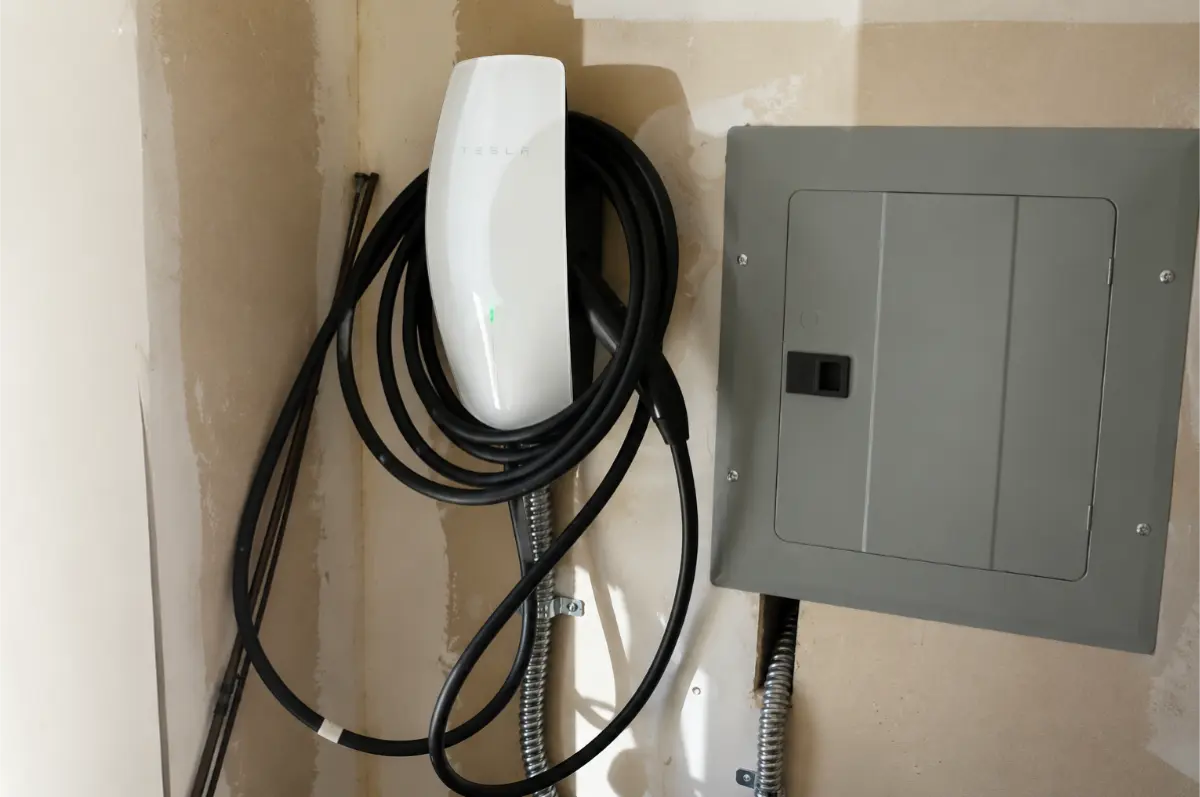
Our published case for an EV charger installation in Issaquah came to $1,300 for a home charging setup for a Tesla. That was a straightforward residential Level 2 job with capacity already available in the panel. It is one house, not a quote for yours, but it shows what a clean home installation looks like when nothing has to be rebuilt.
Does an EV Charger Need a Permit in Washington?
Yes. The Washington State Department of Labor and Industries states that electrical work in Washington requires a permit and inspection, with limited exceptions. Installing an EV charger on a new 240-volt circuit at home falls under that rule, so it requires an electrical permit and an inspection once the work is done.
EV Charger Permit Requirements and Who Pulls It
L&I states that permits must be purchased either by the electrical contractor or by the property owner doing the work. When we install an EV charger, we pull the permit and schedule the inspection, and the fee sits in the quote. We get a lot of calls for EV charger installation, roughly enough for about one sales visit a day, but we do not take shortcuts to compete with unpermitted work. We pull the permit, use qualified technicians, install to code, and stand behind the work with our warranty and insurance. Where you file and what you pay vary by jurisdiction, because some cities run their own inspection programs instead of L&I. Around Seattle, EV charger permits are generally straightforward. Many jurisdictions use an online over-the-counter process, so the permit itself can often be issued quickly once the application is submitted correctly.
Skipping the permit is a bad idea. An uninspected circuit can be discovered during a home sale, and an insurer can ask questions after a fire. In about 10 recent customer service calls, I found do-it-yourself wiring in every home, and each had something I considered unsafe.
What Are the Electrical Requirements for a 240-Volt Circuit?
The charger needs its own dedicated 240-volt circuit sized for the unit, plus enough capacity in the panel to carry it. Washington's residential code at WAC 51-51-0309 requires new dwelling units covered by the rule and built with an attached private garage or attached carport to include at least one 40-amp dedicated 208/240-volt branch circuit for EV charging. The provision took effect March 15, 2024, so a newer home permitted under that code may already have EV charging infrastructure, but you still need to verify what was actually installed.
Will You Need a Panel Upgrade?
Maybe, and an electrician answers that with a load calculation, which totals what the home already runs before adding the car. It tells you whether your electrical panel capacity and electrical service can carry a load this size.
Electrical panel upgrades are not needed on most of our projects. I would estimate the question comes up in about 15 percent of the homes we visit, more often in older houses and in places like Seattle, Kirkland, and Mercer Island. Residential EV charger installs are one of the most common moments a homeowner discovers the service needs attention. We also see homeowners focus on the charger and overlook the condition of the panel itself. An EV project is often the first time anyone checks whether the existing equipment and connections are actually in good enough condition for a large new electrical load. Our published pricing puts that upgrade at $1,500 to $4,500, depending on the job. One customer chose us because our technician was the only contractor who told him the panel needed to be upgraded. The other contractors were prepared to work with the existing panel, but we were upfront about what was needed to make the installation safe.
Are There Rebates for Charging an EV at Home?
Some, and they change, so verify before buying:
- Puget Sound Energy offers up to $300 for a qualifying ENERGY STAR smart charger from its prequalified list. Income-qualified customers can receive up to $600 plus up to $2,000 toward installation. PSE allows one rebate per qualified single-family residence within a five-year window, and the application is due within 60 days of installation.
- PSE Flex EV pays $50 at enrollment plus $0.50 per kilowatt-hour saved during Flex events for customers who enroll a compatible car or charger.
Utilities differ by city here, so check who serves your address first.
Thinking About an EV Charging Station Installation?
We don't come to sell. We come to solve the customer's problem in a way that's right for the customer. That is what we mean by being your tech brother from another mother. Product Air has handled HVAC and electrical jobs in Western Washington since 2017. If you want to know what it would take to put a 240-volt charger in at your address, send us the quote you have, and we will tell you what we would check first.
FAQ
Is it cheaper to charge an EV on Level 1 or Level 2, considering installation and electricity costs?
Level 1 is usually cheaper to start with when a suitable 120-volt outlet is already available, because it may require no new installation. Under the same utility rate, electricity is billed by the kilowatt-hour, not by which level you use. The main advantage of installing a Level 2 charger is faster charging, although smart charging and time-of-use rates can also influence the total cost.
What are the key differences between Level 1 and Level 2 EV chargers, and which is better for home use?
The 120-volt cord adds about 5 miles of range per hour. The 240-volt unit adds 10 to 25, depending on the car. The cord is the better answer if your daily driving is light and you want no installation work at all. The faster option suits longer commutes, bigger batteries, or two cars.
Do I need a Level 2 charger at home, and what factors should I consider when deciding?
Weigh daily miles, how long the car sits parked, battery size, and whether a second EV is coming. Under 40 miles a day with overnight parking usually does not call for one. Check what the panel supports too, because that decides the cost more than the hardware.
How much does a Level 2 charger add to your electric bill?
That depends mainly on how many kilowatt-hours the vehicle uses and your utility rate, not on whether the home charger is Level 1 or Level 2. As one example, FuelEconomy.gov shows how annual mileage and electricity price can be used to estimate home EV charging cost. Under PSE's standard residential rate, the energy charge also depends on monthly usage, with a higher tier after the first 600 kWh, so the actual increase on your bill depends on how much electricity the household is already using.
What is the typical cost to install a Level 2 home EV charger, including hardware, labor, and potential electrical upgrades?
Hardware runs $500 to $4,000 per the Alternative Fuels Data Center. Labor depends on the distance from the panel and whether walls are open. Our published Issaquah job totaled $1,300 with capacity available. Where the panel has to be replaced, add $1,500 to $4,500.
Do I need a permit to install a home EV charger, and what is the process and cost for obtaining one?
Yes. New wiring for a Level 2 EV charger requires an electrical permit and inspection. If you hire a licensed electrician, the electrical contractor buys the permit and schedules the inspection. A property owner who is legally allowed to do their own electrical work may obtain the permit directly. Fees and permit requirements depend on the authority having jurisdiction, which may be L&I or a city that runs its own electrical inspection program.
What are the electrical requirements for installing a Level 2 EV charger, and will I need a panel upgrade?
A dedicated 240-volt circuit sized for the unit, plus enough service capacity to carry it. A load calculation answers the panel question. In our experience it comes up in roughly 15 percent of homes, mostly older housing stock.
Are there any rebates or incentives available for installing a home EV charger?
PSE offers up to $300 for a qualifying smart charger, and more for income-qualified customers. PSE Flex EV adds $50 at enrollment. Snohomish County PUD closed its program at the end of 2025, and the federal credit covered only property placed in service through June 30, 2026.
PLAN YOUR NEXT STEP
Need help with your home comfort?
Explore Product Air’s electrical services or contact the team.
Share this guide