


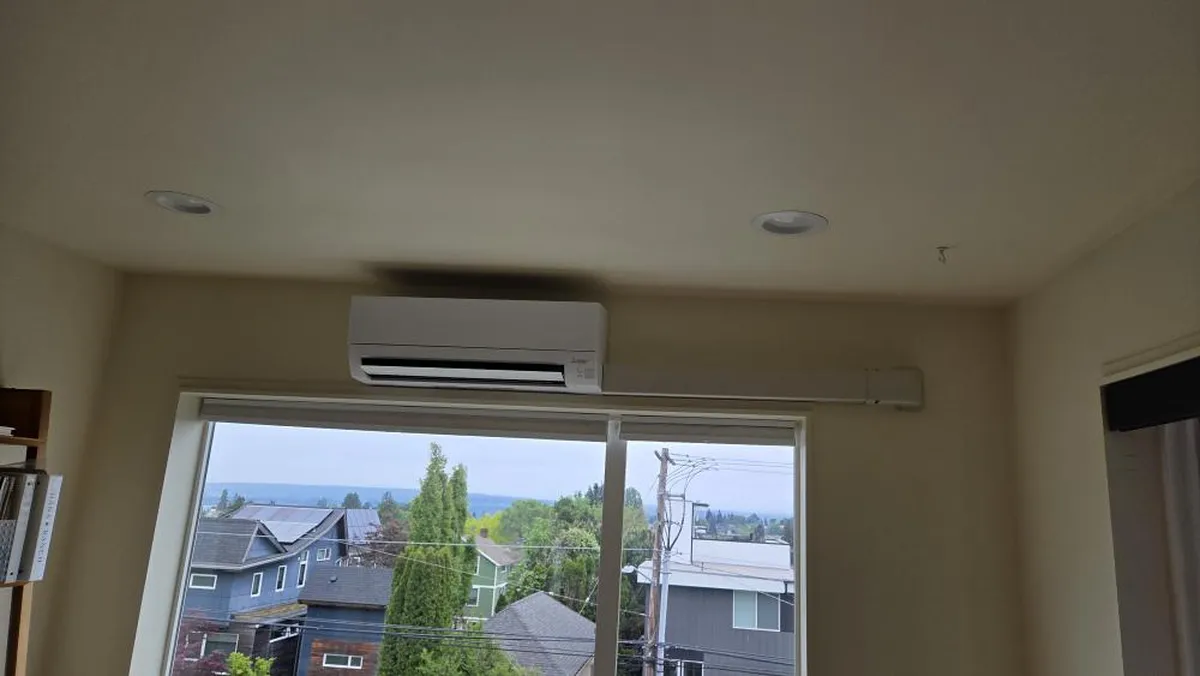
In one Lake Stevens case, adding a heat pump instead of AC to a healthy 12-year-old furnace cost $13,429 after a utility rebate. In a separate Seattle case, a 1947 oil furnace had to be fully replaced alongside adding AC, bringing that project to $19,982.16 with no rebate available. It depends heavily on your furnace’s condition, not just your home’s size. Getting your furnace properly inspected first is the only way to know which range actually applies to your home.
Two homeowners called us with almost the exact same starting point: a furnace that heated the house fine, and no cooling at all. Both wanted air conditioning added to a system that had never had it. They ended up with completely different projects, at completely different prices, and both decisions were right: for their specific furnace, their specific home, and what they actually wanted their house to feel like. That’s the real answer to cost to add AC to existing furnace in Seattle: it depends less on your square footage than on the honest condition of what’s already in your utility closet.
How Much Does It Cost to Add AC to an Existing Furnace? Two Real Examples
Here’s the direct answer, from two completed projects rather than a single generic estimate:
| Homeowner | Home Size | Furnace Condition | Solution | Final Cost |
| Jerry, Lake Stevens 98258 | 3,454 sq ft, 3 bed | 2014 York furnace, 12 years old, confirmed fully healthy | Furnace kept as-is, heat pump added instead of AC | $13,429 (after rebate) |
| Reema, Seattle 98115 | 2,450 sq ft, 4 bed | 1947 oil furnace, aging and taking up basement space | Furnace fully replaced with a new Trane, AC added separately | $19,982.16 (no rebate available) |
Same basic request, “I have a furnace, I want cooling,” and two entirely different, entirely rational outcomes. The reason isn’t home size. It’s what each furnace actually was when a technician looked at it closely.
When Your Furnace Is Healthy: Adding a Heat Pump Instead of AC
Jerry called about air conditioning for the few genuinely hot nights his Lake Stevens home sees each year. His York furnace was 12 years old, and he told Eli directly he wasn’t looking to touch it. Eli’s diagnostic backed that up completely: the furnace was in excellent condition, well-maintained, with a realistic shot at another decade or more of service.
Rather than quote a straight AC system, Eli offered something different: a heat pump add-on instead. Same footprint, same electrical run, same condenser pad, but a unit that heats as well as cools, with the existing furnace demoted to backup heat rather than replaced. The number that made this case worth remembering: after a $1,800 Snohomish County PUD rebate, the heat pump add-on came to $13,429, cheaper than a comparable standalone AC installation would have cost, since AC-only projects don’t carry the same rebate eligibility. Jerry ended up with cooling he didn’t have before, heating capacity in reserve, and a lower final price than the “simpler” option would have run.
This is the answer to “existing furnace, no air conditioning, what to add” for a genuinely healthy furnace: don’t assume AC is automatically the default. A heat pump add-on, priced correctly, can beat it.
When Your Furnace Needs Replacing Too: Furnace + AC Together
Reema’s situation looked similar on the surface, a furnace, no cooling, a homeowner ready to fix that. But her furnace was an oil unit installed in 1947, taking up meaningful floor space in her basement and well past any reasonable expectation of remaining service life. There was no “keep it as backup” option here, because the equipment itself wasn’t a candidate for that role.
Her project became a full AC installation and replacement: the oil furnace came out entirely, replaced with a new 96% AFUE Trane variable-speed furnace, paired with a matched Trane variable-speed AC system. Reema knew about a heat pump rebate worth roughly $6,000 before she ever got a quote and she chose the furnace-and-AC path anyway, because she specifically wanted the feel of hot air coming out of her vents, which a heat pump running at a lower supply air temperature doesn’t replicate the same way. Her total came to $19,982.16, with no rebate applied, since a furnace-and-AC combination doesn’t qualify for the incentive programs built around heat pump adoption.
Reema’s case is the honest counterweight to Jerry’s: when the furnace itself needs replacing, adding AC becomes part of a bigger project, and the economics and the comfort preferences shift accordingly.
Cost by Home Size: What Affects the Price
It’s tempting to look at these two numbers and assume the bigger home simply cost less, but that’s the wrong lesson to take from this comparison. Jerry’s 3,454-square-foot home (the larger of the two, closer to a 3,500-square-foot project) came in at $13,429. Reema’s smaller, roughly 2,500-square-foot home came in at $19,982.16, nearly $6,500 higher. Home size wasn’t the deciding factor. The type of project was.
Jerry’s cost reflected an add-on to existing, healthy equipment: no furnace removal, no new furnace purchase, just a new outdoor unit, coil, electrical circuit, and a rebate that directly targeted heat pump equipment. Reema’s cost reflected a full system replacement: removing decades-old equipment, purchasing and installing an entirely new high-efficiency furnace, plus a separate AC system, with no rebate to offset any of it. For a like-for-like comparison, same size home, same furnace condition, square footage absolutely still affects total equipment capacity and installation labor. But across these two real cases, project type and furnace condition moved the price far more than the difference between a 2,500-square-foot house and a 3,500-square-foot one.
Ductless as a Third Option for Adding Cooling
There’s a third path worth knowing about, even though neither Jerry nor Reema needed it: a ductless mini-split add-on. For homes where central ductwork doesn’t reach a specific addition, a converted attic or basement space, or where a homeowner only needs cooling in one or two rooms rather than the whole house, a single-zone or multi-zone ductless system can add cooling without touching the existing furnace or its ductwork at all.
We’ve installed this exact solution for homeowners needing targeted cooling in a specific space: a rental property’s main living area, a single room addition, where a full central AC or heat pump add-on wasn’t the right scope for what was actually needed. It’s not a replacement for central cooling in a home that needs whole-house coverage, but it’s a legitimate, often lower-cost option when your cooling need is more limited than “the whole house.”
How to Know Which Path Is Right for You
Before assuming you need one specific solution, it’s worth working through a short list honestly. First, how old is your furnace, and has anyone actually inspected its core components (heat exchanger, blower motor, wiring) rather than just guessing based on age alone? Jerry’s furnace was 12 years old and confirmed healthy; a furnace the same age with different maintenance history might not pass that same inspection. Second, what’s your budget, and have you actually priced a heat pump add-on against a standalone AC option, since rebate eligibility can invert which one costs less? Third, how do you feel about the type of heat a heat pump delivers versus a furnace, since that’s a legitimate factor in the decision even when the rebate math favors one option, Reema’s choice proves that comfort preference is allowed to outweigh savings. And fourth, does your home have existing ductwork that reaches every room you want cooled, or would a ductless add-on solve your actual need more precisely than a full central system?
None of these questions has a universally correct answer. They have a correct answer for your specific furnace, in your specific home.
Frequently Asked Questions: Adding AC to an Existing Furnace in Seattle
Can you keep your existing furnace and just add cooling?
Yes, if a diagnostic confirms the furnace is genuinely healthy. In one Lake Stevens case, a 12-year-old York furnace was inspected and found to be in excellent condition, so it was left completely in place while a heat pump was added alongside it, with the furnace demoted to backup heat rather than replaced. This approach only works when the existing equipment is actually sound: an aging or failing furnace isn’t a good candidate for this path.
When does adding AC mean replacing the furnace too?
When the furnace itself is old enough or in poor enough condition that keeping it isn’t a reasonable option, adding cooling naturally becomes part of a larger replacement project. In one Seattle case, a 1947 oil furnace was replaced entirely with a new high-efficiency unit at the same time AC was added, since the original equipment wasn’t a realistic candidate to keep running as backup heat.
Does home size affect the cost of adding AC to a furnace?
It affects the required equipment capacity and installation labor, but in real comparisons, project type and furnace condition have mattered more than square footage alone. A 3,454-square-foot home adding a heat pump to an existing healthy furnace cost $13,429, while a smaller 2,450-square-foot home requiring a full furnace-and-AC replacement cost $19,982.16, nearly $6,500 more despite being the smaller home, because the scope of work was fundamentally different.
I have a furnace but no AC, what are my options?
Generally three paths: add a heat pump alongside a healthy existing furnace, which can heat and cool while keeping the furnace as backup; add standalone central AC if you specifically want to keep furnace-style heating separate; or add a ductless mini-split system if you only need cooling in specific rooms or your ductwork doesn’t reach every space that needs it. The right choice depends on your furnace’s condition, your budget, and how you want your home to feel.
How do you know if a furnace should be replaced when adding AC?
A proper inspection of the core components (heat exchanger, blower motor, wiring, overall age relative to typical service life) is the only reliable way to know. In one case, a 12-year-old furnace passed this kind of inspection with no issues found at all and was kept in service. In another, a furnace installed in 1947 was well past any reasonable expectation of remaining life and needed full replacement rather than continued use.
Should I add a heat pump instead of AC to my existing furnace?
If your furnace is confirmed healthy, it’s worth pricing seriously, since a heat pump add-on can come out cheaper than standalone AC once local utility rebates are factored in: rebates that typically don’t apply to AC-only installations. In one Lake Stevens case, this exact comparison led a homeowner to choose a heat pump add-on over AC, saving money while also gaining heating capacity and extending his existing furnace’s life by reducing its runtime.
Is my furnace healthy enough to keep and just add cooling?
The only way to know for certain is a hands-on inspection of the furnace’s core components, not just its age. A well-maintained furnace at 12 years old passed exactly this kind of inspection in one of our cases and was kept in service as backup heat after a heat pump was added. A furnace with significant age, poor maintenance history, or already showing signs of decline is a different story, and attempting to keep it rather than replace it can end up costing more in the long run.
Key Takeaways
- Adding AC to an existing furnace can cost anywhere from roughly $13,000 to $20,000 or more, depending far more on your furnace’s condition and the type of project than on your home’s square footage alone.
- A genuinely healthy furnace is a strong candidate for a heat pump add-on rather than standalone AC, since heat pump rebates can make that option cheaper than AC-only installations.
- An aging or failing furnace turns an AC add-on into a larger furnace-and-AC replacement project, with different economics and no heat pump rebate eligibility if a heat pump isn’t part of the final system.
- Comfort preference is a legitimate factor in this decision, choosing furnace-and-AC over a heat pump, even when a rebate is available, isn’t a mistake if it’s what actually makes your home feel right.
- Home size affects required equipment capacity, but in real comparisons, furnace condition and project type have moved the final price more than square footage alone.
- A ductless mini-split add-on is worth considering when your cooling need is limited to specific rooms or your existing ductwork doesn’t reach every space you want covered.
Neither Jerry nor Reema needed to be talked into a “right” answer, because there wasn’t a single one waiting for them. There was only the honest condition of the equipment already in their homes, and what they each decided that was worth building around.
— Serge Nikolin, Co-Founder, Product Air Heating, Cooling and Electric
Marysville · Issaquah · Seattle · Western Washington
PLAN YOUR NEXT STEP
Need help with your home comfort?
Explore Product Air’s heating services or contact the team.
Share this guide