


Pricing guides built around an “average” Seattle home don’t help much once your house is pushing 4,000 or 5,000 square feet, spans multiple stories, or has the specific complaint that comes with size: it’s freezing downstairs and unbearable upstairs, because whatever’s cooling the place wasn’t sized or configured for a house this big to begin with. Here’s what central air actually costs for genuinely large homes, based on the largest projects in our own completed work.
How Much Does Central AC Cost for a Large Home? The Real Number
The direct answer, from our largest documented project: $14,473.35 after rebate. That’s what a full heat pump system installation, delivering both cooling and heating from a single system: cost Craig, whose 4,934-square-foot, 7-bedroom home in Issaquah is the biggest house in our case history. His 20-year-old furnace had stopped working entirely, and rather than replace heat alone, he chose a full system that solved both his non-functioning heat and his complete lack of air conditioning at once.
That final number reflects a base price of $24,873.35 before incentives, brought down by $10,400 in stacked utility and manufacturer rebates. It’s the clearest real anchor available for AC installation cost large house in Seattle, a genuinely large home, not a mid-size average stretched to sound bigger than it is.
How Many Tons of AC Does a Large Home Actually Need?
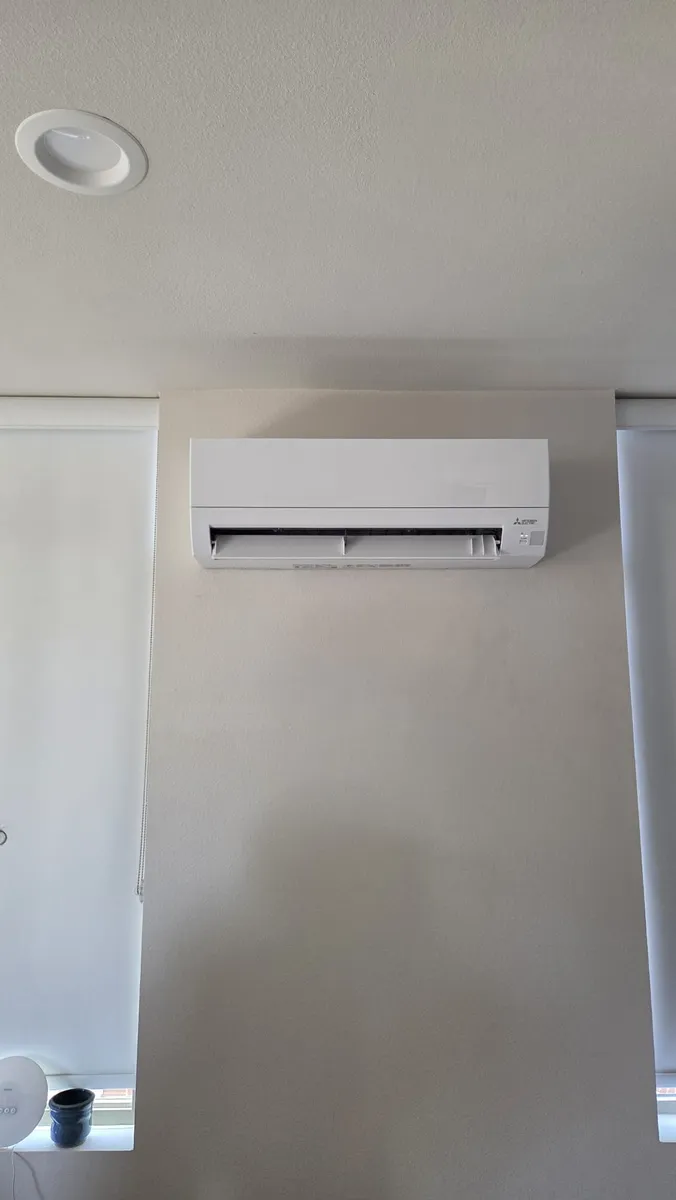
Craig’s home was properly sized with a 5-ton system, a Mitsubishi heat pump rated at 60,000 BTU, working out to roughly 987 square feet per ton. That ratio sits meaningfully higher than the 400-to-700-square-feet-per-ton range often cited as a general industry rule of thumb, and it’s consistent with what you’d expect from a combination of Seattle’s mild climate and a well-insulated, efficiently laid out large home.
AC tonnage for a big house isn’t just a scaled-up version of the math for a smaller one, though. Ceiling height, number of stories, window exposure on each face of the house, and how well the home retains conditioned air all shift the real number, and a home with a daylight basement, like Craig’s, adds its own load considerations from the exposed basement wall area. A proper load calculation, not a square-footage formula, is the only way to confirm what a specific large home actually needs.
Single System vs Multi-Zone: What Large Homes Actually Need
Not every large home is well served by one central system, even a correctly sized one. In a separate North Bend project, a 5-ton Mitsubishi outdoor unit was paired not with one air handler, but with two: a 3-ton unit serving the downstairs and a 2.5-ton unit serving the upstairs, split off a single outdoor condenser through a branch box that divides refrigerant flow between multiple indoor units. That project also involved a complete duct replacement across both the attic and the basement, with three separate refrigerant ports run to support the split configuration.
This kind of setup exists specifically to solve a problem large, multi-story homes run into more than smaller ones: uneven cooling on different floors, where a single centrally ducted system struggles to keep an upper floor as comfortable as the floor below it. Heat rises, upper-level rooms often carry more window exposure and roof-adjacent heat gain, and a single thermostat trying to average across two very different loads often leaves someone in the house saying the same thing: large house too hot upstairs, not enough AC, no matter how the vents get adjusted downstairs. Splitting the system by floor, each with its own dedicated air handler and its own effective zone of control, addresses that directly instead of trying to compensate for it after the fact.
Real Example: A Nearly 5,000 Sq Ft Home in Issaquah
Craig’s project is worth walking through in detail because it shows how a large home’s AC decision actually gets made when it’s approached honestly. His furnace had already outlived a meaningful share of its peers at 20 years old, and it had simply stopped functioning. There was no repair conversation to be had, only a replacement decision.
Eli built him three real options rather than pushing toward one: a furnace-only replacement at $8,878.01 that would restore heat but leave cooling completely unaddressed, a furnace-plus-AC-prep option at $11,577.25 adding groundwork for cooling at a middle price point, and a full Mitsubishi heat pump system at $15,993.05 with tax included, replacing the furnace entirely with equipment that both heats and cools. Craig chose the full heat pump system, priced at $24,873.35 before incentives.
Because the project replaced gas heating entirely with an all-electric system, it qualified as a full fuel switch, unlocking three separate rebate programs: $6,000 from Eastside Energy Smart, $4,000 from the PSE Fuel Switch rebate, and $400 from a Puget Sound Energy Mitsubishi efficiency rebate of $10,400 combined, bringing the final cost to $14,473.35. The installation itself took a single day: two HVAC-certified technicians working eight hours on the equipment, alongside two electricians working four hours on the required circuit, all coordinated in one visit rather than spread across multiple trips.
Does a Bigger Home Always Need a Bigger Single Unit?
Not necessarily, Craig’s project and the North Bend project answer this question in two genuinely different, both correct, ways. Craig’s nearly 5,000-square-foot home was served effectively by one 5-ton system connected to one set of ductwork reaching every level, including the daylight basement. The North Bend project, also built around 5 tons of total outdoor capacity, split that same tonnage across two separate indoor air handlers specifically because a single system wasn’t going to balance the home’s floors evenly on its own.
The difference isn’t really about square footage at all. It’s about the home’s existing ductwork, its layout, and whether uneven cooling between floors is already a known, lived-with problem before any new equipment goes in. A large home with well-designed, well-connected ductwork throughout can often be served by a single appropriately sized system, the way Craig’s was. A large home where upper and lower floors have historically fought for the same air supply is a much stronger candidate for a split, multi-zone approach like North Bend’s, even though both start from a similar total tonnage requirement.
Frequently Asked Questions: AC Cost for Large Homes in Seattle
How much does central AC cost for a large home in Seattle?
Based on our largest documented project, a full heat pump system delivering both cooling and heating for a 4,934-square-foot, 7-bedroom Issaquah home cost $14,473.35 after a $10,400 stacked rebate, with a base price of $24,873.35 before incentives. Costs for large homes vary significantly based on system size, ductwork condition, and rebate eligibility, but this remains the clearest real anchor point for a genuinely large-home project in our case history.
How many tons of AC do I need for a 4,000-5,000 sq ft house?
Based on a real installation, a 4,934-square-foot home was properly sized with a 5-ton system, working out to roughly 987 square feet per ton, higher than the general 400-to-700-square-foot-per-ton industry rule of thumb, consistent with Seattle’s mild climate and efficient home construction. Actual tonnage for any specific large home depends on layout, insulation, window exposure, and number of stories, which is why a professional load calculation matters more than a square-footage formula alone.
Does a large house need multiple AC zones instead of one unit?
It depends on the home’s layout and existing ductwork rather than size alone. In one large-home project, a single 5-ton system served the entire house, including a daylight basement, through one connected duct system. In a separate large-home project, the same general tonnage was split across two air handlers, one per floor, specifically to solve uneven cooling between the upstairs and downstairs, a common complaint in multi-story homes where a single system struggles to balance both levels.
Does multi-zone installation take longer for a large home?
Yes, significantly. In our documented timelines, a single-system large-home installation was completed in a single day, while a comparable multi-zone project requiring two air handlers and a complete duct replacement across the attic and basement took 4 full days of HVAC work plus an additional day of electrical work. Splitting a system across multiple zones adds real installation time, mainly driven by additional ductwork and refrigerant line routing rather than the equipment itself.
Is multi-zone worth the extra cost for a large house?
For homes with a genuine, ongoing uneven-cooling problem between floors, yes, a multi-zone setup with independent air handlers per level directly addresses that in a way a single central system often can’t. For a large home without that specific complaint, and with ductwork already capable of distributing air evenly throughout, a single appropriately sized system can perform just as well at a lower installation cost and shorter timeline. The right answer depends on whether your specific home already struggles with balance between floors.
Is one AC unit enough for a large house?
Often, yes, provided the home’s ductwork is well-designed and capable of distributing conditioned air evenly to every level, including basements. In one of our largest documented projects, a single 5-ton system successfully served a nearly 5,000-square-foot home across two stories and a daylight basement. Homes with known uneven cooling between floors, however, are often better served by splitting the system into multiple zones rather than relying on one unit to balance an uneven load on its own.
Key Takeaways for Homeowners in Seattle
- A full heat pump system for a genuinely large home, nearly 5,000 square feet in our largest documented case, cost $14,473.35 after a $10,400 stacked rebate, from a $24,873.35 base price.
- Large homes in this region have required roughly 987 square feet per ton in our real cases, higher than the general national rule of thumb, consistent with Seattle’s mild climate.
- Uneven cooling between floors is a common large-home complaint, and it’s often solved by splitting a system into multiple air handlers rather than simply installing a bigger single unit.
- Multi-zone installations take meaningfully longer than single-system installations, 4 days of HVAC work versus 1 day in our documented cases, due to added ductwork and refrigerant line routing.
- A bigger home doesn’t automatically require a bigger single unit; the right configuration depends on your home’s existing ductwork and whether floor-to-floor cooling balance is already a known issue.
- Getting a proper load calculation and an honest assessment of your ductwork’s condition matters more for a large home than applying any square-footage formula on its own.
— Serge Nikolin, Co-Founder, Product Air Heating, Cooling and Electric
Marysville · Issaquah · Seattle · Western Washington
PLAN YOUR NEXT STEP
Need help with your home comfort?
Explore Product Air’s air conditioning services or contact the team.
Share this guide