


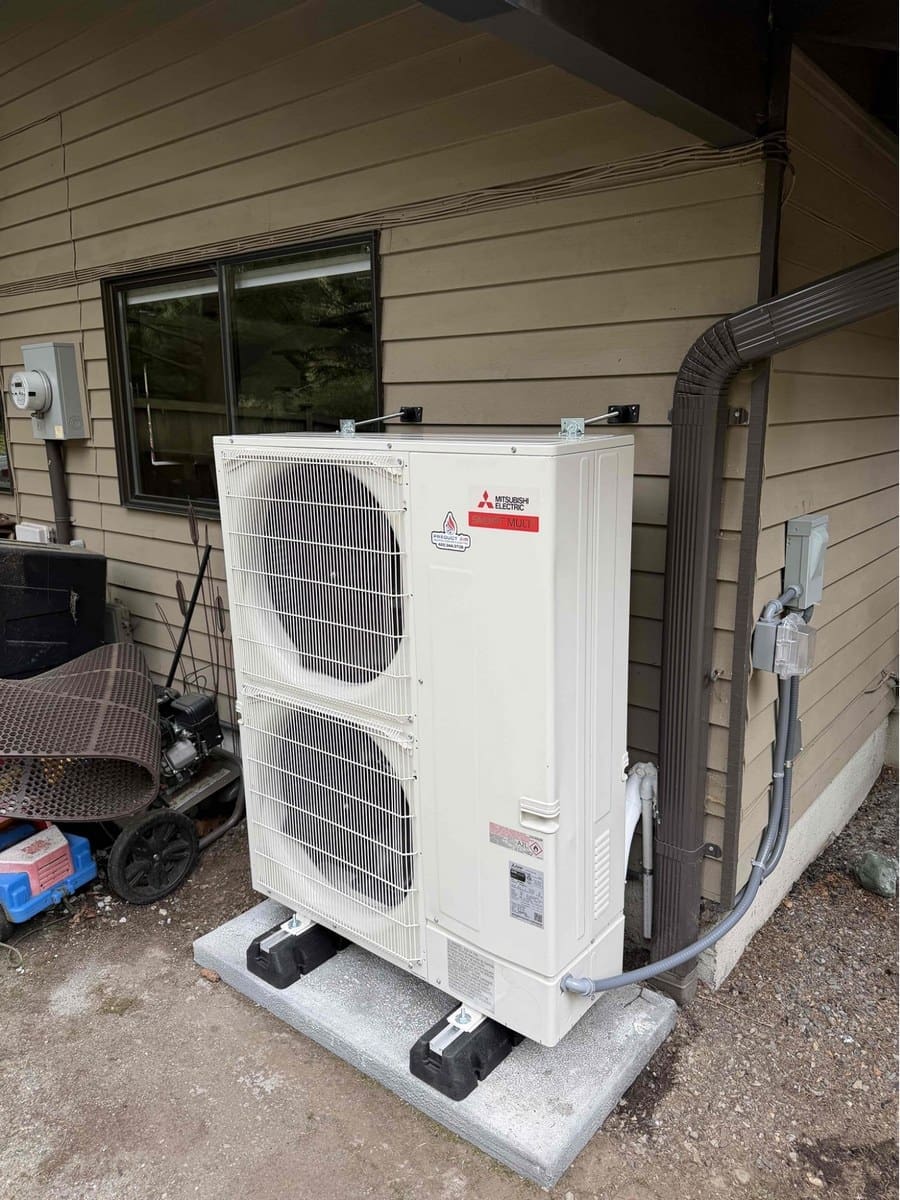
Homeowners ask us this question more than almost any other, and most of the answers floating around online are the same recycled range with nothing behind it. We’d rather show you the actual ages at which our own customers’ systems have failed, been replaced, or kept running fine, including two cases that directly contradict the tidy “15 to 20 years” answer, because a system’s real lifespan depends on more than just the calendar.
How Long Do Heat Pumps Last? The Direct Answer
The average heat pump lifespan in Washington state runs 15 to 20 years with proper maintenance and a correct original installation. That range holds up across our own case history, but it’s not a guarantee, and it’s not the whole story. Two things can shorten it dramatically: installation defects present from day one, and inadequate maintenance that lets small issues compound into premature failures. A system can be mechanically capable of running 20 years and still fail at year five if it was never installed correctly to begin with.
Real Lifespan Data From Product Air’s Own Installations
Here’s the actual age data behind that range, drawn from our own completed projects:
| Homeowner | System Age at Failure/Replacement | Reason | Key Takeaway |
| Anish, Seattle | 17 years | Compressor shorted to ground, out of warranty | Natural end of life, upper half of the expected range |
| Richard, Marysville | 17 years | Complete system failure | Independent confirmation of the same 17-year mark |
| Craig, Issaquah | 20 years | Furnace non-functional, homeowner already aware of its age | Upper boundary of the range, this system outlasted average |
| Michael, Seattle | 16 years | Proactive replacement, system still running | Replaced ahead of failure, not after it |
| Carla, Marysville | ~5 years (installed 2021) | Refrigerant leak from an installation defect, a misplaced TXV sensing bulb | Not an age failure at all, an installation quality failure |
| Meghan, Stanwood | Less than 1 year (home and system built 2024) | Unsecured wall bracket, uninsulated lines, mold risk | The clearest possible proof that age isn’t the only variable |
Four of these six data points (16, 17, 17, and 20 years) line up almost exactly with the 15-to-20-year range we’d tell any homeowner to expect. The other two don’t belong in that range at all, and that’s the point. They’re not exceptions to the rule. They’re evidence that “how long does a heat pump last” and “how long does a correctly installed heat pump last” are two different questions.
When a Heat Pump Fails Much Earlier Than Expected
Can a heat pump fail much earlier than 15 years? Yes, and Carla’s and Meghan’s cases show exactly how.
Carla’s heat pump installation was only about five years old when she discovered a refrigerant leak in her attic air handler. The cause wasn’t age. It was a suction line that had failed, made worse by a TXV sensing bulb that had been mounted in the wrong position from the original install, a detail that put uneven stress on the system’s refrigerant cycle from the day it went in. The equipment itself, once inspected, was fine. The installation underneath it wasn’t.
Meghan’s case is the more extreme version of the same problem. Her home and her Mitsubishi multi-zone system were both built in 2024, less than a year old at the time of her routine maintenance visit. That visit found a wall bracket that had never been properly anchored, refrigerant lines left uninsulated across three of four indoor zones, and a condensate line actively draining inside a wall cavity, creating a real mold risk in a home not yet a year old. None of it was age. All of it was installation quality.
A system installed correctly can run 15 to 20 years without drama. A system installed poorly can develop serious problems in its first year, regardless of how good the underlying equipment is.
Does Seattle’s Wet Climate Affect Heat Pump Lifespan? What Moisture and Mild Winters Actually Do
There are two separate climate effects worth understanding here, and they pull in different directions.
Mild winters mean less mechanical stress on the compressor. Seattle rarely drops into the temperature range where a heat pump has to run intensive defrost cycles or lean on auxiliary heat strips the way systems in the Midwest or Northeast regularly do. Fewer extreme temperature swings over a heating season means fewer demanding cycles on the compressor year over year, a genuine, explainable advantage of this region’s climate, not a marketing claim.
Constant humidity and condensate are a real wear factor, and this is where our own cases provide direct evidence rather than a general assumption. Meghan’s uninsulated refrigerant lines allowed condensation to form and drain directly into a wall cavity, threatening mold and rot in a system less than a year old. A separate case, our Sammamish crawl space moisture project, documented crawl space humidity directly tied to a heat pump’s condensate line, a second, independent confirmation of the same underlying pattern.
Put together: mild winters reduce mechanical wear on the compressor over the years, but the region’s persistent humidity makes correct condensate drainage and line insulation a genuinely critical factor in how long a system lasts as both of these real cases show, well before a system’s natural end of life ever entered the picture. If you’re in our Seattle service area, this is one of the more region-specific things worth asking about at installation time, not just at year fifteen.
How Maintenance Extends (or Installation Quality Shortens) Lifespan
Does installation quality affect how long a heat pump lasts?
Directly, and more than brand or equipment tier does. A premium heat pump installed with an unsecured bracket, uninsulated lines, or a misplaced sensing component doesn’t get to keep its 15-to-20-year expectation just because the equipment itself is rated for it. Meghan’s system was a well-regarded Mitsubishi multi-zone unit, functioning correctly on its own terms, the entire risk in her case came from how it had been mounted and connected, not from anything wrong with the equipment.
How does regular maintenance extend heat pump lifespan?
By catching exactly this kind of defect before it turns into water damage, mold, or an early failure. Meghan didn’t call because anything seemed wrong. She called for routine yearly maintenance, and that visit is the only reason four separate installation defects got caught and corrected before any of them produced visible damage. A system that’s never inspected hands-on can carry hidden issues for years with no symptom a homeowner would notice: maintenance is what turns those into a repair bill in year one instead of a mold remediation project in year three.
Is It Time to Replace My Heat Pump in Seattle? What to Watch For
A few signs your heat pump is nearing end of life are worth watching for directly, separate from any single dramatic failure: the system approaching or passing the 15-to-20-year range, rising repair frequency where the same unit needs attention more than once a year, a warranty that’s already expired, noticeably inconsistent heating or cooling between visits, and utility bills climbing without an obvious cause. None of these alone means replacement is mandatory, but together, especially on a system already past 15 years, they’re the pattern that shows up right before the systems in our own case history (Anish’s at 17, Craig’s at 20) actually failed.
If you’re trying to work out whether repair or replacement makes more financial sense at your system’s current age, our breakdown of what heat pump installation actually costs in Seattle is a useful next step, since it walks through real installed pricing rather than a generic estimate.
Frequently Asked Questions: Heat Pump Lifespan in the Pacific Northwest
How long do heat pumps last in Seattle climate?
Based on our own documented cases, 15 to 20 years is the realistic range for a correctly installed and maintained heat pump in Seattle’s climate. We’ve seen this confirmed directly across multiple projects: systems failing or being replaced at 16, 17, 17, and 20 years old, each independently landing within that same window. Mild winters in this region reduce mechanical stress on the compressor compared to harsher climates, which supports systems reaching the upper end of that range rather than falling short of it.
Why did my heat pump fail after only a few years?
Early failure, well short of the typical 15-to-20-year range, is almost always tied to installation quality rather than the equipment itself. In one of our cases, a heat pump only about five years old developed a refrigerant leak traced back to a misplaced TXV sensing bulb from the original installation, not any defect in the equipment. If a relatively new system is already failing, it’s worth having the original installation reviewed rather than assuming the unit itself is simply bad luck.
Is a 5 year old heat pump failure normal?
No, a heat pump failing at five years old, well short of its expected 15-to-20-year lifespan, typically points to an installation issue rather than normal wear. In one of our documented cases, a five-year-old system’s refrigerant leak was traced directly to how the original installer had positioned a key component, not to the age or quality of the equipment itself. Early failures like this are a strong signal to have the underlying installation inspected, not just the immediate symptom repaired.
How do I know if my heat pump needs replacing?
Key signs include a system approaching or exceeding 15 to 20 years old, a warranty that’s already expired, repair calls becoming more frequent, inconsistent heating or cooling, and rising utility bills without a clear cause. In our own case history, systems replaced at 16, 17, and 20 years old all showed some combination of these signs, while systems well under that age with no such signs, like a healthy 12-year-old furnace in a separate case, were left in place rather than replaced.
What is the most common reason for a heat pump to fail?
Natural end-of-life failure, typically compressor failure, is the most common reason once a system reaches the 15-to-20-year range, as seen in cases where systems failed at 17 and 20 years old. But installation defects are a close second cause of failure, and they can strike at any age, including within the first year, as shown in a case where uninsulated lines and an unsecured bracket created serious risk in a system built the same year as the home itself.
What maintenance does a heat pump need to last 20 years?
Regular maintenance should include inspecting and cleaning the coil and blower wheel, checking refrigerant lines and insulation for gaps or damage, confirming indoor and outdoor units are securely mounted, verifying condensate drainage is functioning correctly, and checking refrigerant charge against manufacturer specifications. In one of our cases, exactly this kind of routine inspection caught an unsecured wall bracket and uninsulated refrigerant lines in a system less than a year old, preventing water damage that would otherwise have gone undetected for years.
How often should a heat pump be serviced in Seattle?
Yearly maintenance is the standard recommendation, and our own case history shows why that cadence matters even for brand-new systems. A homeowner in one of our cases called for nothing more than routine yearly maintenance on a system less than a year old, and that visit uncovered four separate installation defects that could have led to water damage and mold if left unchecked for another year or more. Annual servicing is often the only way hidden installation issues get caught before they become visible problems.
How does installation quality affect heat pump lifespan?
Installation quality can override the manufacturer’s expected lifespan in either direction: a well-installed system reaches or exceeds its full 15-to-20-year range, while a poorly installed one can develop serious problems within its first year, regardless of the equipment’s quality or brand. In two of our documented cases, systems five years old and less than one year old both developed real risks (a refrigerant leak and a mold-risk condensate leak, respectively) traced directly back to how the original equipment had been mounted and connected rather than to the equipment itself.
Key Takeaways for Seattle Homeowners
- The realistic average heat pump lifespan in Washington state is 15 to 20 years, confirmed directly across our own cases at 16, 17, 17, and 20 years old.
- Seattle’s mild winters reduce mechanical stress on a heat pump’s compressor compared to harsher climates, supporting systems reaching the upper end of that expected range.
- The region’s persistent humidity makes correct refrigerant line insulation and condensate drainage a genuine, documented factor in system longevity.
- A heat pump can fail far earlier than 15 years, and when it does, installation quality is the most likely cause, not the equipment itself.
- Even a brand-new system, installed the same year as the home it serves, can carry serious hidden defects that only a hands-on inspection will catch.
- Yearly maintenance is the most reliable way to catch installation defects and early wear before they turn into water damage, mold, or an unplanned early replacement.
A heat pump’s expected lifespan isn’t really about the equipment on the spec sheet. It’s about whether that equipment was put in correctly, checked regularly, and given the kind of attention that catches a loose bracket or an uninsulated line before it becomes a bigger problem than the age of the system ever would have been on its own.
— Serge Nikolin, Co-Founder, Product Air Heating, Cooling and Electric
Marysville · Issaquah · Seattle · Western Washington
PLAN YOUR NEXT STEP
Need help with your home comfort?
Explore Product Air’s heat pumps services or contact the team.
Share this guide