

Location: Brighton Place corridor, Mukilteo, WA 98275
Call Date: February 9, 2026
First Visit: June 11, 2026
Project Completion: June 12, 2026
Lead Technician: Joey, 5 years in the trade, heating and cooling service technician
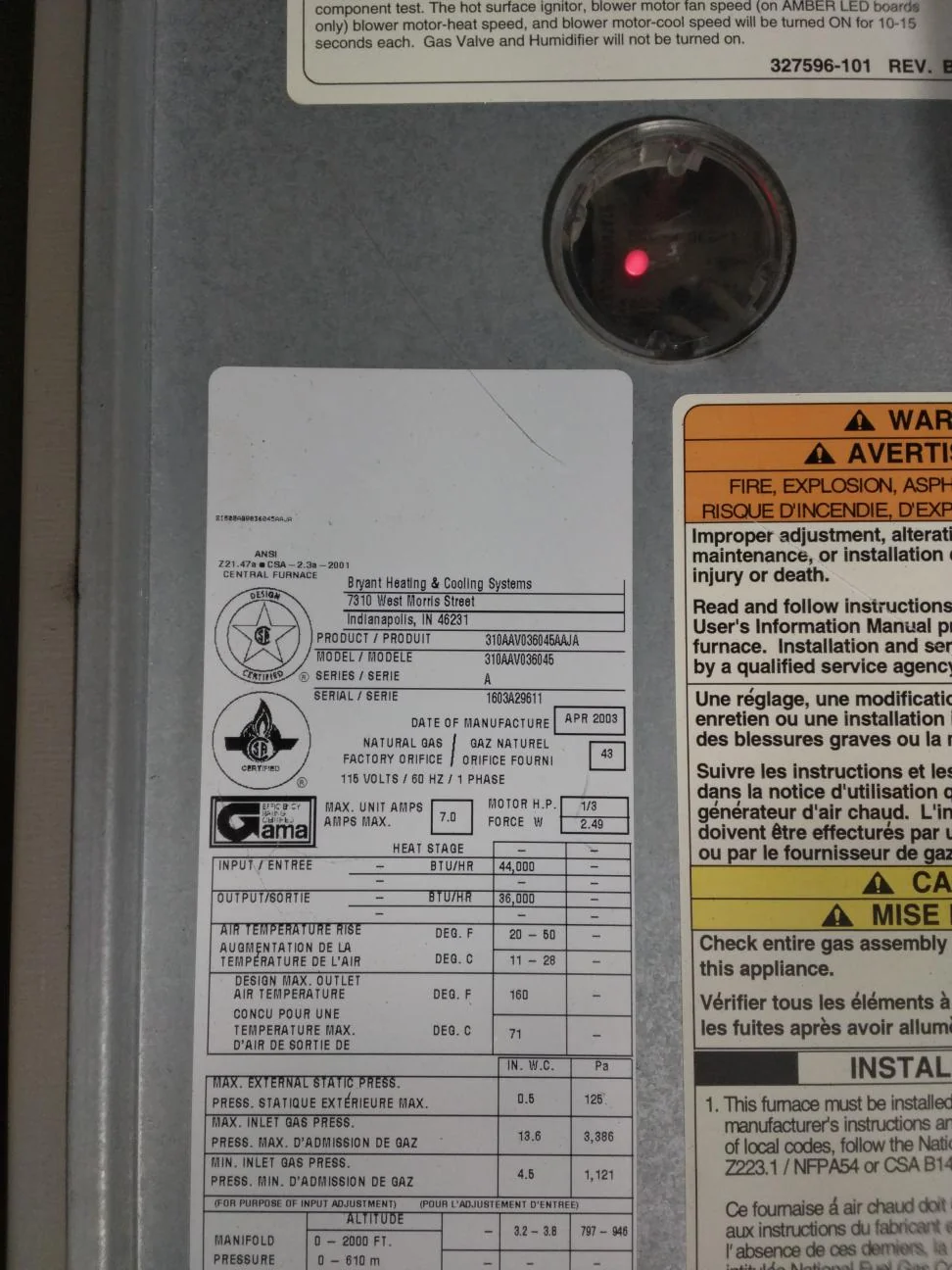
System Before: Bryant gas furnace manufactured in 2003 paired with a Bryant central air conditioner of the same era, running fine until the furnace control board failed when the system was cycled back on at the end of the maintenance visit
System After: Same furnace and air conditioner, with a new furnace control board installed at no charge and the cooling and shared-system maintenance checklist completed
Final Project Cost: $221.19 (paid in full, out of pocket)
Irene's house on the Brighton Place corridor in Mukilteo was built in 2003, and the gas furnace in it was manufactured that same April, with the central air conditioner from the same era. She booked a routine cooling tune-up ahead of summer. The technician ran the full maintenance checklist, and it was when he went to cycle the system back on at the end of the visit that the furnace control board failed.
Nothing about that failure was caused by the maintenance. A control board that has been powering a blower motor for more than 20 years can give out on the next power cycle whether that cycle happens during a service visit or on the first hot afternoon in July. The difference here is that it happened with a technician standing in front of it, and Product Air replaced the board at no charge rather than leave Irene with a cooling system that would not turn on.
Why Irene Booked an AC Tune-Up for a 2003 System
Irene is a new Product Air customer. The visit came out of a maintenance reminder, and her reason for scheduling it was straightforward. "We know our system is getting older and we'd like to make sure it gets through the summer," she told the company. That is the whole job in one sentence: not a breakdown, not a complaint about performance, just a homeowner with equipment past the 20-year mark who wanted it checked before the season it would be leaned on.
The call was logged in February and the AC maintenance visit was scheduled for June, which is the normal rhythm for cooling maintenance in Western Washington. Air conditioning here sits idle for most of the year and gets a short, hard run in July and August, so the useful time to service it is late spring, close enough to the heat that a problem found on the bench is a problem solved before it matters.
What the AC Maintenance Visit in Mukilteo Actually Found
Joey, a heating and cooling service technician with five years in the trade, was on site. The maintenance itself was a standard cooling and shared-system checklist: inspect the outdoor condenser coil, fan blades and cabinet, check refrigerant pressures against the equipment's specifications, look over the indoor coil, test the thermostat in both modes, measure fan amp draw, inspect the electrical components including contactors, capacitors and relays, and run the system in a cooling cycle to confirm it operates safely and records a proper temperature split across the coil.
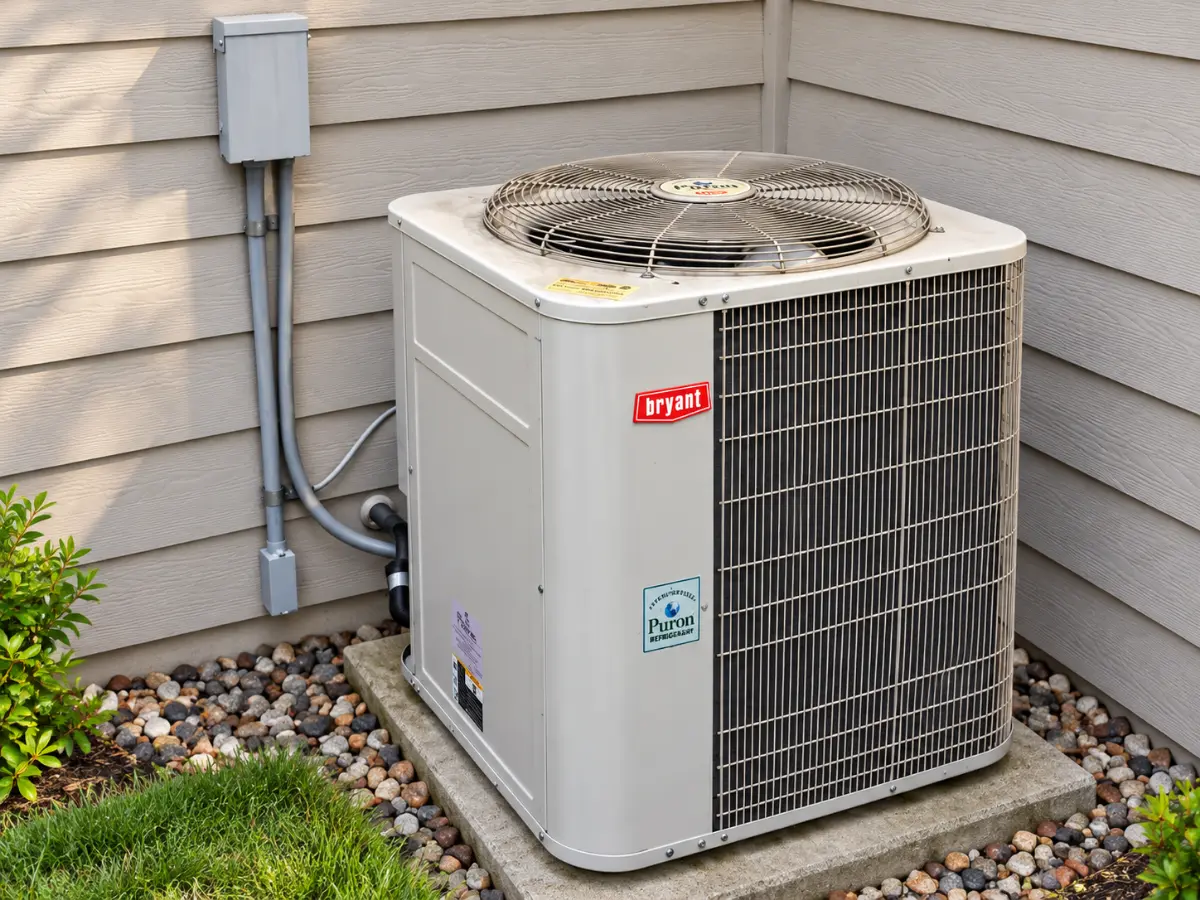
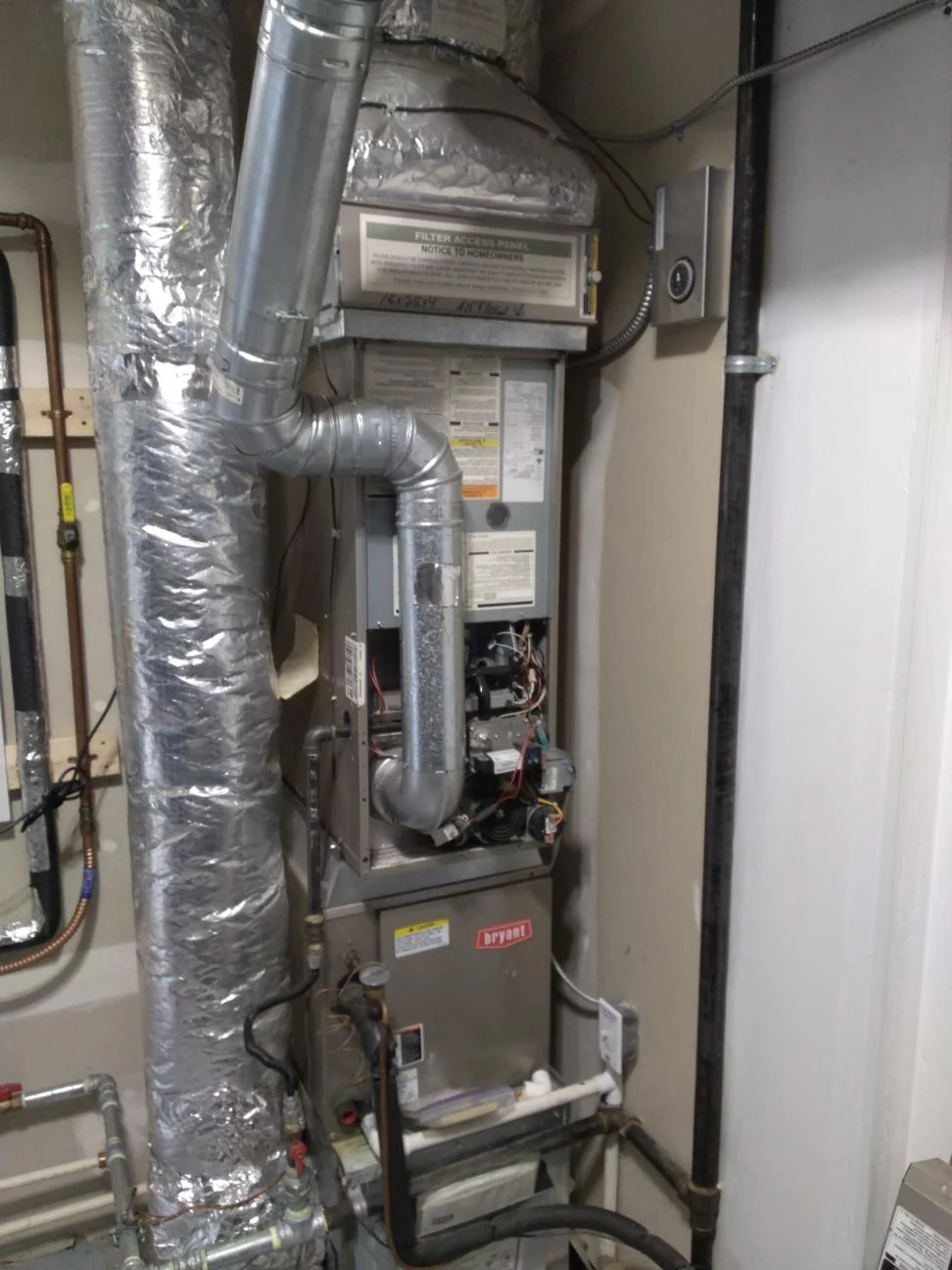
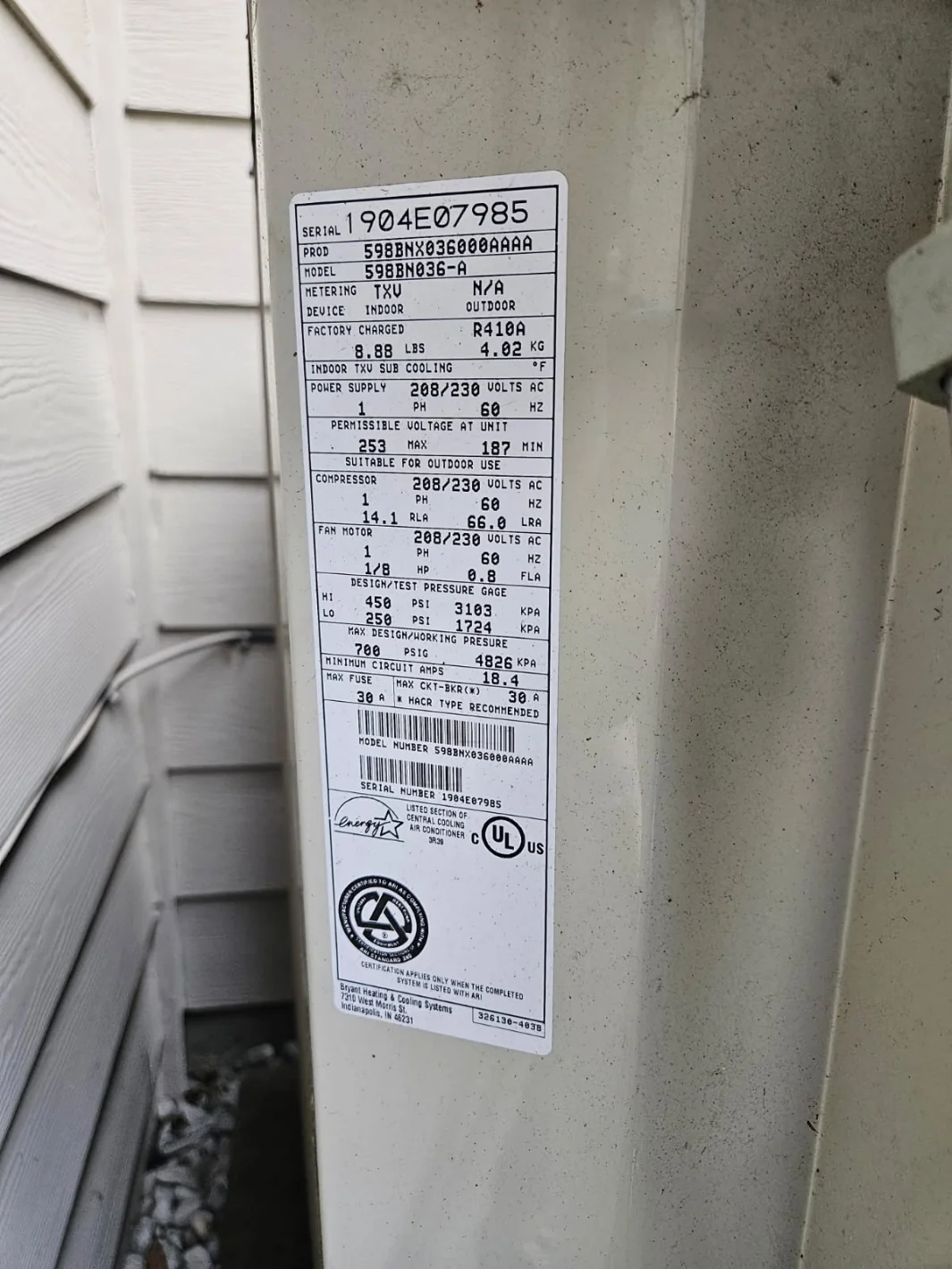
The equipment is a matched Bryant pair. Outdoors is a single-stage air conditioner, model 598BN036-A, charged with R-410A refrigerant and metered by a thermostatic expansion valve. Indoors is a Bryant gas furnace, model 310AAV036045AJA, manufactured in April 2003, rated at 44,000 BTU per hour input and 36,000 BTU per hour output. On a cooling system built this way, the furnace is not just the heater. Its control board runs the indoor blower on a call for cooling, so the air conditioner cannot move any air through the house without it.
That is the board that failed. It did not fail while the system was running, and it did not fail because of anything the checklist involved. It failed on the power cycle at the end of the visit, when the system was switched back on. On a single-stage condenser of this vintage there is no circuit board in the outdoor unit at all, just a contactor and a run capacitor, so the furnace control board is the only board in the system and the only place this kind of failure can originate.
If a Part Fails During a Maintenance Visit, Who Pays to Replace It?
There is no single rule, and it is worth understanding why. A maintenance visit does not put stress on a component that normal operation does not. Turning a system off and back on, checking a capacitor, reading pressures: none of that is harder on a part than the daily cycling it already does. When something fails during a tune-up, the tune-up is almost never the cause. It is usually a part that was already at the end of its life and would have failed on the next cycle regardless.
Because the part was going to fail anyway, the honest position is that the homeowner owns a worn-out component and a contractor found it at a convenient moment. Whether the replacement is billed comes down to the age of the part, whether any warranty still covers it, and the contractor's read on the situation. On this job the board was well out of any manufacturer warranty, more than 20 years old, and the customer did not think the failure was down to the age of the equipment. Product Air replaced it at no charge to keep the relationship on good terms. The maintenance invoice was not adjusted upward, and no separate furnace repair charge was added
What a homeowner should take from this is not that every part failure during service is free. It is that a part failing on the bench is a conversation, not an automatic bill, and the reasoning behind the number should be explained rather than just presented.
Does an Aging AC That Needs One Repair Mean It's Time to Replace the Whole System?
Not on its own. A system that is 20 years old and needs one part is still a system that needs one part. Age raises the odds that the next failure is close behind, and it changes the math on how much to invest in a unit that owes you nothing, but a single fixable fault is not the same as a system that has reached the end of the road. The case for replacement gets stronger when the equipment is out of warranty, when repairs start stacking up in the same season, or when the fix on offer is expensive enough that it only buys uncertain time. One control board, replaced at no cost, is none of those things.
This job is a clean example of the decision being left with the homeowner. Product Air had eight estimates on file for Irene's system, covering the full range from a small parts refresh to a complete new system. She took none of them. The board was replaced, the maintenance was completed, and the 2003 furnace and air conditioner stayed in service. Our own repair versus replacement case studies run the same way: the answer comes from what the diagnostic finds and what the homeowner wants, not from the age on the data plate.
The Options on the Table, From a $238 Capacitor Set to a $23,761.71 System
The estimates written up for this job show the whole spread of what could be done with a system this age:
- A run capacitor replacement set, covering both the larger and smaller capacitors, at $238.
- A contactor replacement bundled with a full refrigerant leak search, a vacuum test, electronic leak detection and an R-410A recharge, at $3,843.
- Six full system replacement configurations, from $15,692.78 to $23,761.71, spanning gas furnace and air conditioner packages and several heat pump options across different equipment tiers.
None of these were sold. They were laid out as options, not as conditions of the maintenance visit, and the customer chose to keep her system as it was. Her reasoning, as relayed by the technician, was that she did not see the board failure as a sign the equipment had aged out. The visit stayed a maintenance visit, plus the board.
This is the part worth being clear about: a maintenance appointment is a diagnostic, and a diagnostic on old equipment is going to surface options. Seeing a replacement estimate on the paperwork after a tune-up does not mean the tune-up was a setup for a sale. It means the technician documented what the system might need so the homeowner has the numbers when she wants them.
What Product Air Did During the Visit
The work went in this order: run the cooling and shared-system maintenance checklist on the Bryant furnace and air conditioner, cycle the system off and back on, identify the control board failure on that power cycle, and install a replacement furnace control board so the system would run again. With the new board in, the blower and the cooling cycle were confirmed working before the technician left.
Component |
Detail |
|---|---|
Outdoor Unit |
Bryant single-stage air conditioner, R-410A, thermostatic expansion valve metering |
Outdoor Model Number |
598BN036-A |
Indoor Unit |
Bryant gas furnace, 44,000 BTU/hr input, 36,000 BTU/hr output, manufactured April 2003 |
Indoor Model Number |
310AAV036045AJA |
Part Replaced |
Furnace control board, installed at no charge |
Warranty on the Replacement Board |
No separate warranty line was recorded for the no-charge board on this job |
Warranty
No separate warranty line was recorded for the no-charge control board on this job. The board was replaced outside any manufacturer coverage window, more than 20 years after the original equipment was made, and Product Air absorbed the part and labor rather than billing it.
One Visit, One Technician, on the Brighton Place Corridor
The job was worked in a single visit on June 11, 2026, on the Brighton Place corridor, by one technician, and closed out in the system the following day. There was nothing non-standard about it: no second trip, no parts ordered and scheduled for later, no coordination with a utility or an inspector. The technician's own read on the job was that it was routine, and the record backs that up. The only thing that made it a story at all is that a worn part chose the moment of the service call to give out, and the response was to replace it on the spot without adding it to the bill.
The Real Number: $221.19, With the Board Replaced at No Charge
The appointment was quoted at $199 when it was booked. The final invoice came to $221.19, paid in full at the time of the visit. That figure is the maintenance visit and nothing else. The replacement furnace control board was not billed, so the number Irene paid is the same number she would have paid if the board had held.
No rebate applies to a job like this. Utility rebate programs in this area, including those run through the local power utility and Puget Sound Energy, are built around installing new high-efficiency equipment, mainly heat pumps and other qualifying systems. A maintenance visit and a control board replacement on a 2003 system do not qualify for any of them, and none was claimed.
What It Means for Irene's System Going Forward
Irene wanted her system checked so it would get through the summer, and it will. The cooling and shared-system checklist is done, the pressures and electrical components were inspected, and the one part that failed has been replaced with a new one. The blower and the cooling cycle were confirmed working before the visit ended.
What she should expect going forward is that a 2003 furnace and air conditioner will keep asking for parts. A capacitor, a contactor, a blower motor: these are the components that wear out next on equipment this age, and the estimates already on file give her the numbers for the larger decisions whenever she wants to make them. For a system being asked to last a few more seasons, staying on one of our maintenance plans, which range from an annual checkup up to a tier with discounted or free repairs, is what keeps the small failures small.
According to the technician, Irene appreciated that Product Air came forward about the failure it found and took care of it, since she had not expected a board to fail on the basis of the equipment's age.
Where This Job Fits: Our Marysville Team
This job was handled by our Marysville team, our technicians out of our main office in Marysville. That location covers Snohomish County, including Mukilteo, Edmonds, and Everett.
FAQ
Who pays if a part breaks during an AC maintenance visit?
It depends on the part, its age, and whether any warranty still covers it. A maintenance visit does not stress a component harder than normal daily operation, so a part that fails during service was almost always already at the end of its life. That makes it a conversation about a worn component rather than an automatic charge. In this Mukilteo case, a furnace control board more than 20 years old failed on a power cycle during the tune-up, and Product Air replaced it at no charge. The maintenance invoice stayed at $221.19.
Is it worth doing AC maintenance on a 20-year-old system?
Yes, if the goal is to get more reliable seasons out of it. Maintenance on older equipment catches worn capacitors, weak contactors and refrigerant issues before they turn into a no-cooling call in a heat wave. It also produces an honest picture of what the system needs next. For this 2003 Bryant furnace and air conditioner in Mukilteo, the visit both completed the checklist and surfaced a control board failure that was fixed the same day, so the system went into summer in known condition.
What is a furnace control board and why does the air conditioner need it?
The furnace control board is the circuit board that sequences the furnace and, on a call for cooling, runs the indoor blower. In a system with a gas furnace and an add-on air conditioner, the outdoor unit cools the refrigerant but the furnace blower is what pushes conditioned air through the ducts. If the control board fails, the air conditioner has no way to move air, so the house gets no cooling even though nothing in the outdoor unit is wrong. That is exactly what happened on this job.
Does a failed control board mean the furnace or AC is done?
Not by itself. A control board is a replaceable part, and swapping it restores the system. Age matters for judging how much to invest in a unit overall, but one board failing is a single fixable fault, not a verdict on the whole system. In this Mukilteo case the homeowner was offered options ranging from a $238 capacitor set up to full replacements between $15,692.78 and $23,761.71, and chose to replace only the board and keep the system running.
Are there rebates for AC maintenance or a control board replacement in Mukilteo, WA?
No. Utility rebate programs serving the Mukilteo area, including those through the local power utility and Puget Sound Energy, are aimed at installing new qualifying high-efficiency equipment such as heat pumps. Routine maintenance and a repair part like a control board on an existing older system are not eligible. No rebate was applied to this job, and the invoice reflects only the maintenance visit.
How much does an AC maintenance visit cost?
On this job the visit was quoted at $199 and the final invoice was $221.19, paid in full. That covered the full cooling and shared-system checklist on a gas furnace and air conditioner: outdoor coil and fan inspection, refrigerant pressure checks, indoor coil inspection, thermostat testing in both modes, fan amp draw, an electrical component check, and a cooling cycle with a temperature split reading across the coil. The failed control board found during the visit was replaced at no additional charge.
Key Takeaways
- A central air conditioner paired with a gas furnace depends on the furnace control board to run the indoor blower in cooling mode. If that board fails, the AC stops even when the outdoor unit is fine.
- A part failing during a maintenance visit is not automatically the homeowner's bill. On this job Product Air replaced a control board more than 20 years old at no charge, and the invoice stayed at the maintenance price of $221.19.
- Age alone is not a verdict. This 2003 system was quoted everything from a $238 capacitor set to a $23,761.71 full replacement, and the homeowner chose to keep it running.
- A maintenance visit is a diagnostic, not a sales appointment. The eight estimates written up for this job were options, not conditions of the tune-up.
Irene asked for her aging system to be checked before summer, and that is what she got, along with a new control board she did not pay for after the old one failed on the bench. The 2003 Bryant furnace and air conditioner are back in service, and the numbers for the bigger decisions are on file for whenever she wants them.
— Serg Nikolin, Co-Founder, Product Air Heating, Cooling and Electric
Marysville · Issaquah · Seattle · Western Washington
See our reviews at our Marysville Google Business Profile.
PLAN YOUR NEXT STEP
Need help with your home comfort?
Explore Product Air’s air conditioning services or contact the team.
Share this guide