


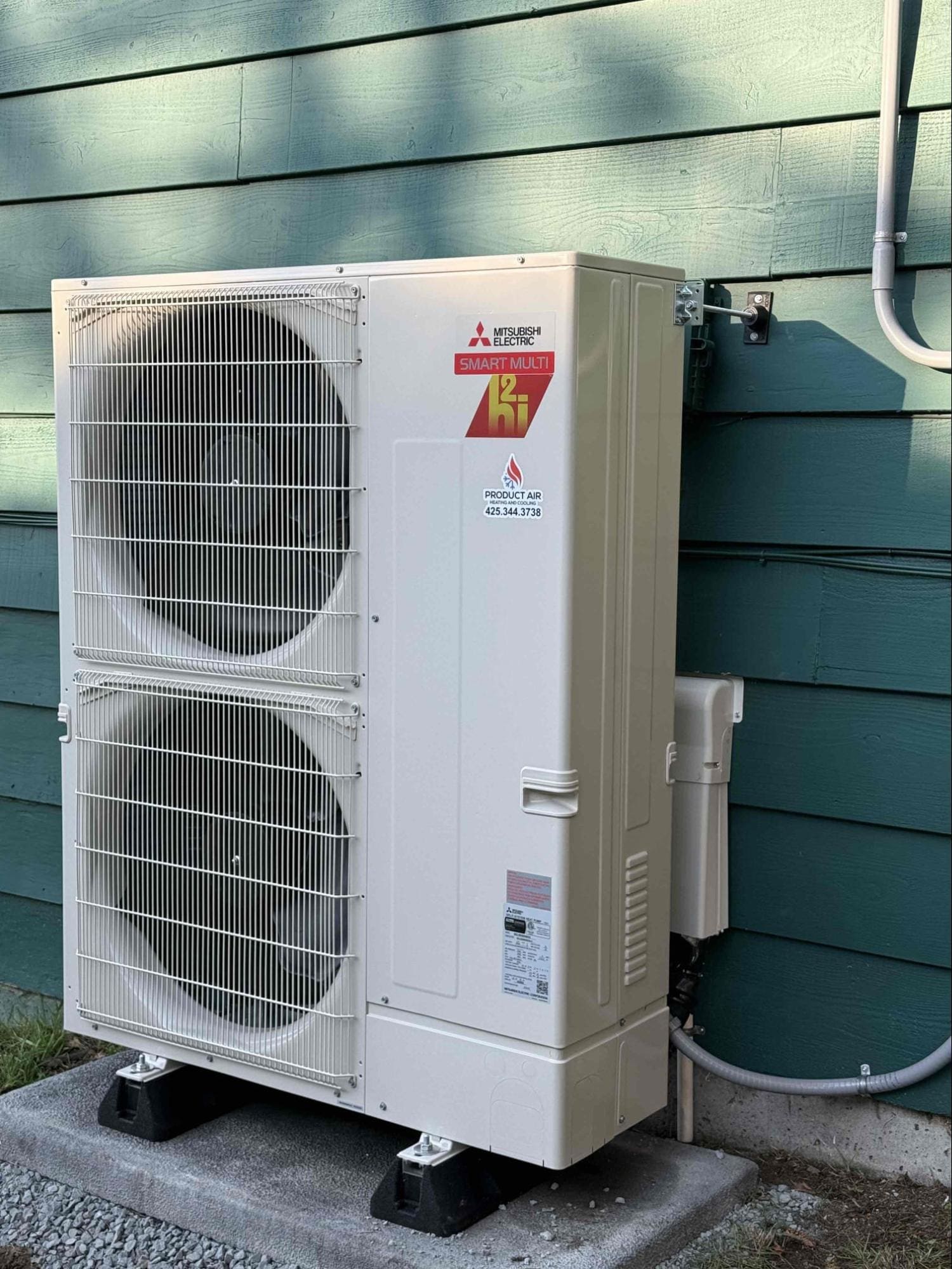
Most HVAC content answers “repair or replace” with the same instinct: replace it, always, eventually, because that’s usually where the bigger invoice lives. We’d rather show you what actually happened across six real decisions we made with real homeowners, decisions where the honest answer was repair in some cases, replacement in others, and in one case, doing nothing to the equipment at all. This isn’t a theoretical framework. It’s six actual outcomes, with the real diagnostics and the real prices attached.
Repair or Replace? The Real Decision Framework
The direct answer: repair makes sense when a diagnostic finds a specific, fixable cause and the equipment underneath it is still fundamentally sound, and replacement makes sense when a system is out of warranty, old enough that repair only buys uncertain time, or when the actual fix on offer isn’t a fix you can trust. Here’s how that played out across six real projects:
| Homeowner | Situation | Decision | Why | Price |
| Carla, Marysville | First contractor said the coil needed replacing, cut an “extreme” price with no clear explanation | Repair | Real cause was a leaking suction line and misplaced TXV bulb, the coil was fine | $4,364 |
| Jerry, Lake Stevens | 12-year-old York furnace, expected he’d need to replace it | Nothing, furnace confirmed healthy | Diagnostic found no fault at all; furnace kept as backup heat | $0 on the furnace |
| Anish, Seattle | AC compressor shorted to ground, 17 years old, out of warranty | Replace | Repair was technically possible but carried no warranty protection | $13,063.22 after rebate |
| Flynn, Ballard | Ductless AC non-operational, prior contractor offered repair only, no warranty, no replacement mentioned | Replace | A repair with zero warranty coverage wasn’t a good trade | $7,608.62 |
| Craig, Issaquah | 20-year-old furnace, not working | Replace | Age had already passed typical service life; repair wasn’t seriously considered | $14,473.35 after rebate |
| Michael, Seattle | System 16 years old (he thought 10), not broken | Proactive replace | Age plus wanting a system he “didn’t have to think about” with a new baby in the house | $22,888.07 after rebate |
Read across that table and the pattern is clear: repair won when a diagnostic uncovered a cheaper real cause or found nothing wrong at all. Replacement won when the system was out of warranty, old enough that repair only delayed the inevitable, or when the repair being offered didn’t actually protect the homeowner going forward.
When Repair Is the Right Call: A Second Opinion That Saved an Unnecessary Replacement
Carla’s case is the one we lead with, because it directly contradicts the assumption that HVAC contractors always push toward the bigger job. She was one week into owning her Marysville home when she found a refrigerant leak at the air handler. The original service company told her the coil needed replacing, quoted an extreme price, then cut that price significantly with no new finding to explain the change. Her words when she called us: “I don’t feel like they know what they’re doing or are trying to scam me.”
We sent Devon out for a proper heat pump repair diagnostic, and what he found had nothing to do with the coil at all. The actual leak was in the suction line outside the air handler, made worse by a TXV sensing bulb that had been mounted in the wrong position from the original installation, plus a completely separate issue, a cracked drain pan. The coil itself was in good condition and never needed to be touched.
The repair (a full leak search, lineset repair, new filter drier, system evacuation and recharge, and drain pan replacement) came to $4,364. Carla didn’t just save money. She got an accurate answer to a question the first contractor never actually answered: what was actually wrong with her system. Heat pump compressor and coil repair cost in Seattle can genuinely come in well below a replacement quote when the diagnostic is done right, and Carla’s case is the clearest proof we have of that.
When Nothing Needs to Be Done at All
The rarest, and maybe most honest, outcome on this list belongs to Jerry, in Lake Stevens. He called about air conditioning, not about his furnace, but his York furnace was 12 years old, and like a lot of homeowners in that position, he half-expected that a conversation about his HVAC system would eventually turn into a conversation about replacing it.
It didn’t. Eli’s diagnostic on the furnace found nothing. No cracks, no soot, no red flags on any of the components that actually tell you something about a furnace’s condition. “A very healthy furnace, just a little older,” is how the visit got documented, and replacement wasn’t on the table because there was nothing to replace it for. The furnace stayed exactly as it was, and the only equipment that changed hands was a new heat pump added alongside it with the furnace demoted to backup heat, which actually extends its working life rather than shortening it.
This is worth naming directly because it’s the outcome that never makes it into most HVAC marketing: sometimes the honest diagnostic conclusion is that nothing is wrong, and the right move is to leave well enough alone.
When Replacement Makes More Sense Than Repair
Three cases on our list landed on replacement, and each one got there for a different, specific reason, not a generic “it’s old, replace it” instinct.
Anish’s AC compressor had shorted to ground, an internal electrical failure that was tripping his breaker every time the system tried to start. Repair was technically possible. But the system was 17 years old and its warranty had already run out, which meant a repair bought him a working system with zero protection if anything else failed next. He chose a full replacement, upgrading from AC-only to a heat pump and bundling in a water heater replacement in the same visit, for $13,063.22 after rebates.
Flynn’s situation was different, and arguably more clear-cut. His ductless Fujitsu unit had stopped working entirely, and the first contractor he called told him it needed a repair, with no warranty on that repair, and never mentioned replacement as a possibility at all. Flynn’s read on that conversation was simple: there had to be a better way to go about this. He was right. A repair with no warranty on a system that had already failed once wasn’t a trade worth making, and he replaced it with a new Mitsubishi heat pump for $7,608.62.
Craig’s furnace was 20 years old and had simply stopped functioning. He already knew, before he ever called us, that its age put it well past the point where repair made sense. The conversation wasn’t about whether to repair or replace. It was about what to replace it with, and he ended up with a full heat pump system for his 4,934-square-foot home at $14,473.35 after a stacked rebate package.
What Heat Pump Repair Actually Costs in Seattle
Repair costs vary enormously depending on what’s actually failing, which is exactly why a real diagnostic matters more than a quick guess. Carla’s documented repair, a full leak search, suction line repair, new filter drier, system evacuation and recharge, and a separate drain pan replacement, came to $4,364. That’s a useful anchor point for what a legitimate, multi-issue repair looks like when the underlying equipment (the coil, the compressor, the core components) is confirmed to be in good shape.
Repair costs generally track with the complexity of the diagnostic work involved, not just the cost of parts. A leak search that has to trace refrigerant through a full circuit to find the actual failure point takes real time and expertise, time that shows up on the invoice, but that also protects you from paying to replace a component that was never actually the problem.
What Heat Pump Replacement Actually Costs in Seattle
Replacement costs range widely depending on system size, home size, and scope and our own case history shows exactly how wide that range runs:
| Homeowner | Scope | Final Cost After Rebates |
| Flynn, Ballard | Single-zone ductless heat pump replacement | $7,608.62 |
| Anish, Seattle | AC-to-heat-pump upgrade, bundled with water heater | $13,063.22 |
| Craig, Issaquah | Full 5-ton heat pump system, 4,934 sq ft home | $14,473.35 |
| Michael, Seattle | Full ducted Mitsubishi Hyper Heat system | $22,888.07 |
Heat pump repair cost versus replacement cost in Seattle isn’t a simple ratio: a small single-zone replacement can actually land close to a larger repair job, while a full ducted system replacement for a large home runs several times higher than either. The right comparison isn’t repair-price-in-general versus replacement-price-in-general. It’s the specific repair quote in front of you versus the specific replacement quote for equipment sized to your actual home.
Questions to Ask Before Agreeing to a Repair or Replacement
Carla’s case is the clearest example we have of what signs a heat pump diagnosis was wrong actually look like, and it’s worth turning that into a practical checklist for anyone facing a repair-or-replace decision right now.
Ask exactly what component failed, and how the technician confirmed it, a real diagnostic on a refrigerant system involves an actual leak search, not a guess based on symptoms alone. Ask why the price changed if it changed, and expect a technical reason, not just a lower number with no new finding behind it. Ask whether the other core components (compressor, coil, blower) were actually inspected, or whether the diagnosis jumped straight to a single expensive conclusion. Ask what happens if the recommended repair doesn’t resolve the actual complaint, and whether that risk was accounted for in the diagnostic. And if a contractor recommends replacement without recommending repair at all, ask directly why repair wasn’t presented as an option. Flynn’s case shows exactly what happens when that question goes unasked.
A second opinion costs the time of another visit. In Carla’s case, it saved her from paying for a coil replacement that was never actually necessary. That’s what a real heat pump second opinion diagnostic is supposed to do: confirm or overturn the first answer with actual evidence, not just a second guess.
Frequently Asked Questions: Heat Pump Repair vs Replacement in Seattle
How do I know if I should repair or replace my heat pump?
The decision generally comes down to three factors: whether the system is still under warranty, how old it is relative to its typical service life, and whether a proper diagnostic has actually confirmed the cause of the problem. Across six of our own documented cases, repair won when a diagnostic found a cheaper, fixable cause or confirmed the equipment was healthy, while replacement won when systems were out of warranty, 15 or more years old, or when the repair on offer carried no warranty protection at all.
Can a wrong diagnosis lead to an unnecessary heat pump replacement?
Yes, and it’s more common than most homeowners assume. In a Marysville case, a homeowner was told her coil needed replacing at an extreme, unexplained price, but a second opinion found the actual problem was a leaking suction line and a misplaced TXV sensing bulb. The coil itself was never damaged. Getting a diagnosis wrong doesn’t just cost more money; it leaves the real problem unresolved even after paying for the wrong fix.
Is a 15+ year old heat pump worth repairing?
It depends on warranty status and what the actual repair would cost relative to replacement, but age alone is a meaningful factor. In our case history, a 20-year-old furnace and a 17-year-old AC compressor both led to replacement rather than repair. One because it had already failed completely and age made repair impractical, the other because the system was out of warranty and a repair would have carried zero protection against the next failure.
What does heat pump repair typically cost vs replacement in Seattle?
In our documented cases, a comprehensive repair, including a full leak search, component repair, and drain pan replacement, cost $4,364, while full replacements ranged from $7,608.62 for a single-zone ductless system up to $22,888.07 for a full ducted system in a larger home. The right comparison isn’t a general repair-versus-replacement average, but the specific repair estimate in front of you versus a replacement quote sized to your actual system and home.
Is it ever right to do nothing and not repair or replace?
Yes, and it’s an outcome worth taking seriously when a diagnostic supports it. In a Lake Stevens case, a homeowner expected he’d eventually need to replace his 12-year-old furnace, but a thorough inspection found it in excellent condition with no faults at all, and the furnace was left completely untouched, a new heat pump was added alongside it instead, extending the furnace’s working life rather than replacing it prematurely.
How old does a heat pump need to be before replacing instead of repairing?
There’s no single age cutoff, but combined with warranty status and the specific cost of repair, systems in the 15-to-20-year range are commonly where replacement starts making more sense than repair. In our case history, both a 20-year-old furnace and a 17-year-old out-of-warranty AC compressor were replaced rather than repaired, while a 12-year-old furnace with no confirmed faults was left in place entirely: age matters, but it’s only one part of the decision.
When does heat pump repair make more sense than replacement?
Repair makes the most sense when a proper diagnostic identifies a specific, fixable cause and confirms the system’s core components (compressor, coil, blower) are still in good condition. In a Marysville case, a full leak search and repair addressed the actual problem for $4,364, well below the cost of an unnecessary coil replacement a different contractor had originally recommended, because the underlying equipment simply wasn’t the issue.
Is my heat pump too old to fix?
Age alone doesn’t automatically make a system unfixable, but it does change the math on whether fixing it is worth it, especially once a system is out of manufacturer warranty. A system 15 to 20 years old that’s already lost warranty coverage means any repair only buys time with no protection if the next component fails, which is often the deciding factor toward replacement rather than the repair cost itself. A proper diagnostic is the only way to know whether your specific system, at its specific age, is genuinely worth repairing.
Key Takeaways for Seattle Homeowners
- Repair is the right call when a diagnostic finds a specific, fixable cause and the system’s core components are confirmed healthy, not every refrigerant leak or breaker trip means the equipment is done.
- Replacement makes more sense when a system is out of warranty, old enough that repair only buys uncertain time, or when the repair on offer carries no protection going forward.
- A wrong diagnosis can lead directly to an unnecessary and expensive replacement: a real leak search and component-level inspection is the only way to confirm the actual cause before agreeing to major work.
- Sometimes the right answer is neither repair nor replacement: a system found to be genuinely healthy should be left alone, even if its age made you expect otherwise.
- Documented repair costs in our case history run around $4,364 for a comprehensive multi-issue fix, while replacements have ranged from $7,608.62 for a single-zone system to $22,888.07 for a full ducted system in a larger home.
- A second opinion is worth the time it costs, especially when a repair recommendation changes price without a new technical finding to explain it. That’s the exact pattern that led one homeowner to a second opinion that saved her from an unnecessary coil replacement.
We don’t have a house style that says “always replace” or “always repair,” because neither one is true. What we do have is a habit of finding the actual cause before recommending anything, and being honest when the answer turns out to be smaller, or cheaper, or simpler than either of us expected walking in.
— Serge Nikolin, Co-Founder, Product Air Heating, Cooling and Electric
Marysville · Issaquah · Seattle · Western Washington
PLAN YOUR NEXT STEP
Need help with your home comfort?
Explore Product Air’s heat pumps services or contact the team.
Share this guide