


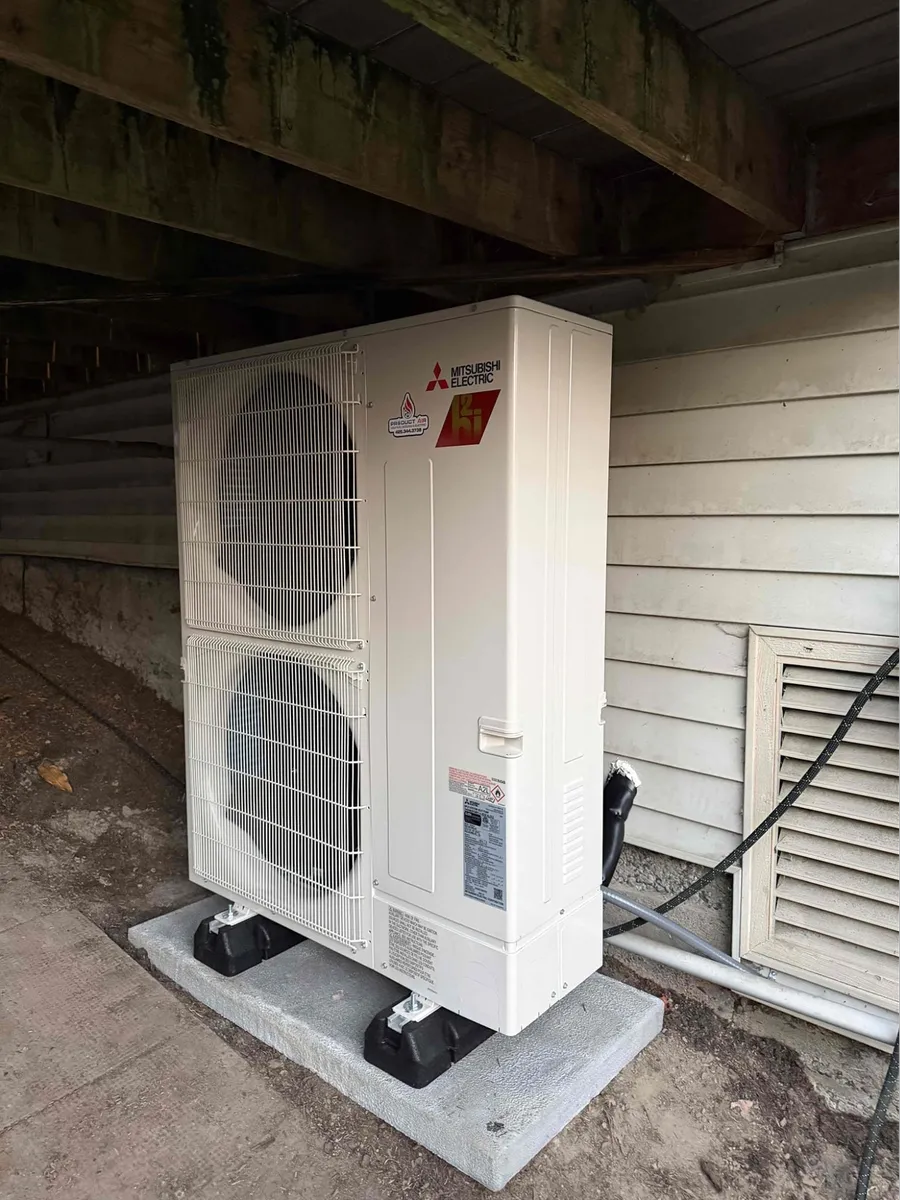
Location: S Massachusetts St corridor, Beacon Hill, Seattle, WA 98108
Call Date: May 28, 2026
First Visit: June 8, 2026
Work Start: June 18, 2026
Project Completion: June 19, 2026
Lead Technician: Eli Nikolin, Mitsubishi trained, Seattle refrigeration card, EPA refrigerant card
System Before: Aged furnace-only system with no air conditioning, believed by the homeowner to be 10 years old, confirmed by the equipment nameplate to be 16 years old
System After: Mitsubishi 3-Ton Hyper Heat ducted heat pump system, outdoor unit model SUZAK36NLHZ paired with air handler model SVZAP36NL
Final Project Cost: $22,888.07 (after Seattle City Light rebate)
Michael had lived in his home on S Massachusetts St in Beacon Hill for two years before he called anyone about the HVAC system. Two years is long enough to notice a pattern, and the pattern he’d noticed was that summers seemed to be getting warmer every one of them, in a house that had never had air conditioning to begin with. What actually moved him to pick up the phone wasn’t the heat, though. It was a new baby in the house, and the particular kind of clarity that comes with wanting one less thing in your home you have to wonder about. “Looking for durability” was how he put it, just a father who wanted a system reliable enough that it wouldn’t be a variable in his family’s comfort.
How a New Parent in Seattle Found Product Air Through ChatGPT While Searching for a Reliable Heat Pump
Michael found Product Air through ChatGPT. He asked an AI assistant a question about a reliable heat pump for his home, and the answer that came back pointed him to Product Air. That’s worth sitting with for a moment, because it’s a genuinely new kind of trust signal. A homeowner asking an AI for a recommendation and getting a specific, real contractor’s name back means that contractor’s reputation has become credible enough that the model surfaces it as a real answer rather than a generic suggestion to “get quotes from local contractors.” Michael was a new customer, with no clear memory of whether another contractor had ever been in the picture before. Product Air was simply the answer he got when he asked the right question.
The need itself was straightforward once he called: a home with no cooling, an HVAC system he assumed was aging but manageable, and a family that had just gotten more fragile in the specific way a newborn makes a household more fragile. He needed reliable HVAC for a new baby, and he wanted someone to tell him honestly what he actually had before deciding what to do about it.
Why Michael Thought His System Was 10 Years Old And What Eli Found Was Actually a 16-Year-Old Unit
Eli Nikolin came out for the first visit on June 8. Mitsubishi trained, carrying both a Seattle refrigeration card and an EPA refrigerant card: credentials that matter on a job like this one, where the system would need both correct refrigerant handling and manufacturer-specific installation knowledge. Michael told him upfront what he believed about his system: he thought the furnace was about 10 years old, aging but not urgent.
Eli checked the equipment’s data plate, the manufacturer’s nameplate that records the actual production date, not a homeowner’s best guess based on how long they’d owned the house. It read 16 years old, not 10. That’s how to find the true age of your HVAC system with any confidence: not by estimating from memory or from what a previous owner mentioned in passing, but by reading the manufacture date stamped directly on the equipment itself. Six years is a meaningful gap for a system already this deep into a typical 15-to-20-year service life.
A system a homeowner believes has several years of comfortable margin left might actually be approaching the point where failure becomes a real possibility rather than a distant one, and that gap between what Michael thought he owned and what he actually owned was the real starting point for the conversation that followed.
Eli didn’t soften that finding, and he didn’t dramatize it either. “I know that you mentioned you’re looking for an AC, and that you think the furnace is 10 years old,” he told Michael. “But as your tech brother from another mother, always looking to help and educate you on your home and be a steward of my expertise: your system is actually 16 years. The systems I will present are really strong options to support you in your family goals and needs. The one that achieves all of your comfort goals and meets Washington suggestions is the Mitsubishi system.”
Six Options, One Clear Choice: What a Full HVAC Replacement Costs in Seattle 98108
Eli didn’t walk in with a single system to sell. He built out a full range, from the simplest possible fix to the most complete one, and let Michael see where each option actually landed before making a recommendation.
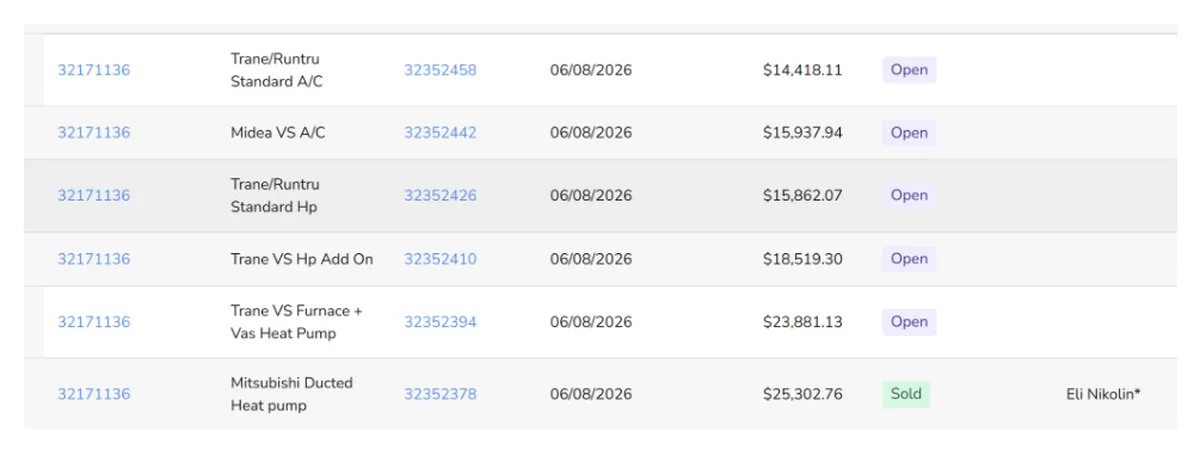
The range ran from a Trane/Runtru Standard A/C at $14,418.11, up through a Midea variable-speed A/C at $15,937.94, a Trane/Runtru Standard Heat Pump at $15,862.07, a Trane variable-speed heat pump add-on at $18,519.30, a Trane variable-speed furnace paired with a heat pump at $23,881.13, and finally the Mitsubishi Ducted Heat Pump system that Michael ultimately chose. That’s the real menu behind the question of what a full heat pump replacement costs in Seattle 98108, not one number, but a spread that widens significantly depending on whether you’re solving for cooling alone or solving for a complete, durable, reliable system built to last through the next fifteen to twenty years of a growing family’s life in the house.
Michael didn’t choose the cheapest option, and he didn’t choose the option in the middle either. He chose the one built specifically around what he’d told Eli mattered to him, which is a different decision-making process than picking based on price alone.
What’s the Best Heat Pump Option for a Family with Young Children?
Before writing up the proposal, Eli asked Michael directly what actually mattered to him on a project like this, working from a short list of common priorities homeowners weigh against each other. Michael checked comfort, convenience, air quality, quality of work, long life, and quiet operation. He didn’t check energy efficiency, savings, financing, or home resale value.

That list is a clear signal about what “durable” actually meant to this particular homeowner. He wasn’t optimizing for the lowest utility bill or the fastest payback period. He was optimizing for a system that would run quietly around a sleeping baby, keep the air in the house clean, hold up over a long service life without drama, and simply be dependable enough that it stopped being something he had to think about. For a family with young children, that’s often the right way to weigh a heat pump decision against the much simpler question of whether this is a system you can trust to just work, season after season, without becoming a source of stress.
Mitsubishi Hyper Heat Ducted System Specs: What Product Air Installed
The system Eli recommended, and Michael chose, was a Mitsubishi 3-Ton, 36,000 BTU Hyper Heat Ultra Quiet heat pump, side-discharge, with modulating variable-speed communicating operation, model SUZAK36NLHZ, paired with a matched Mitsubishi 3-Ton, 36,000 BTU modulating variable-speed electric communicating air handler, model SVZAP36NL, measuring 43-7/8 inches high, 21 inches wide, and 21-5/8 inches deep.
| Component | Detail |
| Outdoor Unit | Mitsubishi 3-Ton, 36K Hyper Heat, Ultra Quiet, Side Discharge, Modulating/Variable Speed |
| Outdoor Model Number | SUZAK36NLHZ |
| Indoor Unit | Mitsubishi 3-Ton, 36K Modulating/Variable Speed Electric Communicating Air Handler |
| Indoor Dimensions | 43-7/8″ H x 21″ W x 21-5/8″ D |
| Indoor Model Number | SVZAP36NL |
| Manufacturer Warranty | 12 years |
| Product Air Labor Warranty | 5 years |
Hyper Heat is Mitsubishi’s cold-climate variable-speed line, engineered to modulate output rather than cycle on and off at full power the way a single-stage system does, which directly supports the quiet operation and long-term reliability Michael had flagged as priorities. Where the old furnace-only system had no cooling capability at all, this system heats and cools from the same outdoor unit, closing the gap Michael had lived with for two summers.
What to Expect During a Full Ducted Heat Pump Installation
The consultation itself ran about two hours, enough time for Eli to walk Michael through the full range of options, the nameplate discovery, and the reasoning behind the Mitsubishi recommendation. Michael was honest about what came next: he told Eli he hadn’t planned on making an investment this size that day, and he wanted to do it right, so he asked for a couple of weeks to think it over. Work started ten days later, on June 18, proof that Product Air’s process doesn’t rely on pressuring a same-day decision, and that a homeowner taking real time to think it through is a completely normal part of a project this size.
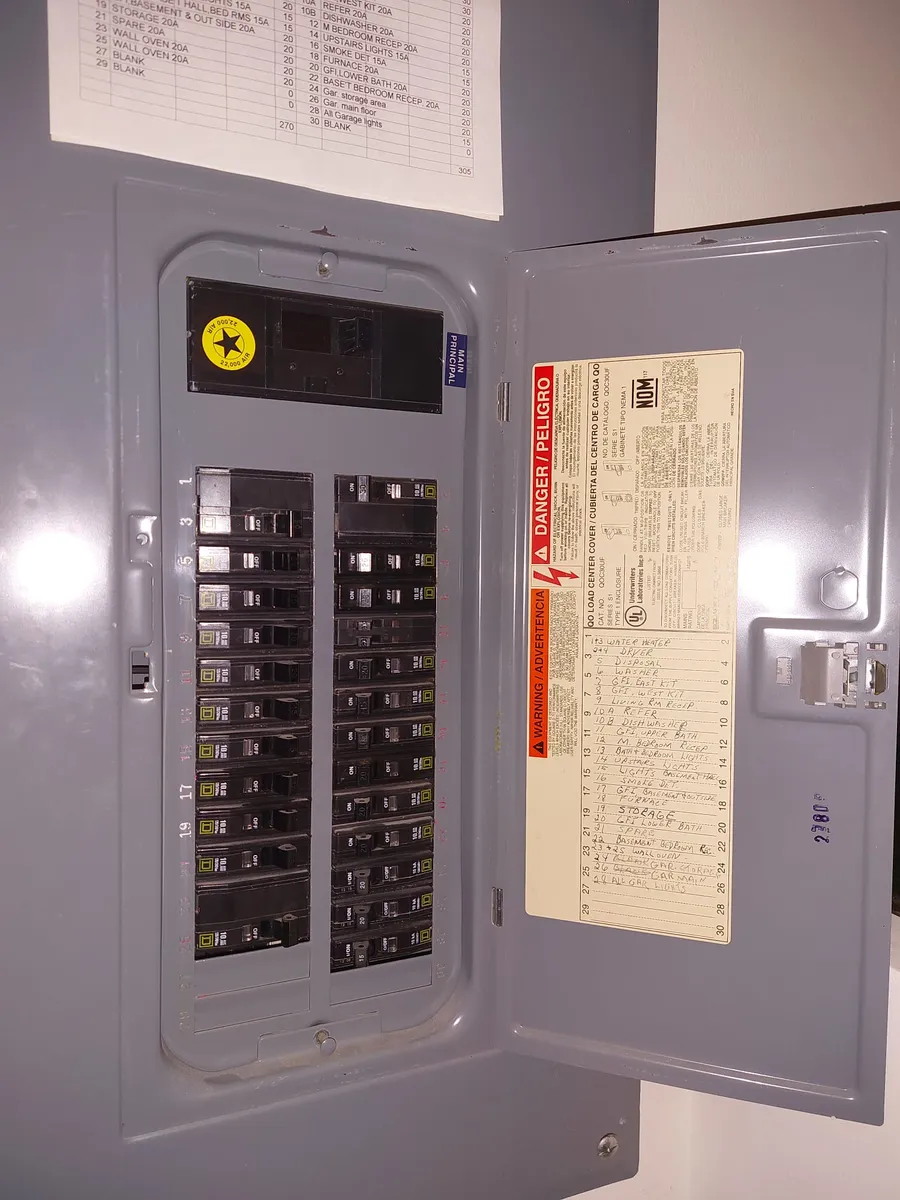
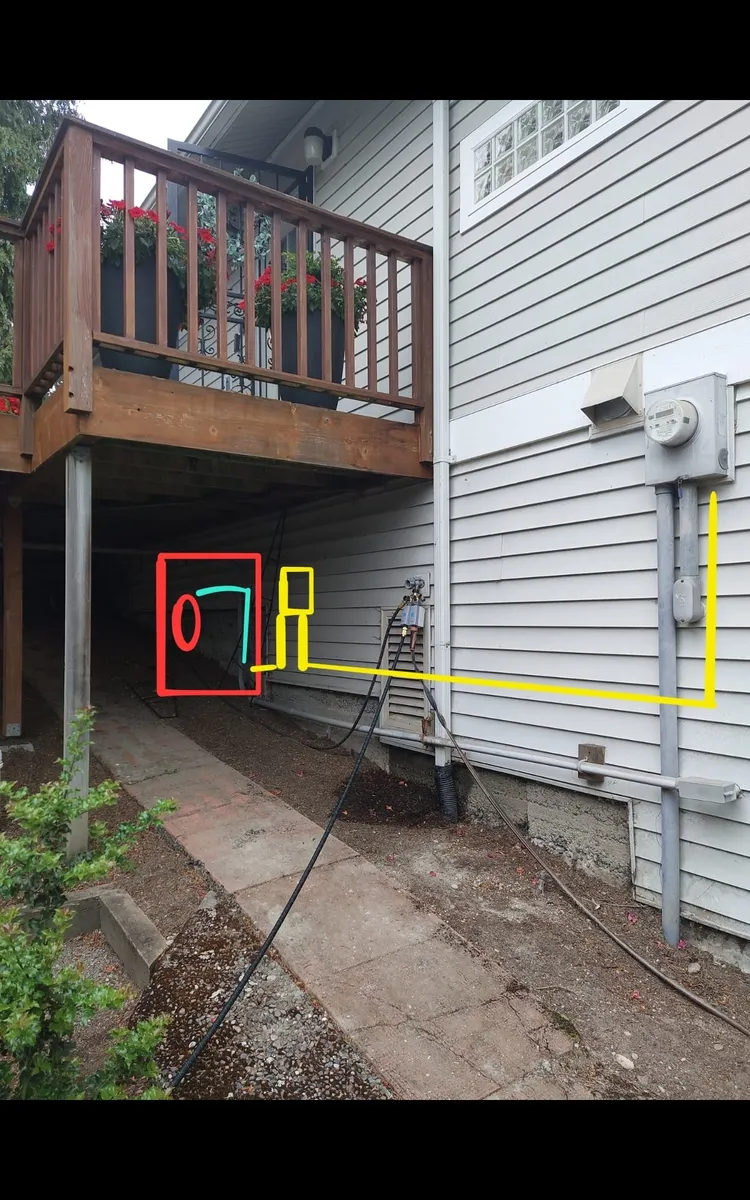
The physical installation was handled by two technicians, Dima and Nathan, over 13 hours of on-site work, removing the old furnace-only system, setting the new outdoor unit and indoor air handler, running refrigerant lines, and tying the new system into the home’s ductwork and electrical.
How Long Does Heat Pump Installation Take in Seattle and How Many Inspections Does It Require?
The physical work wrapped in a single day of installation labor, with the final walkthrough completed the following day, June 19. What often surprises homeowners is what comes after the equipment is set: in Seattle, a project of this scope requires inspection across three separate jurisdictions (electrical, mechanical, and refrigeration), each verifying a different part of the installation meets code. On Michael’s project, all three inspections were completed in a single day, which is a faster and more coordinated outcome than many homeowners expect when they hear “the city has to sign off on this.”
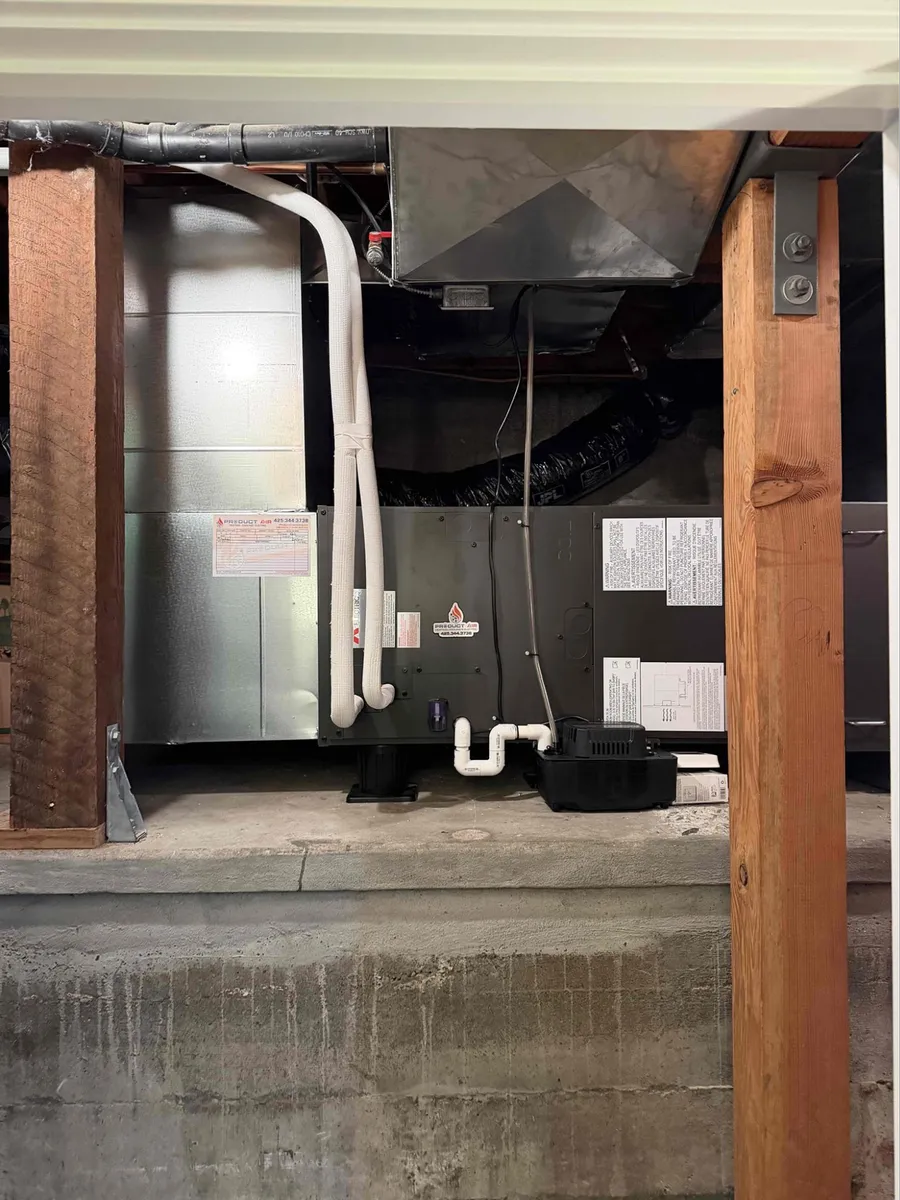
Product Air handled the permitting and inspection scheduling from end to end, which meant Michael’s only involvement in that part of the process was being home for the walkthrough.
The Real Numbers: $23,288.07 Before the Seattle City Light Rebate
The Mitsubishi Ducted Heat Pump system priced out at $23,288.07 before incentives. A $400 Seattle City Light rebate applied, tied to the Mitsubishi Midstream program for systems rated at 8.5 HSPF2 or higher, a smaller, less widely known program compared to the larger county-level heat pump rebates, but a real, stackable discount for Seattle homeowners installing qualifying high-efficiency equipment.
| Program | Amount |
| Seattle City Light Mitsubishi Midstream Rebate (8.5 HSPF2) | $400 |
| Total Rebates | $400 |
Base price: $23,288.07
Final cost after rebate: $22,888.07
Michael paid out of pocket, no financing involved.
What a Durable System Means for a Family Just Getting Started
The system Michael now owns carries a 12-year manufacturer warranty and a 5-year Product Air labor warranty, a meaningfully longer runway than the 16-year-old furnace-only system he’d been living with, and one that comes with actual cooling for the first time since he’d owned the house. For a family with a young child, the value isn’t abstract efficiency math. It’s a system quiet enough to run without disturbing a sleeping baby, reliable enough that a heat wave or a cold snap doesn’t become a household emergency, and new enough that Michael won’t be back in the position of not knowing his own equipment’s real age for a very long time.
Michael’s reaction after the work was finished matched exactly what he’d asked for at the start: he was pleased with the install, and he was already looking forward to using it through a full summer of air conditioning and a full winter of heating: the first year in his home where neither season would be a question mark.
Frequently Asked Questions: Heat Pump Installation and Replacement in Seattle, WA
How much does a Mitsubishi ducted heat pump cost in Seattle?
In a recent Beacon Hill installation, a 3-ton Mitsubishi Hyper Heat ducted system priced out at $23,288.07 before incentives, and $22,888.07 after a $400 Seattle City Light rebate. Costs vary by home size, ductwork condition, and system tier, and homeowners are often shown a full range of options rather than a single number, in this case, a full comparison ran from around $14,400 for a basic AC-only system up to roughly $25,300 for the top-tier Mitsubishi option, giving the homeowner a clear view of the full cost spectrum before deciding.
How do I know the real age of my HVAC system?
The most reliable method is checking the manufacturer’s data plate on the equipment itself, which records the actual production date rather than relying on memory or assumptions passed down from a previous owner. In one Seattle case, a homeowner believed his furnace was about 10 years old, but a technician’s inspection of the nameplate confirmed it was actually 16 years old: a six-year gap that mattered significantly given HVAC equipment’s typical 15-to-20-year service life. If you don’t know your system’s exact age, a professional inspection is the only way to find out for certain.
What is the Seattle City Light heat pump rebate?
Seattle City Light offers a Mitsubishi Midstream rebate for qualifying high-efficiency heat pump installations rated at 8.5 HSPF2 or higher, applied directly at the time of installation. In one recent Beacon Hill project, this rebate provided $400 toward a Mitsubishi Ducted Heat Pump system, reducing the final cost from $23,288.07 to $22,888.07. It’s a smaller, lesser-known program compared to some county-level rebates, but it can be combined with other applicable incentives depending on the equipment and utility territory.
What inspections are required for a heat pump installation in Seattle?
A full ducted heat pump installation in Seattle typically requires inspection across three separate disciplines: electrical, mechanical, and refrigeration, each verifying that a different part of the work meets code. In one Beacon Hill installation, all three inspections were completed in a single day, coordinated directly by the contractor so the homeowner didn’t need to manage scheduling with the city. Requirements can vary slightly depending on project scope, but a complete system replacement generally involves this same three-part inspection process.
What’s the best heat pump option for a family with young children?
For families prioritizing reliability over the lowest upfront cost, a variable-speed, modulating system like Mitsubishi’s Hyper Heat line is often the strongest fit, since it runs quietly and avoids the on-off cycling of single-stage equipment. In one Seattle case, a new parent specifically prioritized comfort, air quality, quality of work, long life, and quiet operation over savings or financing when choosing a system, and selected a Mitsubishi 3-ton Hyper Heat ducted heat pump as the option that matched those priorities. The right choice depends on what a family values most, but durability and quiet operation consistently top the list for households with young children.
How long does heat pump installation take in Seattle?
For a full ducted system replacement, on-site installation typically takes about a day of active labor with a two-person crew, followed by a final walkthrough and city inspections shortly after. In one Beacon Hill project, two technicians completed the physical installation in roughly 13 hours across a single day, with electrical, mechanical, and refrigeration inspections all completed the following day. Timelines can extend if additional electrical work, ductwork modifications, or scheduling conflicts with city inspectors come into play.
What are the signs a 16-year-old HVAC system needs replacing?
At 16 years old, a system is deep into its typical 15-to-20-year service life, and even one running without an obvious breakdown can be approaching the point where components start failing more frequently. Common signs include declining efficiency, inconsistent temperatures, rising repair frequency, and, in systems without cooling, simply lacking a capability a household now needs. In one Seattle case, a homeowner’s system showed no dramatic failure symptoms at all, the deciding factor was learning the true age of the equipment and recognizing that waiting for a breakdown wasn’t a plan, especially with a new baby in the house.
How do I choose the most durable heat pump for a family home?
Start by identifying what actually matters most to your household: comfort, quiet operation, air quality, and long service life carry different weight than upfront savings or financing terms, and the right system should match those specific priorities rather than a generic recommendation. Variable-speed, modulating heat pumps, like Mitsubishi’s Hyper Heat line, are generally built for quieter, more consistent operation over a long service life compared to single-stage equipment. In one Seattle case, a homeowner’s explicit priorities of comfort, quality of work, long life, and quiet operation directly shaped the recommendation toward a top-tier ducted Hyper Heat system rather than a base-level option.
Key Takeaways
- Homeowners are frequently wrong about their HVAC system’s actual age, checking the manufacturer’s nameplate is the only reliable way to confirm it, and the gap can be significant, as in this case where a homeowner’s estimated 10-year-old system turned out to be 16.
- A full Mitsubishi ducted heat pump replacement in Seattle can range from roughly $14,400 for a basic AC-only option up to around $25,300 for a top-tier system, with the final invoiced project in this case coming to $22,888.07 after rebates.
- The Seattle City Light Mitsubishi Midstream rebate offers $400 toward qualifying 8.5 HSPF2 or higher heat pump installations, a smaller but real incentive stackable with other applicable programs.
- A full ducted heat pump installation in Seattle requires electrical, mechanical, and refrigeration inspections, which can often be completed in a single coordinated day when scheduled directly by the contractor.
- Homeowners prioritizing durability and reliability for a growing family often weigh comfort, quiet operation, and long service life more heavily than upfront savings when choosing a heat pump system.
- Finding a contractor through an AI assistant like ChatGPT is an increasingly common path for homeowners researching HVAC decisions, reflecting how specific and credible a contractor’s reputation has to be to surface as a direct recommendation.
Michael didn’t come to us because his system had failed. He came because he wanted to stop wondering, and because a new baby in the house had turned “probably fine” into a question worth actually answering. Every home reaches that point eventually, whether it’s a breakdown that forces the decision or, like this one, a father deciding he’d rather be sure than lucky.
— Serge Nikolin, Co-Founder, Product Air Heating, Cooling and Electric
Marysville · Issaquah · Seattle · Western Washington