


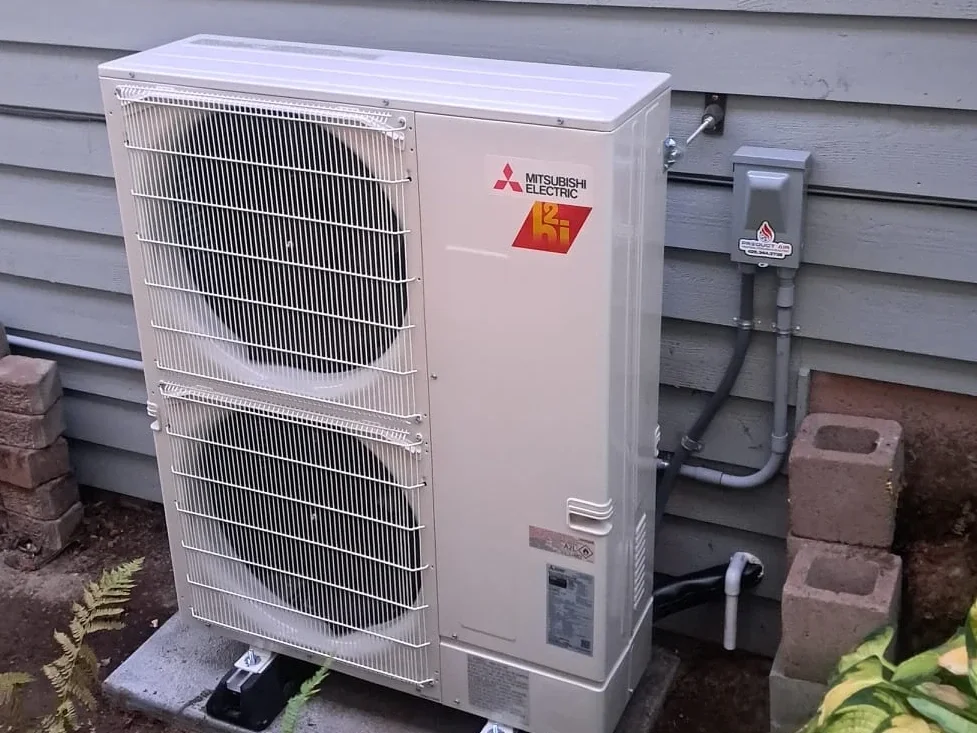
What Western Washington Homeowners Should Know
If you replaced your old heating system with a heat pump over the summer, the first winter can bring a few surprises. The outdoor unit sits in the rain for days, develops a white coating of frost one morning, then suddenly stops its fan and sends up a cloud of steam. When your family depends on that equipment for heat, you want to know whether something is wrong.
Ordinary rain shouldn't interfere with a properly installed, working heat pump. Frost can be normal, too. But snow that blocks airflow, ice near the fan, and flooding can interrupt heating or damage equipment.
The key is understanding what you're seeing and whether the system is recovering on its own. Once you know that, it's easier to decide when to leave it alone, when you can safely help, and when to call for service.
When Rain Needs Your Attention
Your outdoor unit is built to operate outside. It doesn't need dry weather to heat your home, so you don't need to shut it off or cover it during normal rainfall.
What matters is where the water comes from and where it goes. Rain landing on the cabinet creates different conditions than a steady stream from an overflowing gutter.
Suppose snow melts on your roof during the day, drips onto the unit, and keeps dripping as the evening temperature falls below 32°F. Ice can build up on parts of the equipment even though the heat pump itself is working properly. Pacific Northwest National Laboratory (PNNL) shows an example of exactly this problem: roof runoff froze around an outdoor unit despite its elevated installation.
If you notice runoff hitting your unit, a video taken from a safe location can help a professional understand the problem. The fix may involve repairing a gutter or redirecting the water. Don't climb onto a wet roof during a storm to investigate.
Flooding requires a different response. If rising water may have entered the unit, don't assume it's safe to restart after it dries. Stay away from flooded equipment, and don't step into water to disconnect it. Washington L&I advises having a qualified professional disconnect power before anyone approaches a submerged or recently submerged electrical system. What happens next depends on the affected components and the manufacturer's requirements.
Why Frost Forms When It Isn't Freezing Outside
Now consider a more familiar sight: there's no flooding or roof runoff, but the thin metal fins on the outdoor coil have turned white. It's about 40°F outside, which makes that frost look out of place.
The outdoor air and the coil aren't necessarily the same temperature. To absorb heat from the air, the coil runs colder than the air passing through it. Under the right conditions, its surface can fall below 32°F while the air stays above freezing.
Moisture collects on that cold surface and freezes. You don't need a snowstorm, or even rain, for this to happen. Humid air and a cold enough coil are sufficient. The Department of Energy explains this process in Section 3.3 of its heat pump performance report.
The system periodically runs a defrost cycle to remove that buildup. It temporarily reverses the refrigeration cycle, warming the outdoor coil and melting the frost. The outdoor fan may stop, the sound may change, and you may see a brief white cloud of mist that looks like steam. Once defrost is complete, the system returns to heating.
I encourage homeowners to watch the sequence rather than judge the system by one snapshot. Frost develops, the coil clears, heating resumes, and the house stays at its set temperature. That tells you much more than a picture of a frosty unit.
Frost returning later doesn't automatically mean something has failed. The same damp conditions may still be present. If ice keeps building, heating doesn't recover, and the house gets colder, however, the system needs attention.
There isn't one defrost time limit that applies to every heat pump. Controls vary by model and operating conditions. Don't keep dismissing a cooling house as "just defrost" when normal heating isn't returning.
How Snow Can Interfere With a Working Heat Pump
Defrost helps clear the coil, but it isn't designed to melt a snowdrift around the equipment.
Your heat pump needs outdoor air moving through it. Wet snow can block the intake or the space where air leaves the unit, limiting its ability to collect heat. Heating performance may suffer, and the system may shut down to protect itself.
Even a heat pump designed for cold climates needs unobstructed airflow. Mitsubishi Electric specifically emphasizes keeping outdoor units clear of snow and ice buildup that can interfere with operation.
After a snowfall, you can carefully clear loose snow from the ground around the equipment if it's safe to reach. Keep the shovel on the ground and move snow away from the unit and visible lines or wiring. Don't pile it in front of the fan or push it underneath the equipment.
You don't need to scrape every fin clean or get the cabinet completely dry. Keep tools out of the grille, don't try to turn the fan, and don't chip away snow that's frozen to the unit. The coil and other components are easy to damage.
If removing snow from the equipment itself requires force, stop and get help. Your role is to keep the surrounding space open without working inside the unit. This guide for new heat pump owners, hosted by DOE, explains the importance of keeping outdoor airflow clear.
Defrost Water Needs Somewhere to Go
Water beneath the outdoor unit after defrost isn't necessarily a leak. The melted frost has to drain away.
Trouble starts when that water collects and refreezes. Imagine one defrost cycle leaving water in a low spot. It freezes overnight, then the next cycle sends more water onto the existing ice. Without a clear path out, the buildup can continue.
Ice on the ground is already a slipping hazard. For the equipment, the concern grows when ice reaches toward the bottom of the coil, obstructs drainage, or gets close to moving parts.
The next step is to find out where water is collecting and why. Attaching a homemade drain hose isn't automatically a solution because the hose can freeze and create a blockage. For example, Mitsubishi's installation manual for PUZ-AK·NLHZ and SUZ-AK·NLHZ units warns against using a drain pipe in cold climates because it can freeze. Other models need to be checked against their own instructions.
If the ice keeps coming back, removing it once won't address the underlying problem. Drainage needs to be evaluated so the same conditions don't produce the same buildup during the next cold spell.
When an Awning Might Help
After your first snowfall, covering the equipment may seem sensible. A cover or tarp over an operating heat pump, however, can restrict the air it needs.
A properly designed awning can divert water or falling snow while leaving airflow unobstructed. PNNL recommends open sides and checking the equipment manufacturer's requirements.
I'd start with the problem you're trying to solve. If snow falls from the roof onto the unit, evaluate protection from that specific hazard. If a damaged gutter is sending water onto it, address the gutter. Ordinary rain falling on a normally operating unit isn't, by itself, a reason to add a structure.
Any proposed awning also needs to account for where its runoff will go, where snow will collect, and whether a technician can still service the equipment. Protection should improve the installation's conditions without creating another obstruction.
When You Shouldn't Wait for Another Defrost Cycle
Freezing rain can coat the grille, fan, and other parts that don't warm up the way the coil does during defrost. You can't assume the system will clear ice from every part of the unit.
If you hear repeated knocking or scraping, or notice pronounced vibration after a storm, stop the system using its normal controls if you can safely do so from indoors, then contact a professional. Continuing to run equipment with a mechanical obstruction can make the damage worse.
Setting the thermostat to OFF doesn't electrically isolate the equipment or make it safe to take apart. Don't remove the grille or try to move the fan by hand.
I also don't recommend chipping ice off the unit or pouring hot water over it. You could damage components, direct water toward electrical parts, or create more ice when the water refreezes. Mitsubishi instructs users to use only manufacturer-recommended methods to accelerate defrosting or clean the equipment.
If the outdoor unit needs to stay off, ask what backup heating your particular system has. Emergency Heat requires compatible equipment and controls, and not every heat pump installation includes it.
A burning electrical smell, sparking, or other signs of fire aren't normal defrost behavior. If you see signs of a fire, move away from the equipment and call 911.
What a Technician Needs to Determine
Weather may explain why heating got worse after a snowfall, but it doesn't establish the cause on its own.
A technician should determine whether air can move freely, where water drains, whether the fan operates correctly, and whether the system enters defrost and returns to heating. Depending on the findings, diagnosis may include sensors, controls, and refrigerant-system measurements using the model's service documentation.
Consider two hypothetical situations. In one, snow around the base traps water that repeatedly freezes even though defrost works. In the other, airflow and drainage are clear, but the system isn't completing the proper defrost sequence. A homeowner might describe both as "my heat pump is iced over," yet they call for different solutions.
A photo helps start the conversation, but it doesn't justify automatically replacing a sensor or another part. A professional discussion of defrost diagnosis likewise emphasizes evaluating the whole system before identifying an individual component as faulty.
For me, a useful diagnosis leaves you understanding what was found, what supports that finding, and why the proposed repair should help.
If You're Unsure, Tell Us What Changed
You don't have to recognize every operating mode during your first winter with a heat pump. If something concerns you and the house isn't staying warm, contact Product Air Heating, Cooling, and Electric and describe what has changed.
Tell us what the weather was doing, when ice or an unusual sound appeared, and whether the indoor temperature is holding. A photo showing the whole outdoor unit, a short video, or an error message can help if you can get it safely. Don't walk across ice, enter standing water, or open equipment panels to get a better picture.
If you've simply seen normal defrost for the first time, you deserve a clear explanation of how your system works. If there's a problem, the next step is to identify the cause and discuss reasonable options.
That's what being "your tech brothers from another mother" means to me: taking what's happening in your home seriously, explaining it as I would to my own family, and helping you make a decision without pressure or guesswork.
PLAN YOUR NEXT STEP
Need help with your home comfort?
Explore Product Air’s heat pumps services or contact the team.
Share this guide