

You open your electric bill, compare it with last fall’s, and wonder what happened. The heating system hasn’t changed. You haven’t bought any major appliances. The thermostat is right where you usually keep it, and the weather doesn’t seem much different.
So why are you paying more?
Across Western Washington, utility rate changes are part of the answer in 2026. Your home may also be using more electricity, even if your daily routine feels the same. Sometimes a billing adjustment explains the difference. Other times, the bill is the first indication that equipment needs attention, well before the house starts feeling cold.
Before I recommend a repair or a new system, I want to separate two things: how much electricity your home used and what you were charged for it. Once we understand those numbers, we can make a much better decision about what to do next.
Start With Two Bills and a Fair Comparison
Pull up your current bill and one covering a similar period last year. Start with the service dates, because a bill that arrives in November may include several weeks of October, and the number of billing days can vary.
Next, find your electricity use in kilowatt-hours, usually labeled kWh. Dividing that number by the days in the billing period gives you a useful starting point.
Here’s a simple example:
| Billing period | Electricity used | Days billed | Average daily use |
| Last year | 900 kWh | 30 | 30 kWh |
| This year | 990 kWh | 33 | 30 kWh |
Total use increased by 10%, but daily use stayed the same. That difference alone gives us no reason to suspect the equipment. You were simply billed for three more days.
Then compare the charges. Look at the energy rates, basic service charge, adjustments, and any previous balance. If your utility supplies both electricity and natural gas, compare those services separately.
Also check whether you’re looking at current energy charges or a payment amount under a budget billing plan. PSE explains that budget payments can change after a review of energy use or prices, and an outstanding balance can affect the amount due. PSE: What Is Impacting My Bill?
If comparable usage stayed about the same while charges increased, start with the billing explanation. If daily usage also went up, we have another question to answer: where did that extra energy go?
Electricity Rates Changed in 2026, but the Changes Depend on Your Utility
There is no single electricity rate for Western Washington. Comparing your bill with a friend’s in another city can be misleading if you have different utilities or rate plans.
These are some of the officially announced changes that took effect in 2026. The information below was checked against official utility and regulatory sources on November 11, 2026:
| Utility | Announced change |
| Puget Sound Energy | A package of adjustments effective January 1 had an estimated impact of 12.18%, or $16.84 per month, for a residential customer using 800 kWh. That describes the impact of those specific adjustments, not the year-over-year increase every customer should expect (per Washington UTC). |
| Seattle City Light | A previously approved average rate increase of 5.4% took effect January 1. City Light also announced an increase in its basic service charge. |
| Snohomish PUD | Beginning April 1, the residential energy charge increased from 10.26 cents to 10.61 cents per kWh. The utility estimated an average residential bill increase of about $3.22 per month, with the actual change depending on usage (per Snohomish PUD). |
These figures describe specific rate changes, not the year-over-year increase every customer will see.
Your increase can also be larger than a percentage you saw in the news because price and consumption may have risen together. As a hypothetical example, a 10% increase in the price of energy combined with a 20% increase in usage produces a 32% increase in that variable portion of the cost.
If your usage really is unchanged and the difference still doesn’t make sense, ask the utility to walk through the two bills with you. A useful question would be “Can you show me which charges changed between these periods?”
The Same Thermostat Setting Can Require More Energy
We tend to remember the dramatic weather conditions like a windstorm, or an unusually sunny weekend, not to mention a few freezing mornings. Your heating system responds to conditions throughout the day and night.
Colder nights can increase heating demand even when afternoons feel familiar. Wind, air leaks, and changes in how much sunlight reaches the house can also affect how quickly it loses heat.
Setting the thermostat to 68°F tells the system what temperature you want. It doesn’t limit how much electricity the system will need to maintain it.
One tool used to compare heating demand is heating degree days, a measure of how cold a period was relative to a baseline temperature. It is most useful when you compare the appropriate location and the actual dates covered by your bills, as per U.S. Energy Information Administration: Degree Days.
Still, I wouldn’t blame your increase on colder weather without checking. “Bills go up in the fall” doesn’t explain why yours is higher than it was last fall.
A Comfortable House Can Still Have an Equipment Problem
A system can sometimes compensate for declining performance by running longer. If it has backup heat, that backup may help keep the house comfortable while hiding a problem with the primary heating system.
You feel the same indoor temperature, but the equipment is taking a different path to get there.
Restricted airflow, dirty coils, or a control problem are possible places to investigate. A bill by itself cannot tell us which one applies. Carrier’s description of professional heat pump service includes airflow, refrigerant and electrical checks, along with testing how the system performs.
Long operating cycles are not automatically a problem, either. Variable-capacity equipment may run for extended periods at a lower output. What matters is how power consumption and operating time relate to the amount of heat delivered to the home.
Check How Backup Heat Is Being Used
Before discussing backup heat, we need to know what your system actually has. Some heat pumps use electric resistance heat strips in the indoor air handler. Others are paired with a gas furnace. The equipment and controls determine when that secondary heat source operates.
Electric resistance backup can provide heat during defrost, help the home recover to its temperature setting, or keep it warm when the primary system has a problem. You should also keep in mind that it uses more electricity to produce heat than an efficiently operating heat pump.
To illustrate why operating time matters, a hypothetical 10-kW heater running two hours a day would use 600 kWh over 30 days. That is an example, not an assumption about the equipment in your home.
Now imagine a system whose outdoor unit is no longer heating properly while its electric backup continues carrying the load. The homeowner may not notice an obvious breakdown because the house is still warm. The change shows up first in electricity consumption.
That is a diagnostic possibility worth checking and not a conclusion we can draw from a high bill alone.
If your thermostat displays AUX, don’t disable the backup heat to save money. Note when it appears, how long it stays on, and whether the system maintains the temperature so a technician can determine whether the operation makes sense for your equipment and conditions.
Should You Turn the Thermostat Down at Night?
This is where general energy-saving advice can become confusing.
Lowering the indoor temperature can reduce heat loss while the house is cooler. Later, the system has to warm the house back up. On some heat pump systems, an aggressive recovery can bring on electric resistance backup and reduce the savings you expected.
That is why I would first look at your equipment, controls, and schedule.
A steadier temperature can help avoid unnecessary swings and keep a heat pump operating comfortably. But it would be inaccurate to say that every nighttime setback increases costs.
Pacific Northwest National Laboratory (PNNL) describes thermostats with adaptive recovery that begin warming the house earlier to limit the need for electric resistance backup. The way the system manages recovery matters.
If you sleep better in a cooler room, you shouldn’t abandon that preference without a conversation. We need to understand how much you lower the temperature and how quickly you expect the house to recover, and also how your system responds.
I also wouldn’t buy a new thermostat solely because the packaging promises savings. First, check what your existing controls can do and whether a replacement would preserve the functions your equipment needs.
If You Have a Gas Furnace, Look Beyond the Heating System
A gas furnace uses electricity for its blower, controls, and other components, but gas provides the primary heat. A higher electric bill therefore deserves a broader look at the home.
Has the fan setting changed? Is it now circulating air continuously? Are you using a space heater in a bedroom because the central system doesn’t keep that room comfortable?
Then consider other substantial loads, such as an electric water heater, clothes dryer, garage refrigerator, hot tub, or EV charging. The appliance can be the same while its operating time changes.
A Small Space Heater Can Add a Noticeable Amount
A heater’s physical size doesn’t tell you much about its monthly electricity use.
For example, a 1,500-watt heater running six hours every evening uses 270 kWh in 30 days. At a hypothetical energy price of $0.20 per kWh, that is $54 in energy charges. Your actual cost depends on your rate.
If you need that heater every evening, I would also want to know why the room stays cold. An airflow or heat-loss problem may deserve attention. Asking the family to tolerate an uncomfortable room leaves the underlying issue unresolved.
Don’t Overlook Water Heating
A hot-water leak means the water heater must continually replace lost hot water with the newly heated one. Colder incoming water also requires more energy to bring the same amount of water to the same temperature.
Neither situation automatically means the water heater needs replacement. We need to establish whether there is a leak, a change in demand, or an equipment problem.
This is why “we haven’t bought anything new” is useful information, but it doesn’t end the investigation.
Start Saving With Changes You Can Explain
The most useful first steps are tied to something you can observe or verify:
- Review normal thermostat settings. Check the temperature, schedule, and selected mode. Leave installer settings and backup-heat configuration to a qualified professional.
- Look at your usage history, if your utility provides it. A recurring morning spike or sustained overnight load can help narrow the investigation, although a whole-home graph does not identify a particular faulty appliance.
- Check a homeowner-accessible filter according to the equipment instructions. Make sure furniture is not blocking supply registers or return grilles.
- Pay attention to large, long-running loads. Space heaters and other heating appliances deserve attention before you worry about an unused phone charger.
- Address obvious drafts appropriately. Air leaking around a window or door adds to the heating load.
Try not to change everything at once, since a measured approach makes it easier to see what helped.
I would also avoid randomly closing central-heating registers in unused rooms. The system needs appropriate airflow, and blocking outlets can affect air distribution without delivering the savings you expected.
Finally, distinguish energy savings from payment assistance. An eligible discount program may reduce your financial burden, and budget billing may make monthly expenses easier to plan. Neither necessarily changes how many kilowatt-hours your home uses.
Know When Safety Comes First
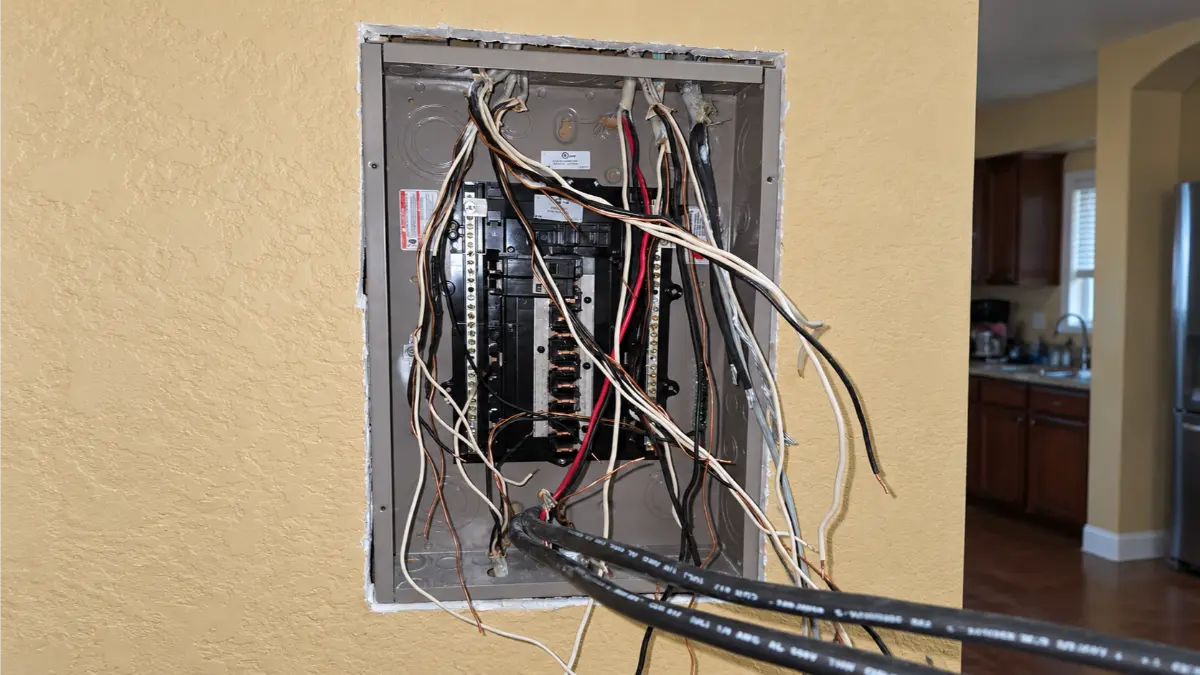
A high bill by itself does not establish an electrical hazard. Burning smells, sparks, unusual outlet heat, crackling, or repeatedly tripping breakers require more immediate attention.
Seattle Fire Department advises contacting a qualified electrician for warning signs such as warm or discolored outlets, flickering lights, burning odors, and sparks.
Stop using suspect equipment if you can do so safely. Stay away from a smoking or sparking electrical panel. If there is smoke or fire, get to safety and call 911.
What a Professional Should Help You Understand
Questions about rates, billing adjustments, or meter readings belong with your utility. Changes in heating performance, unusual icing, or unexpected operating modes call for an HVAC assessment. Problems involving outlets, circuits, or the electrical panel need an electrician.
At Product Air Heating, Cooling, and Electric, we work on both HVAC and electrical systems. Depending on the symptoms, we may check airflow, controls, operating conditions, electrical measurements, and backup-heat operation. A normal voltage reading alone doesn't establish normal energy use, so power draw and operating time may also matter.
We'll explain the findings, the appropriate next steps, and the scope and cost of any additional work before it proceeds.
When Does Replacement Make Sense?
A higher electric bill alone doesn't justify replacing a heating system. If a setting or repairable fault explains the problem, address that first. Replacement becomes worth comparing when equipment condition, expensive repairs, or multiple significant problems make continued service less practical.
Compare the full installed cost, expected energy use, local rates, and eligible rebates. If you change heating fuels, include both electricity and gas costs. The proposal should also account for any necessary electrical work, permits, and inspections. Product Air handles the required permits for its contracted work, subject to the applicable jurisdiction. Washington L&I explains that most electrical work requires a permit, with specific exceptions.
Check the Result in Both the Equipment and the Usage
After a repair or adjustment, the technician should verify that the equipment operates as intended, including airflow, controls, and the relevant heating mode.
The billing result takes longer to assess. Compare daily kWh while accounting for weather, thermostat settings, billing days, rates, and other household use. If the heating fuel changed, include both electricity and gas costs. That helps distinguish verified equipment improvements from estimated savings.
You Don’t Have to Figure It Out Alone
If your bill remains unusually high or your heating equipment behaves differently, contact Product Air. Tell us what changed, and we'll help determine the appropriate next step.
That's the idea behind Your Tech Brother From Another Mother: listening to the problem, explaining the findings, and recommending only the work that makes sense for your home.
PLAN YOUR NEXT STEP
Need help with your home comfort?
Explore Product Air’s electrical services or contact the team.
Share this guide