

Location: 30th Avenue NE, Wedgwood, Seattle, WA 98115
Call Date: January 15, 2026
First Visit: January 17, 2026
Project Completion: February 11, 2026
Lead Technician: Eli, 10+ years, licensed HVAC technician
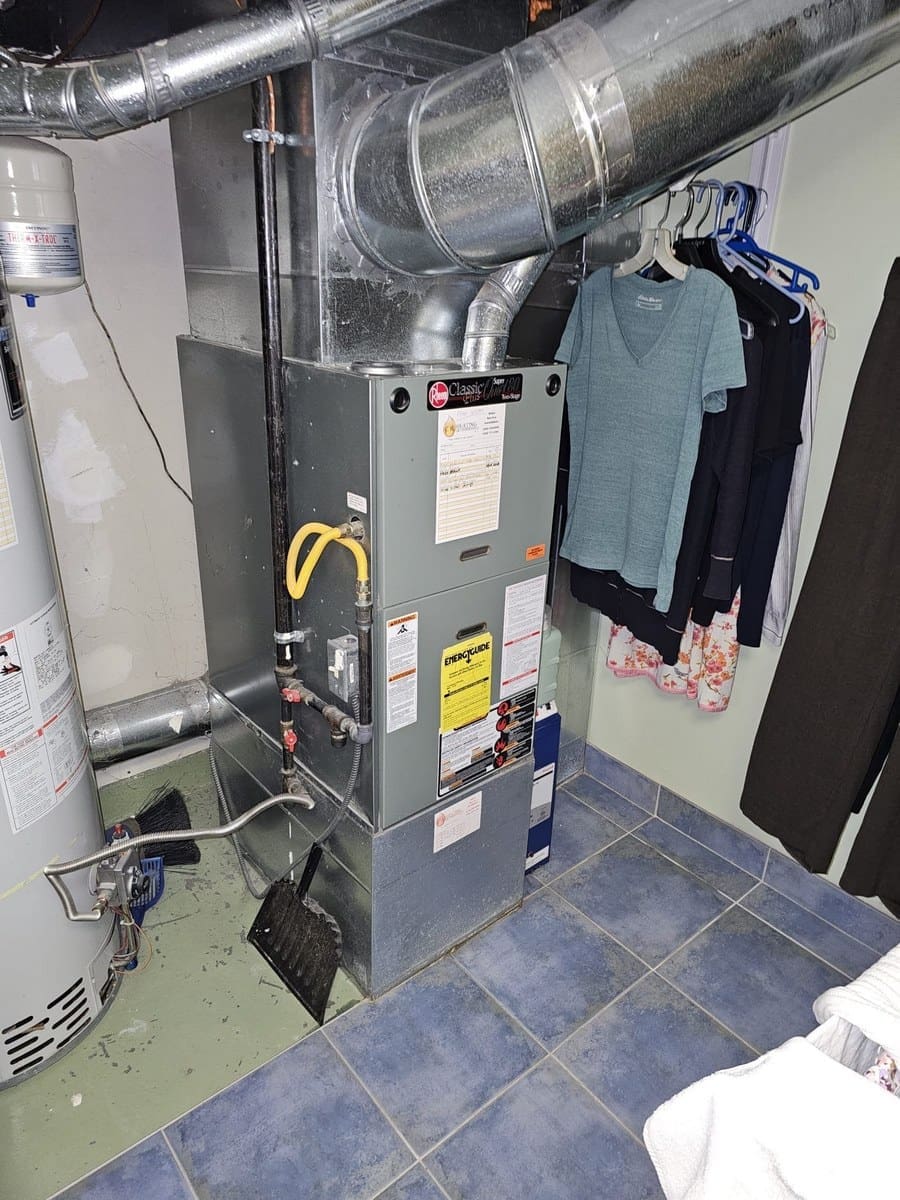
System Before: 2007 Rheem gas furnace, 80% AFUE, single-stage, ~19 years old; no central cooling
System After: Trane S8V2B080M4 modulating gas furnace (80,000 BTU) + Mitsubishi PUZHA42NKA Hyper Heat heat pump (3.5 ton) with intelli-HEAT MCO PAA-A42BA1 dual-fuel coil and 5″ filter cabinet, a hybrid dual-fuel system
Final Project Cost: $20,227.62 (after rebates)
The Call That Came From a Neighbor
Jason had been in his 1942 home on 30th Avenue NE for more than five years when he called us in the middle of January. Nothing had failed. The 2007 Rheem furnace in the closet was still pushing heat through the two-story Wedgwood house, but it had been repaired before, the noise had been climbing for a while, and Jason had stopped trusting it. That is a different kind of call than a furnace that quit on a Tuesday night. It is the call of a homeowner who has decided he does not want to find out, in the coldest week of the year, what it feels like to lose heat with kids in the house.
His words, close to how he said them: “I have been in this home for five-plus years. The unit is making unnecessary noise and I’m losing confidence in it. I know it’s old and I’ve had issues with it before.”
Jason found Product Air the way our best calls tend to arrive. His neighbor had used us the year before and told him he had been treated like family. When a referral comes in carrying that exact phrase, it sets a standard for the visit before the visit happens. Jason had also called CM Heating and Seatown, two established names in the Seattle market. He was not shopping for the lowest sticker. He was looking for the company he wanted in his house.
What Eli Asked Before He Looked at Anything
Eli came out on January 17. His first questions had nothing to do with model numbers or tonnage. They were the questions we open with on every visit, because the equipment answer is meaningless until you know what the family actually needs: What is important to you and your family? What does a perfect climate look like for you? Do you care who installs this system?
What came back from Jason shaped the entire job. He wanted a system that would last and stay efficient, but he wanted it to be able to fall back on gas heat when Seattle’s temperatures dropped hard. He did not want to bet his family’s heat on a single fuel source. His son had seasonal allergies. The summer wildfire smoke that rolls in from eastern Washington bothered the whole household every year. And reliability mattered to him more than hitting the lowest possible price.
That is not a spec sheet. That is a brief. And it pointed clearly toward a particular kind of system.
What the Rheem Was, and What 19 Years Looks Like
The house is a 1942 two-story single-family home in Wedgwood, the kind of pre-war Seattle construction that has been updated in layers by successive owners. The Rheem furnace was a 2007 unit, 80% AFUE, single-stage: the most common residential furnace design of its era, and one that runs in exactly one mode. Full blast or off.
There is no modulation, no ramping, no holding a gentle middle gear. When a single-stage furnace calls for heat, it fires at 100% and shuts down when the thermostat is satisfied, then does it again and that on-off cycling is a large part of the noise a homeowner hears, and feels, in a house where the furnace sits in a closet near the living space.
At roughly 19 years old, a single-stage 80% furnace carries the wear you would expect of a unit that age. The blower has cycled through hundreds of thousands of starts. The heat exchanger has gone through nearly two decades of thermal expansion and contraction, the heat-and-cool stress cycle that, over enough years, is the thing inspectors watch for in furnaces of this vintage, because a compromised heat exchanger is the path to carbon monoxide entering the airstream.
Jason had already had the unit repaired before. None of that means the Rheem was about to fail on the day Eli stood in front of it. It means it was a system at the back end of its service life, doing a job it could only do one way, in a house where someone had stopped trusting it for good reasons.
There was no central air conditioning anywhere in the home. Whatever direction Jason chose, summer cooling was a gap the existing setup could not close.
The Options, and the Conversation That Decided It
Eli wrote up a range of options, from budget-conscious to the top of the line, and laid them out the way we always do: every option in writing, every price fixed, no number that grows after a signature.
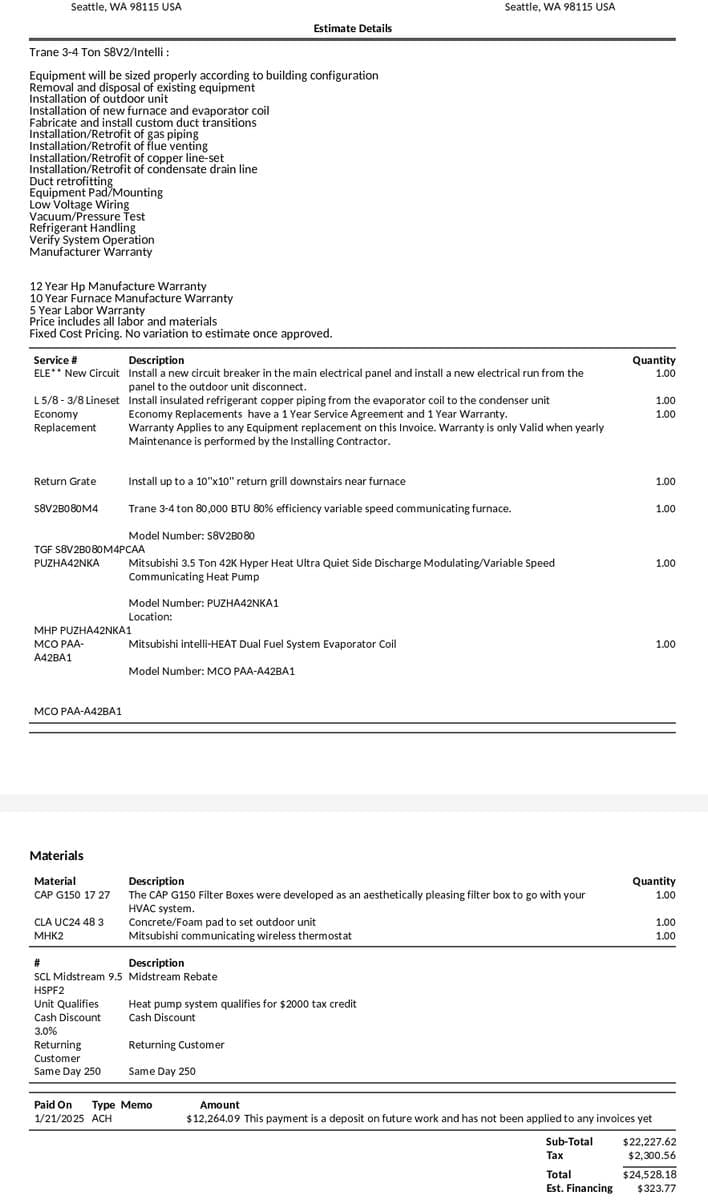
Product Air’s estimates are fixed-cost: no variation to the estimate once approved.
At the top sat the system built specifically for the brief Jason had given him: a Trane S8V2B080M4 modulating gas furnace (80,000 BTU, variable-speed, communicating) paired with a Mitsubishi PUZHA42NKA Hyper Heat heat pump, 3.5 ton, tied together through Mitsubishi’s intelli-HEAT MCO PAA-A42BA1 dual-fuel coil, with a 5-inch filter cabinet added to the return.
This is a hybrid system. The heat pump carries the heating load through Seattle’s mild months and provides air conditioning through the summer. When temperatures drop into the range where gas heat becomes the more efficient choice, the system hands off to the Trane furnace automatically. Two heat sources, one integrated control, no decision left to the homeowner standing at the thermostat in January.
Here is what Eli said to him, close to word for word: “Jason, I heard you want a system that lasts, stays efficient, and can switch to gas in a pinch. I also heard that the fires bother you and your son has seasonal allergies. This is a big investment, but look at the top option. It meets every one of those criteria. I also wrote up some more budget-friendly choices if you want to compare.”
Jason chose the top option because it was the one that answered every line of the brief he had given at the start of the visit.
When a Hybrid System Is the Right Call, and When It Isn’t
Jason’s decision raises a question that comes up constantly in Seattle homes that already have a working gas furnace: if you are adding a heat pump, do you keep gas heat as a backup, or do you go all-electric and remove gas from the equation entirely? Both are legitimate answers. The right one depends on the house and the homeowner.
An all-electric Cold Climate heat pump, the kind we install regularly in Wedgwood and across the city, is a complete heating and cooling solution on its own. Mitsubishi’s Hyper Heat units hold full heating capacity well below freezing and keep running to -13°F, which covers a Seattle winter with room to spare. For a homeowner who wants to be done with gas, that is the path, and it is a good one.
A hybrid dual-fuel system makes a different bet, and it is the right bet for a specific kind of homeowner. The heat pump does the heavy lifting through the 25°F-to-45°F band where Seattle spends most of its winter, operating at an effective coefficient of performance of 2.5 to 3.5, meaning two and a half to three and a half units of heat delivered per unit of electricity, far more efficient than burning gas in that temperature range.
But when an arctic outflow drops the region into the teens or single digits, the intelli-HEAT control hands the load to the gas furnace, which delivers its rated output regardless of how cold it gets outside. Jason wanted exactly this: maximum efficiency in normal weather, and a second, independent heat source he could fall back on when the weather turned hard. For a father who did not want to gamble his kids’ heat on a single system, the redundancy is the whole point.
The Mitsubishi intelli-HEAT platform is what makes this clean rather than clumsy. Older dual-fuel setups bolted a heat pump onto a furnace and switched between them with a crude outdoor temperature sensor. The intelli-HEAT coil integrates the Mitsubishi heat pump and the Trane furnace into one communicating system that decides, in real time and automatically, which heat source is the more efficient choice at any given moment. The homeowner sets a temperature on the MHK2 thermostat. The system does the rest.
Then there is the air quality piece, which is not a side note in this case. It was part of the brief. Jason’s son has seasonal allergies, and the household feels the wildfire smoke every summer. A standard one-inch furnace filter is built to protect the equipment, not the people. It catches the large debris that would foul the blower and coil, and lets most of the fine particulate through.
The 5-inch filter cabinet we installed has roughly five times the media depth, which means dramatically more surface area to capture the fine particles that carry allergens and the microscopic particulate in wildfire smoke. It also means the filter loads up far more slowly, so airflow stays strong and the homeowner changes it far less often. For a family that has spent five summers smelling smoke inside the house, that is a tangible, year-after-year difference.
What We Installed
The Trane S8V2B080M4 is a variable-speed, communicating gas furnace rated at 80,000 BTU and 80% AFUE. The “variable-speed, communicating” part is what separates it from the Rheem it replaced. Where the old single-stage unit runs full-on or off, the S8V2 modulates. It ramps the blower and the burn to match the actual heating demand, holding a steady, quiet output instead of slamming on at full capacity and cycling back down. That modulation is most of the reason the new system is so much quieter than the one Jason had stopped trusting, and it is the foundation of the dual-fuel handoff that makes the hybrid work.
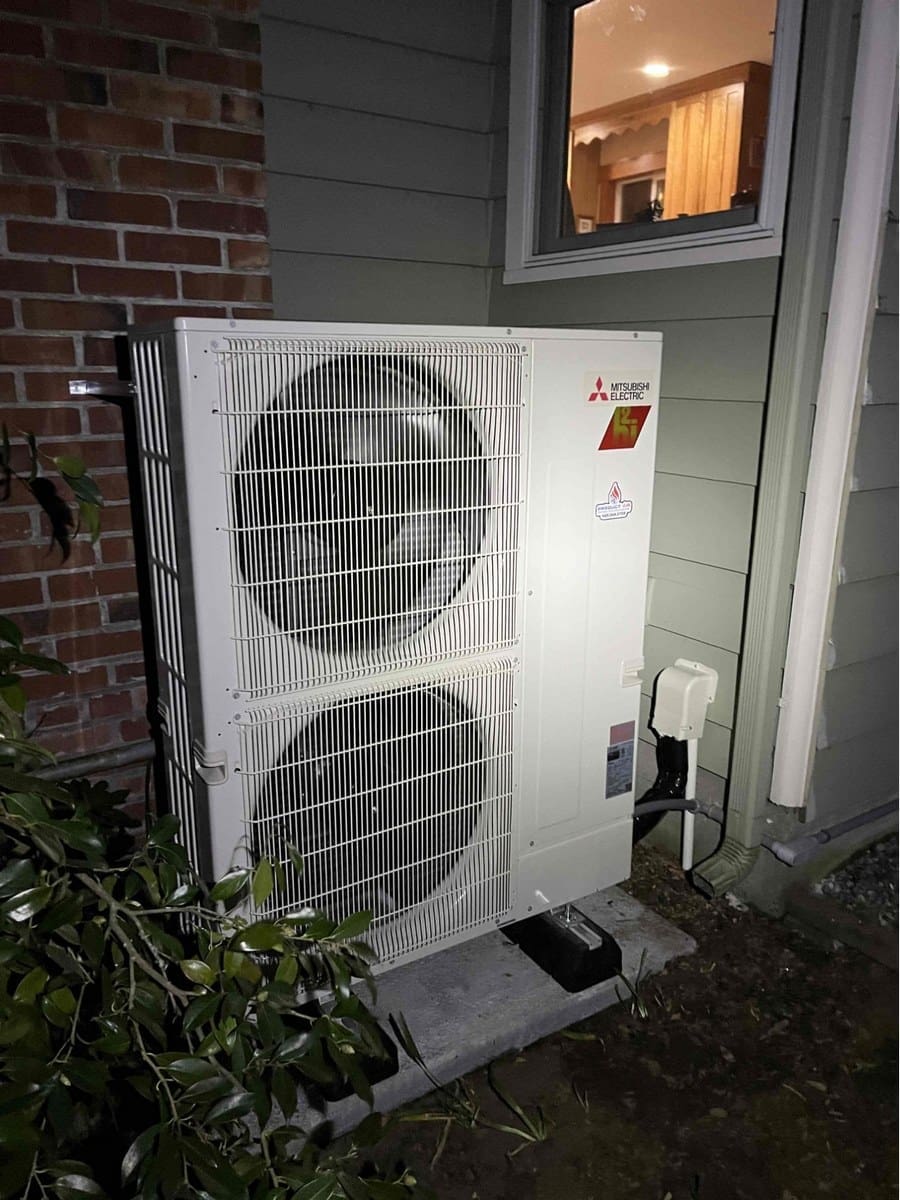
The Mitsubishi PUZHA42NKA is a 3.5-ton Hyper Heat outdoor unit, ultra-quiet, side-discharge, modulating and variable-speed, communicating directly with the indoor equipment. It carries the heating load through Seattle’s normal winter, provides full air conditioning through the summer the house never had cooling for, and holds capacity down to -13°F when it is called on. It sits on a concrete-and-foam pad on the side of the house, fed by an insulated copper line-set and a new dedicated electrical circuit our licensed electricians ran from the main panel to the outdoor disconnect.
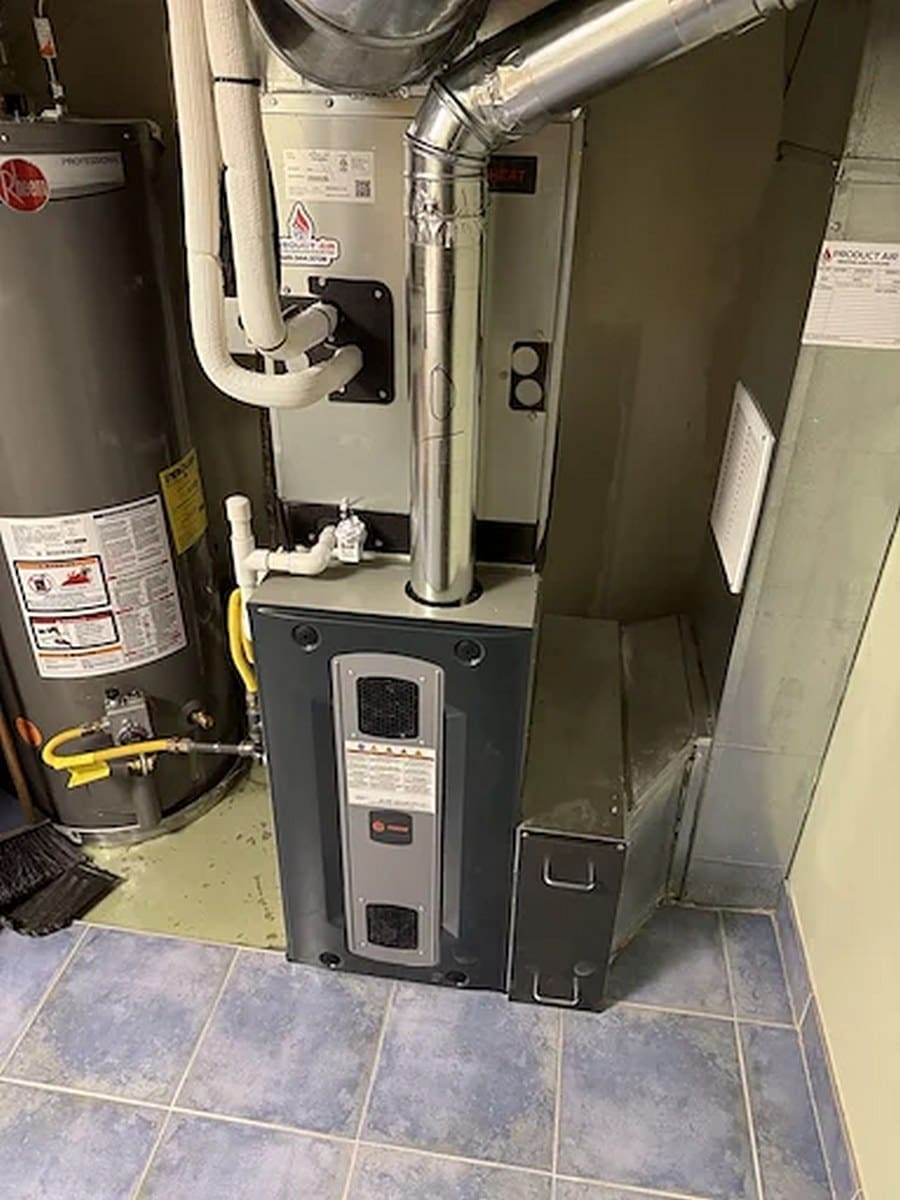
Tying the two together is the Mitsubishi intelli-HEAT MCO PAA-A42BA1 dual-fuel evaporator coil, which sits on the Trane furnace and is the piece that lets the heat pump and the gas furnace operate as one integrated system rather than two appliances sharing a closet. The 5-inch CAP G150 filter cabinet handles the allergen and smoke filtration. A Mitsubishi MHK2 communicating wireless thermostat runs the whole system from the wall.
| Component | Detail |
| Gas Furnace | Trane S8V2B080M4 Variable-Speed Communicating |
| Furnace Capacity | 80,000 BTU, 80% AFUE |
| Heat Pump | Mitsubishi PUZHA42NKA Hyper Heat, 3.5 Ton |
| Heat Pump Cold Rating | Operates to -13°F |
| Dual-Fuel Coil | Mitsubishi intelli-HEAT MCO PAA-A42BA1 |
| Filtration | 5″ CAP G150 Filter Cabinet |
| Thermostat | Mitsubishi MHK2 Communicating Wireless |
| Electrical | New dedicated circuit, main panel to outdoor disconnect |
| Furnace Model Number | S8V2B080M4 |
| Heat Pump Model Number | PUZHA42NKA1 |
| Manufacturer Warranty | 12 years (Mitsubishi heat pump), 10 years (Trane furnace) |
| Product Air Labor Warranty | 5 years |
How the Installation Ran
The visit and full written estimate were completed on January 17. Jason reviewed the options, chose the hybrid system, and the installation was scheduled.
The full installation was completed on February 11. Our crew removed the 2007 Rheem furnace from the closet and disposed of it, then set the new Trane S8V2B080M4 in the same location with new flue venting and gas piping connections. The intelli-HEAT MCO coil was installed on top of the furnace, and the 5-inch filter cabinet was integrated into the return with a new return grate. Outside, the Mitsubishi PUZHA42NKA was set on its concrete-and-foam pad, and the insulated copper line-set was run from the outdoor unit to the indoor coil.
Our licensed electricians installed a new circuit breaker in the main panel and ran a new electrical circuit out to the outdoor unit disconnect. The system was pressure-tested and evacuated, refrigerant was charged to Mitsubishi’s specification, the MHK2 thermostat was commissioned, and the dual-fuel changeover logic was configured and tested. System startup and verification completed the same day.
Product Air handles all permitting as part of every installation. Heat pump work in Seattle requires mechanical, refrigeration, and electrical permits from Seattle SDCI, with combined costs that run $149 to $500 depending on declared project value, and we pull them in most cases within 4 to 24 hours. The permit inspection was scheduled for the day after the installation, and the inspector signed off the following morning.
What the Project Cost
| Program | Amount |
| Seattle City Light Midstream Rebate (HSPF2 9.5) | $600 |
| Federal Tax Credit | $2,000 |
| Total Rebates and Credits | $2,600 |
Base price: $22,827.62
Final cost after rebates and credits: $20,227.62
Jason paid out of pocket. No financing was used. The Seattle City Light midstream rebate of $600 applies because the Mitsubishi heat pump qualifies at the higher HSPF2 9.5 efficiency tier, the level that earns the upper SCL rebate rather than the $300 base. The $2,000 federal tax credit was applied for this installation, completed in early 2026.
The midstream rebate was deducted directly on the invoice; our office team handled the paperwork and program filing. Jason did not chase forms or wait for reimbursement on the rebate. The savings were built into the number he paid.
What the Next 15 to 20 Years Look Like
A professionally installed hybrid system of this caliber, maintained on a regular schedule, carries an expected service life of 15 to 20 years in Seattle’s climate. The 12-year Mitsubishi manufacturer warranty on the heat pump, available only through a Mitsubishi Diamond Elite Contractor, which Product Air is, covers the parts on the heat pump for the full term, two years longer than the standard 10. The Trane furnace carries its own 10-year manufacturer warranty.
Product Air’s 5-year labor warranty covers the installation itself, with no strings attached to that commitment.
The efficiency change is real and it works in two directions. The old Rheem was an 80% single-stage furnace, meaning 20 cents of every gas dollar went up the flue, and it had no cooling capacity at all. For most of the Seattle heating season, Jason’s heat now comes from the heat pump operating at an effective COP of 2.5 to 3.5, which is dramatically cheaper to run than burning gas in mild weather.
When it is genuinely cold, the modulating Trane furnace takes over and delivers steady, efficient gas heat. And in summer, the house has air conditioning for the first time: the same outdoor unit, doing the opposite job. Homeowners who move from a gas-only furnace to a hybrid heat pump in Seattle commonly see heating costs drop meaningfully across the milder two-thirds of the year, with the gas furnace reserved for the stretches where it is the better tool.
Then there is the thing Jason called us about in the first place: the noise, and the confidence. The single-stage Rheem that cycled on and off in a closet near the living space is gone. In its place is a variable-speed system that ramps gently and holds a steady output, with a heat pump outside that Mitsubishi built specifically to be quiet. The household is breathing through a 5-inch filter that catches what the old one-inch never could through allergy season and through smoke season both.
After the work was done, Jason called back. His words: “I’m so happy that I chose you and could speak freely of all my needs. Yes, it was a big investment, but it’s one I don’t regret.”
Key Takeaways
- A hybrid dual-fuel system pairs a heat pump with a gas furnace so the heat pump handles Seattle’s mild winter efficiently while the furnace provides an independent backup for the coldest stretches, the right choice for a homeowner who wants efficiency but refuses to depend on a single heat source.
- Mitsubishi’s intelli-HEAT platform integrates the heat pump and furnace into one communicating system that automatically selects the more efficient heat source in real time; the homeowner sets a temperature and the system decides which fuel to use.
- A 5-inch filter cabinet holds roughly five times the media depth of a standard one-inch filter, capturing far more of the fine particulate that carries allergens and wildfire smoke, a meaningful upgrade for households with allergy or air-quality concerns, and it needs changing far less often.
- Replacing a single-stage furnace with a variable-speed, communicating model is most of the reason a new system runs quieter: modulation lets the equipment ramp to match demand instead of cycling on and off at full capacity.
- Seattle City Light’s midstream rebate pays $600 for heat pump systems qualifying at the higher HSPF2 efficiency tier; combined with the $2,000 federal tax credit applied at this installation, Jason’s out-of-pocket cost dropped from $22,827.62 to $20,227.62.
- A working furnace at the end of its service life is a reasonable thing to replace before it fails: Jason’s Rheem still ran, but at roughly 19 years old, with prior repairs and rising noise, he chose to replace it on his own schedule rather than during the coldest week of the year with two contractors he didn’t choose.
What We Are Building Here
Product Air Heating, Cooling and Electric serves Western Washington from Seattle through Snohomish County, the Eastside, and Skagit County. We are a Mitsubishi Diamond Elite Contractor and a licensed electrical contractor in every jurisdiction we work, and the team working Wedgwood, Sandpoint, Lake City, and the University District has been doing this work in these neighborhoods for over a decade.
Jason called two other established companies before he called us. He chose Product Air because his neighbor told him he would be treated like family and because when Eli walked in, the first questions were about Jason’s family and what they needed, not about what we wanted to sell.
That is the whole idea. Come to understand the problem, lay out every option in writing, and leave the choice in the homeowner’s hands. Jason had the budget-friendly options in his hand the entire time. He chose the system that answered every line of what he told us mattered. We installed it, pulled the permits, stayed through the inspector’s sign-off, and left him with heat he does not have to doubt in January.
— Serge Nikolin, Co-Founder, Product Air Heating, Cooling and Electric
Marysville · Issaquah · Seattle · Western Washington
PLAN YOUR NEXT STEP
Need help with your home comfort?
Explore Product Air’s heat pumps services or contact the team.
Share this guide