

If you’re comparing furnace estimates for your home, you may find yourself looking at three different descriptions: single-stage, two-stage, and variable-speed. Each sounds like a different level of equipment coming with a different price tag. What’s harder to tell is whether the upgrade will make your bedroom warmer, your living room quieter, or your heating bill noticeably smaller.
Those are the questions I want to help you answer.
The first thing to understand is that these terms describe different functions. Single-stage and two-stage refer to the furnace’s gas heating output. Variable-speed usually refers to the blower that moves air through your home (AFUE describes how efficiently the furnace converts fuel into heat).
Once you separate those features, the conversation becomes much more useful. You can look at what your house needs and decide which improvements are worth paying for.
Start With the Burner, the Blower, and the Efficiency Rating
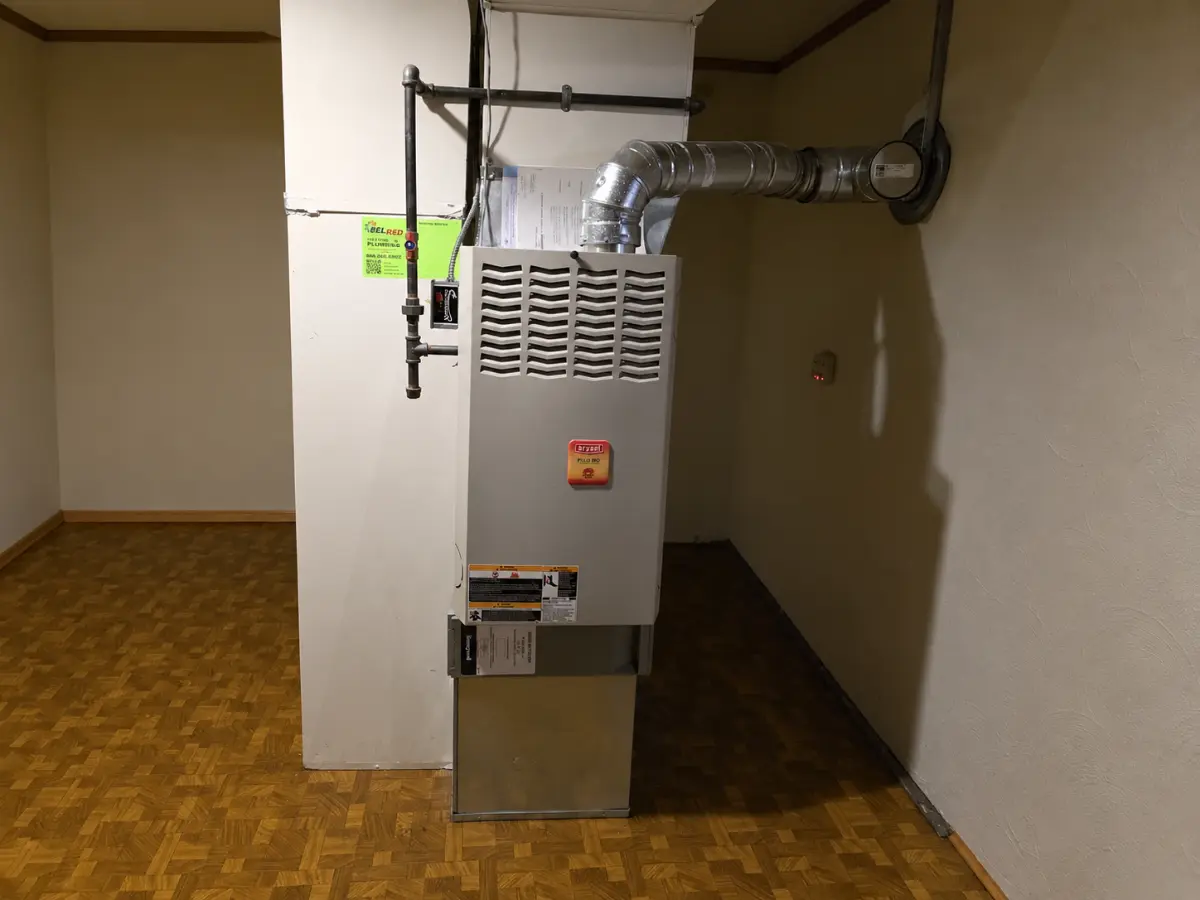
A gas furnace produces heat by burning fuel inside a combustion system. That heat passes through a heat exchanger, while a separate blower moves household air across the exchanger and through the ductwork.
A single-stage furnace has one operating level of gas heat. When the thermostat calls for heating, the furnace runs at that level until the call is satisfied.
A two-stage furnace has a lower and a higher heating output. It can use the lower stage when the house needs less heat and the higher stage when demand increases.
A variable-speed blower provides additional control over airflow. A furnace can have both two-stage gas heat and a variable-speed blower, so these aren’t three mutually exclusive choices.
Modulating gas heat is another feature altogether. A modulating furnace can adjust its heating output across a broader range rather than choosing between two fixed stages. The words “variable-speed” alone don’t tell you that the gas burner modulates.
Trane’s equipment provides a comparison example. Its 80% AFUE lineup includes the single-stage S8X1, the two-stage S8X2, and the two-stage, variable-speed S8V2-C. Their heating and blower capabilities differ even though they share the same AFUE rating.
Single-stage equipment can also have a high efficiency rating. Trane offers its S9X1 family under the 96 Single-Stage name, which is a reason you shouldn’t assume that the number of heating stages determines fuel efficiency.
Where Two-Stage Heating Can Make a Difference Around Puget Sound
Western Washington’s climate is moderated by the Pacific Ocean and Puget Sound, although conditions vary between the lowlands and the foothills. That variation matters when sizing equipment for a particular address.
Consider an illustrative fall day when it’s 45°F outside and you’re keeping the house at 70°F. Your home needs heat, but it may need considerably less than the furnace’s full output.
A single-stage furnace supplies heat at its one operating level, then shuts off when the thermostat is satisfied. A two-stage furnace may be able to run longer at its lower output, bringing the temperature up more gradually.
That can feel different in everyday life. You may notice less of a rush of warm air, gentler temperature changes, and quieter operation during low-stage heating. Carrier describes these as potential comfort benefits of matching furnace output more closely to heating demand.
When the house needs more heat, the higher stage is available. Having a lower stage doesn’t mean the furnace has to struggle through a cold spell.
The equipment still needs to be sized properly, though. If the furnace is so large that even its low stage supplies too much heat, it can continue to cycle more often than you would want. Two-stage operation gives the system more flexibility, but it doesn’t remove the need for a proper load calculation.
Longer Heating Cycles Don’t Automatically Mean Higher Bills
A quieter furnace that runs longer can make homeowners nervous. You’re used to hearing the old system shut down, and now the new one seems to keep going. Operating time is only part of the energy calculation, as you also need to know how much fuel or electricity the equipment uses while it runs.
Here’s a simplified example. Suppose a house needs 20,000 BTU of heat over an hour. Equipment delivering 60,000 BTU per hour would provide that amount in about 20 minutes. At an output of 40,000 BTU per hour, it would take about 30 minutes.
That example leaves out cycling losses and other real-world effects, but it illustrates the basic relationship: lower output over a longer period can deliver the same amount of heat.
It also explains why I wouldn’t promise a large reduction in gas use simply because a furnace has two stages. If you’re comparing two models with the same AFUE, ask what supports the savings estimate. Improved comfort may be a meaningful benefit even when fuel savings are modest.
What Moving From 80% to 96% AFUE Could Save
AFUE measures useful heating output relative to fuel input under a standardized calculation. It doesn’t describe heat losses throughout your duct system or replace a separate assessment of blower electricity use.
With the same heating requirement, the theoretical reduction in fuel use when moving from 80% to 96% AFUE is:
1 − 80 ÷ 96 = approximately 16.7%.
If the fuel used specifically for space heating costs $1,200 a year in an illustrative example, that works out to about $200 in annual savings. It doesn’t reduce fixed utility charges or gas used by your water heater and cooking appliances.
According to PNNL guidance on direct-vent equipment, the installation cost matters just as much. A condensing furnace needs an appropriate venting system and condensate drainage, and the location of the equipment can make those changes straightforward or more involved.
I want homeowners to see both sides of that calculation: the potential reduction in operating costs and the full installed price of achieving it.
A Better Blower Still Needs a Suitable Duct System
Variable-speed equipment gives us more control over airflow, but the value of that control depends on the system around it.
It’s also important to make a fair comparison. A modern variable-speed blower may look particularly attractive next to an old motor, while a less expensive new furnace may already include an efficient ECM motor. The letters ECM don’t, by themselves, tell you that two furnaces have the same airflow capabilities.
For a blower designed to maintain a target airflow, increasing duct resistance can cause it to increase speed and electrical consumption within its operating limits. DOE’s technical analysis accounts for this relationship.
That’s why I wouldn’t treat a variable-speed blower as a reason to ignore restrictive or damaged ducts. It has a job to do, and the system needs to allow it to do that job properly.
A Cold Bedroom Needs Its Own Explanation
Imagine an Everett home where the living room is comfortable but a bedroom above the garage stays cold. This is a hypothetical example, but it illustrates the diagnostic process.
That bedroom might lose more heat through its floor and exterior walls. It might receive too little supply air, or air might have trouble getting back to the return system when the door is closed.
I would like to know when the problem occurs. Does opening the door help? Does the room become noticeably colder during windy weather? Is airflow weak even while the furnace is running steadily?
Those observations help determine what to inspect and measure. A new blower won’t insulate the floor above the garage, and replacing the furnace won’t repair a crushed duct branch unless that work is included.
The same reasoning applies to equipment size. New windows, added insulation, or a finished basement can change a home’s heating requirements. The capacity of the old furnace tells us what someone installed, not necessarily what the house needs today.
An ACCA Manual J load calculation provides a method for evaluating those requirements. Where individual rooms have comfort problems, room-by-room loads are especially useful.
A Stanwood Project Shows Why the Whole Plan Matters
On one of our Stanwood projects, the homeowner had a gas heating system that was approximately 30 years old and no central cooling. The living room tended to be cooler than other spaces, and many of the home’s windows had already been replaced.
The project needed to address the house as it existed and the homeowner’s plans for staying there. We installed a two-stage Trane furnace with an 80% AFUE rating alongside a heat pump. That combination served several purposes. The heat pump added cooling capability, while the furnace provided staged gas heating.
It would take appropriate measurements to assign energy savings to any individual feature. What the project demonstrates is the importance of choosing equipment around the homeowner’s actual needs, including needs that extend beyond winter heating.
Compare the Installed Systems, Including What Happens After the Sale
Two estimates may include substantially different work. One might retain your existing thermostat and duct connections, while another includes new controls, a filter cabinet, duct modifications, and a different venting arrangement.
Before calling the entire price difference an upgrade to two-stage heating, compare:
- The complete model numbers and capacities, as well as AFUE ratings.
- The blower type and proposed controls.
- Duct, venting, drainage, and electrical changes.
- Permits, inspections, and startup testing.
- Equipment and labor warranties.
- Taxes and the final installed price.
Your thermostat deserves attention here. Having an app doesn’t establish compatibility with every furnace. The contractor needs to check how the proposed system will control its heating stages and what connections or communicating controls it requires.
After installation, the equipment should be checked in its intended operating modes. Warm air coming out of a register confirms that something is happening, but it doesn’t establish that the whole system is configured correctly.
When I Would Consider a Single-Stage Furnace
If your previous system kept the house comfortable, airflow is adequate, and you mainly need to replace worn-out equipment, a properly selected single-stage furnace should meet your needs.
With a limited budget, it may also make sense to address a documented duct problem or excessive heat loss rather than spend the entire amount on additional furnace features.
Two-stage heating becomes more interesting when gentler heating cycles and potentially quieter low-stage operation matter to you. Variable-speed airflow offers additional capabilities that should be evaluated against your particular system.
Ownership costs belong in that discussion, too. Some electronic controls and blower components can cost more to replace, but that doesn’t establish that a more sophisticated furnace will fail more often.
Ask what the warranty actually covers. Things like parts, labor, registration requirements, and maintenance conditions all deserve a clear explanation. A long heat exchanger warranty is not the same as a promise of free repairs for the entire furnace.
Mention Future Heat Pump Plans Before Choosing a Furnace
If you expect to add a heat pump later, bring that up before selecting the furnace.
The equipment needs compatible airflow, an appropriate indoor coil arrangement, and controls that coordinate the heating sources. Neither two-stage heat nor a variable-speed blower guarantees compatibility with every future heat pump.
Operating costs also need a whole-system comparison. A hybrid system can reduce gas consumption while increasing electricity consumption, and the financial result depends on rates and how the equipment operates. PSE specifically notes this in its hybrid heat pump guidance.
Rebates have their own customer, equipment, and installation requirements. Buying a two-stage furnace alone doesn’t establish eligibility, and a program available today shouldn’t be assumed to remain unchanged for a project several years away.
Permits and Startup Testing Are Part of a Proper Replacement
Installation quality determines how well the equipment can deliver its rated performance.
Permit requirements depend on the jurisdiction and scope of work. Redmond, for example, explicitly includes furnace replacement among projects requiring a permit and requires a final inspection to complete the process.
At Product Air, we handle the necessary permit paperwork and coordinate required inspections as part of the project.
The installation also needs appropriate gas connections, combustion air, venting, electrical connections, and condensate drainage where applicable. Changes to a shared vent can affect another appliance, such as a gas water heater, so that relationship needs to be evaluated.
Startup testing includes checking airflow, gas heating input, and temperature rise across the furnace against the applicable equipment requirements. These checks are included in PNNL’s guidance for quality gas furnace replacement.
Where electrical work is involved, Washington L&I advises homeowners to verify contractor licensing, worker qualifications, permits, and inspections.
You should also receive a practical walkthrough of your system: thermostat operation, filter access, maintenance requirements, and the documents associated with the completed work.
Bring Us the Problems You Want to Solve
Before a consultation, make a few notes about your home. Identify the rooms that feel uncomfortable, when the noise bothers you, and whether temperatures change noticeably between heating cycles. Mention improvements such as new windows or insulation, and have heating-season utility bills available if operating costs are a priority.
Those details help us distinguish between a straightforward replacement and a project that needs changes elsewhere in the system.
At Product Air Heating, Cooling, and Electric, my role is to be your tech brother from another mother: to explain the options in terms of what they can do for your house. You should understand the reason for each recommendation, what the additional cost buys, and which problems the proposed work can realistically address.
If you’re planning a furnace replacement in Western Washington, we can start with an assessment of your home and the comfort you want from it. That gives us a sound basis for choosing equipment you’ll be comfortable living with long after the installation is finished.
PLAN YOUR NEXT STEP
Need help with your home comfort?
Explore Product Air’s heating services or contact the team.
Share this guide