

Location: NE 80th Street corridor, Seattle, WA 98115
Call Date: April 22, 2026
First Visit: April 24, 2026
Project Completion: May 29–30, 2026
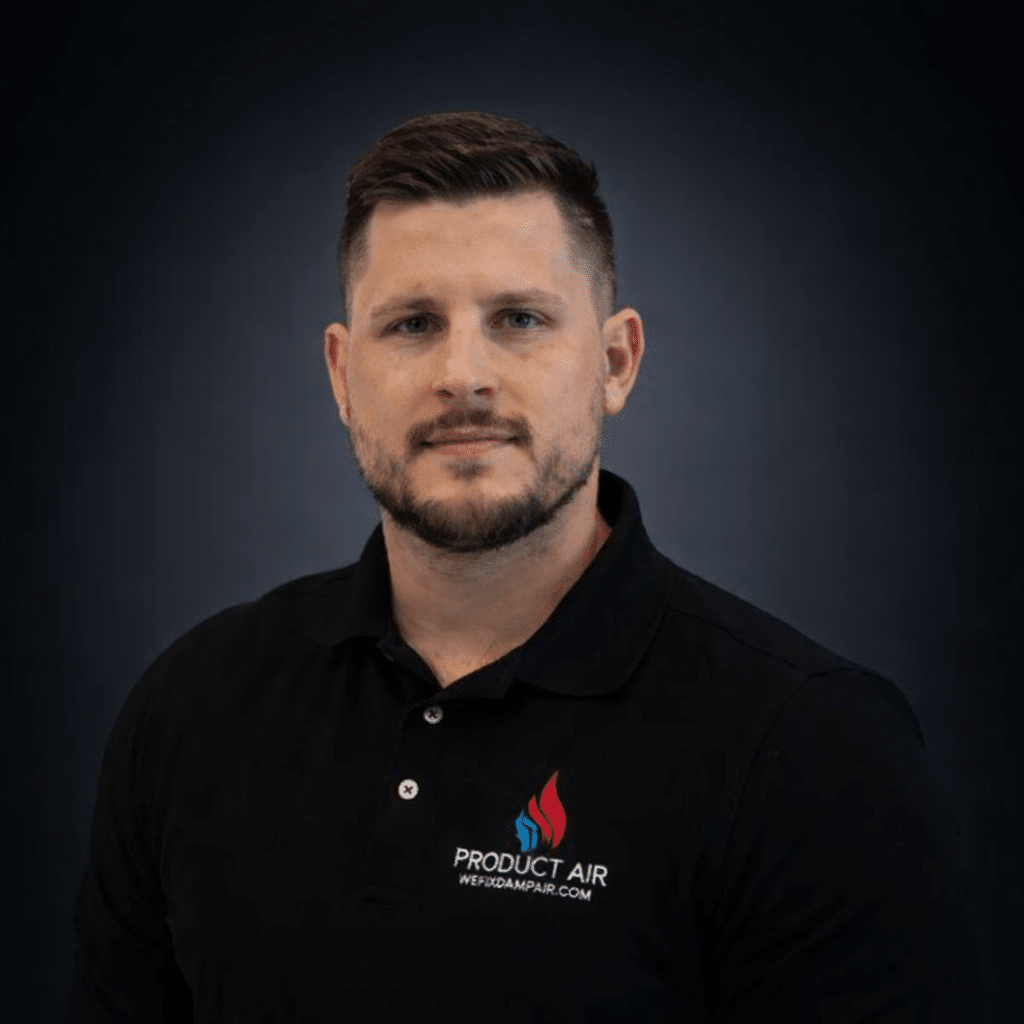
Lead Technician: Serge Nikolin, co-founder, 12 years of HVAC experience
System Before: Wall heaters throughout, no AC, panel without capacity for heat pumps
System After: Two independent Mitsubishi single-zone ductless AC systems (MUZJX09WL + MSZJX09WL), each individually controlled
Final Project Cost: $12,999.92
The Office That Faced West
Daine had been in Seattle for about a year when she finally decided to do something about the afternoons.
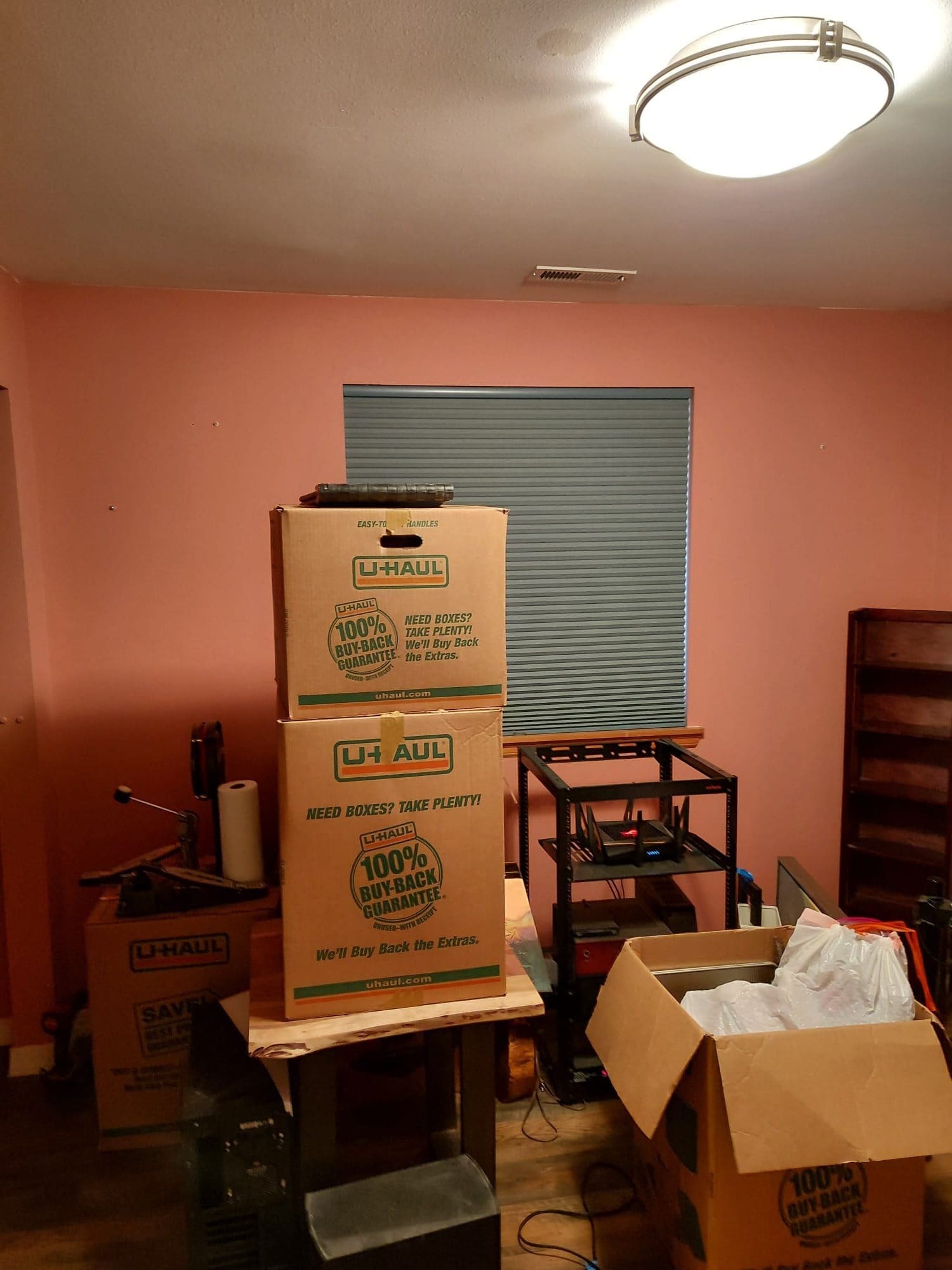
The house on NE 80th Street was built in 1908: two stories, 2,820 square feet, the kind of older Seattle home that was built before air conditioning existed as a concept. She and her partner had moved in and discovered, the way people always discover Seattle summers, that the Pacific Northwest gets warm in a way no one tells you about before you arrive. And Daine worked from home, mostly at a desk in her office on the west side of the house.
Every afternoon, the sun came through that west-facing window and turned the room into a sauna. By 2 or 3 p.m., it was difficult to work. She tolerated it through one Seattle summer. By April of the second year, she was done tolerating it.
“I work mostly from home and with the office facing west, I get super warm here,” she told Serge when he arrived on April 24. Word for word, that was the whole problem.
She had found Product Air on Angi. She called because two other contractors had already come out and walked away without a solution.
What the Other Contractors Said
Both of them had the same answer: it can’t be done. Neither one explained in detail why or what specifically they had ruled out, or what alternatives they had considered. They came, they looked, and they told Daine that cooling her office wasn’t something they could help with. She accepted that for about as long as it took to find Product Air on Angi and schedule a third opinion.
Serge arrived on April 24. He walked through the 1908 house and understood within a few minutes exactly what the other contractors had seen and exactly where their thinking had stopped.
What the Assessment Showed
A 1908 Seattle home carries a specific electrical profile. The house was built on wall heaters, electric resistance units mounted in the rooms, which is how most Seattle homes of this era were heated before ductwork became standard. No forced air. No central system. No infrastructure for a ducted heat pump.
The electrical panel was the constraint. The home’s existing electric wall heaters already consumed most of the available capacity, leaving little room for additional electrical load.
Most contractors looked at the panel and concluded that adding a ductless system wasn’t possible. Had the new system been intended to provide heating as well, they would have been right to be cautious. The panel didn’t have enough spare capacity to comfortably accommodate another major heating load.
Serge saw the same panel, but he approached the problem differently.
The homeowners didn’t need a new heating system. They needed cooling. During the summer, when the ductless units would be running, the electric wall heaters would be off. Because those loads would never operate at the same time, the panel could safely support compact AC-only ductless units sized specifically for the home’s cooling needs.
Where others stopped at what the panel couldn’t do, Serge focused on what it could do.
Three Options, One Engineering Constraint, and One Pitch That Made Sense of It All
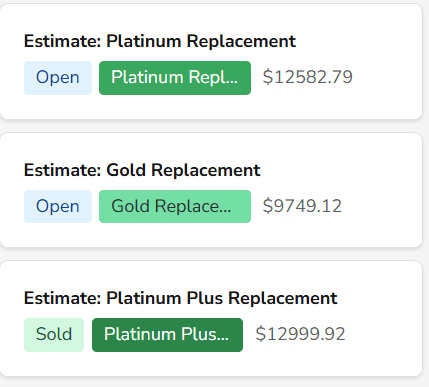
Serge put together three estimates. All three were ductless because that was the only viable path for a house with no forced air and a panel running at capacity. The difference between them was scope: how many zones, and how many independent systems.
Gold. Ductless AC for Daine’s office only: One outdoor unit, one wall-mounted indoor unit, one zone. The office gets cooling. Everything else stays as it is. $9,749.12.
Platinum. Ductless AC with 2 zones: One outdoor unit, two indoor units, two zones running off a single system. Two rooms cooled, shared compressor. $12,582.79.
Platinum Plus. Two fully independent ductless systems: Two separate outdoor units, two separate indoor units, two completely independent systems. Each workspace controlled on its own thermostat, with no shared equipment. $12,999.92.
The difference between Platinum and Platinum Plus was $417. One gave them two zones sharing a single compressor. The other gave them two zones that had nothing to do with each other.
Serge explained it directly:”The panel situation is why so many contractors said it couldn’t be done. They were thinking of a heat pump. What I can do is AC-only ductless, because the panel can carry that. And Daine, I heard that you want to be able to control your room separately from everyone else. That’s why I’m offering the two separate systems. So both spaces can be individually controlled.”
She and her partner both worked from home. Both had their own rooms. The Platinum Plus gave each of them their own system: separate controls, separate thermostats, no negotiating about temperature.
What Other Contractors Miss When They Say “It Can’t Be Done”
This case comes up more often than it should in Seattle, and it’s worth explaining what’s actually happening when a contractor looks at an older home and says the words “can’t be done.”
In almost every case, what they mean is: the specific solution I’m familiar with won’t work here. They’re not wrong. They just didn’t finish the sentence.
A ductless heat pump system for a 1908 Seattle home with wall heaters and an older panel is, in many cases, genuinely not viable without a panel upgrade. The combined electrical load (wall heaters running in winter, heat pump running) exceeds the panel’s safe capacity. That’s a real constraint. It’s not made up.
But an AC-only ductless system is a different calculation entirely. Ductless AC-only units at the 9,000 BTU range, the size appropriate for a home office or a single-occupancy room, draw roughly 6 to 8 amps at operating load. A panel that can’t add a heat pump can almost always carry one of these. Sometimes two.
The tradeoff is that an AC-only ductless system does not provide heating. In a house with wall heaters that already handle the heating, this is not a tradeoff at all. The wall heaters stay. The ductless system handles the cooling. The two systems don’t compete for panel capacity because they run in different seasons.
It’s not a workaround. It’s the correct solution for the specific situation. This is the kind of reading a 12-year technician does standing in front of a 1908 panel. Not every contractor has seen enough of these houses to get there quickly. Serge has.
What Was Installed
Two independent Mitsubishi single-zone systems, identical in specs, installed in the two separate workspaces.
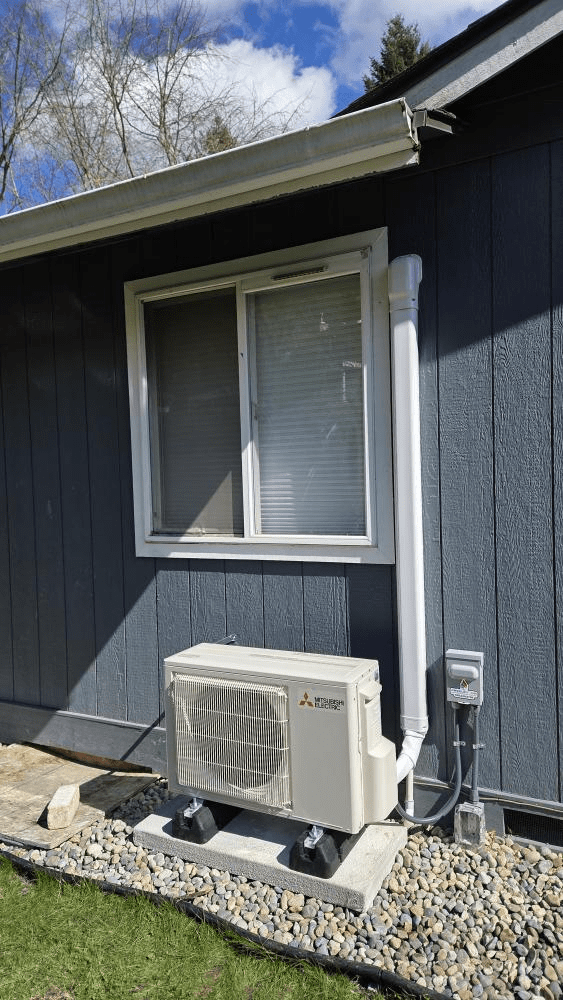
Outdoor unit (×2): Mitsubishi MUZJX09WL, 0.75 ton, 9,000 BTU, ultra-quiet side discharge. Single-zone. Modulating, variable speed compressor.
Indoor unit (×2): Mitsubishi MSZJX09WL, 0.75 ton, 9,000 BTU, ultra-quiet wall-mounted fan coil. Variable speed. Individual thermostat and remote control for each unit.
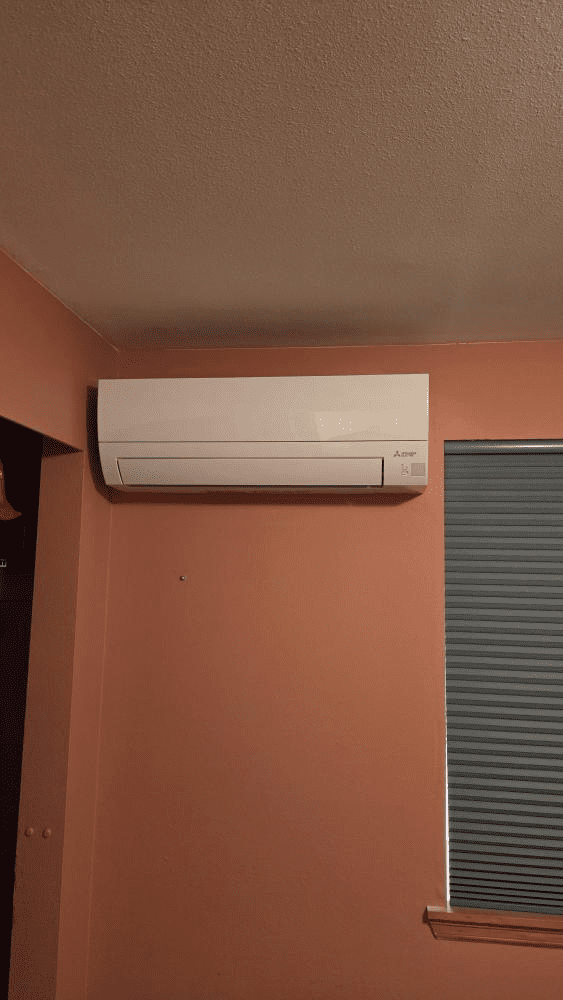
The 9,000 BTU capacity is specific to room-level cooling: a home office, a bedroom, an individual workspace. It is not a whole-house system, and it was never presented as one.
Daine’s problem was her office. Her partner’s problem was their workspace. Each system solves one room completely, independently, without affecting the other.
The Mitsubishi JX series is the entry into Mitsubishi’s residential lineup, the unit you install when the cooling need is specific and the space is defined. Ultra-quiet means the indoor unit registers around 19 to 26 decibels at low speed, which is quieter than a whisper. Variable speed means it modulates output to the actual thermal demand of the room rather than cycling on and off at full capacity.
| Component | Detail |
| Outdoor Unit | Mitsubishi MUZJX09WL, 0.75 ton, 9,000 BTU, variable speed |
| Indoor Unit | Mitsubishi MSZJX09WL, 0.75 ton, 9,000 BTU, wall mount, variable speed |
| Configuration | Two fully independent single-zone systems |
| Operation | AC-only. Cooling and dehumidification, no heating |
| Manufacturer Warranty | 12 years |
| Product Air Labor Warranty | 5 years |
The Installation: One Day on Site
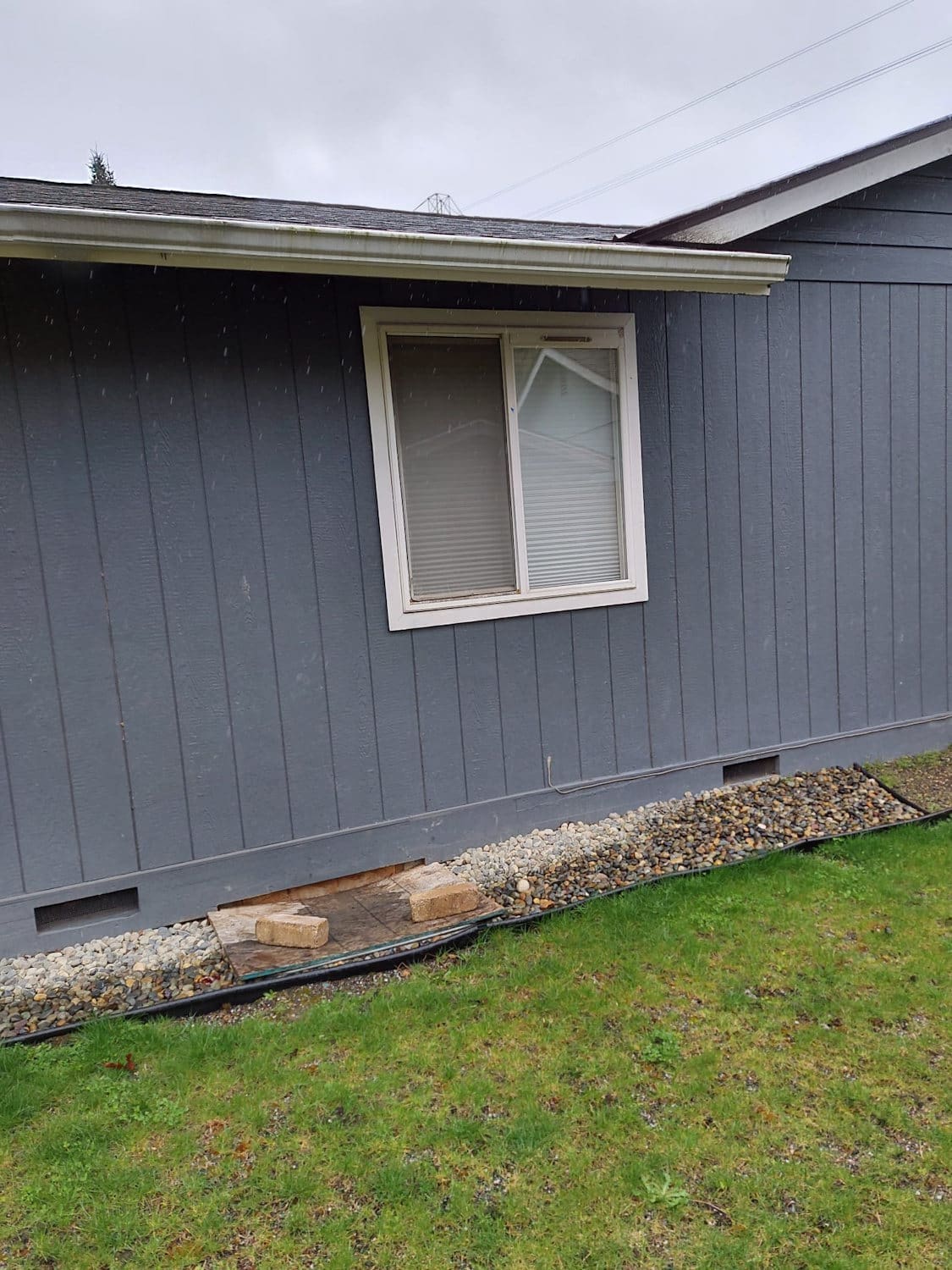
The installation ran on May 29. One day, both systems, start to finish. Each outdoor unit was set on a pad at the exterior wall below the respective room’s window. Refrigerant line sets were run through the exterior wall and up to each indoor unit. The line is visible on the outside of the house, neatly routed and covered.
Each indoor unit was mounted high on the interior wall, above the window line, positioned to distribute cooling across the full depth of the room. Both systems were commissioned, pressure-tested, and confirmed operational before the crew left.
Product Air pulled all permits ahead of the installation date. Seattle mechanical and refrigeration permits for a ductless installation of this type run $149 to $500 depending on project scope; Product Air handles permitting directly with SDCI and pulled the permits in advance of the May 29 work date. Inspectors came out May 30 to sign off. The homeowners filed nothing.
Price and Rebate Transparency
Final project cost: $12,999.92.
No rebates were applied to this project, and that answer is straightforward. The available rebate programs in Seattle, Seattle City Light, PSE, and the Energy Smart Eastside program, are structured for heat pump installations. A heat pump provides both heating and cooling; the rebate programs exist to accelerate the transition away from gas and resistance heating by incentivizing heat pump adoption.
An AC-only ductless system does not provide heating. It does not qualify for heat pump rebate programs, because it isn’t replacing a heating source. The wall heaters stay. The ductless systems handle the cooling only.
Serge laid this out on the April 24 visit. The rebate conversation was short: no programs apply to this installation type. The price on the invoice is the price paid.
$12,999.92. Paid cash.
What This Looks Like Going Forward
The Mitsubishi JX series carries a 12-year manufacturer warranty, one of the longest in residential ductless, available because Product Air holds Mitsubishi Diamond Contractor status. A standard installer gets a 10-year warranty on the same equipment. The Diamond status adds two years at no cost to the homeowner.
Product Air’s labor warranty runs 5 years on this installation. The systems themselves are sized for room-level use in a Pacific Northwest climate. Seattle’s cooling season (the weeks of genuine heat, concentrated between June and September) is well within what a 9,000 BTU variable speed system handles at partial load most of the time. The unit doesn’t run hard here. It modulates. On a 75°F afternoon, it barely works. On the days that used to make Daine’s office unusable, it keeps the room at whatever temperature she sets.
Each system is on its own thermostat, controlled independently. Daine sets hers. Her partner sets theirs. Nobody negotiates. “Daine is in love with having an opportunity to control her office temp to her liking,” Serge said afterward.
That was the whole ask. That’s what was delivered.
Key Takeaways for Seattle Homeowners in Pre-1930s Homes Without Central Air
- When a contractor says “it can’t be done,” ask them what specifically can’t be done. In most cases they mean one specific type of system won’t work. That is not the same as no solution existing.
- A ductless heat pump and an AC-only ductless system have very different electrical load profiles. If your panel can’t carry a heat pump, it may still be able to carry an AC-only unit and in a home with existing wall heaters, AC-only is the correct solution anyway.
- AC-only ductless installations do not qualify for Seattle heat pump rebate programs. The rebates are specifically for heat pumps. This should be disclosed upfront, and Serge disclosed it on the first visit.
- A 9,000 BTU single-zone system is sized for a home office, a bedroom, or a defined individual workspace, not a whole house. For whole-house cooling in a home without ductwork, multiple zones or a multi-zone system are needed. Sizing to the actual problem costs less than oversizing.
- Two fully independent single-zone systems cost only marginally more than one multi-zone system ($12,999.92 vs. $12,582.79 in this case), but give each occupant complete independent control with no shared compressor. For a household where two people work from home in separate rooms, this is the correct design.
- Mitsubishi Diamond Contractor status extends the manufacturer warranty from 10 to 12 years at no additional cost. On a system expected to run for 15 to 20 years, that matters.
Product Air Heating, Cooling and Electric. HVAC and electrical service in Seattle, Marysville, Issaquah, Mercer Island, and across Western Washington. Licensed HVAC and electrical contractors. When other contractors leave without a solution, we keep looking until we find one. We came to solve the problem, not to explain why it can’t be solved.
— Serge Nikolin, Co-Founder, Product Air Heating, Cooling and Electric
Marysville · Issaquah · Seattle · Western Washington
PLAN YOUR NEXT STEP
Need help with your home comfort?
Explore Product Air’s heat pumps services or contact the team.
Share this guide