

The Call Came In as a Routine Maintenance Visit
When I pulled up to a house in Mukilteo for what the homeowner had described as routine electrical maintenance, I wasn’t expecting much. A maintenance visit is usually methodical, quiet work. You go through the panel, you check the connections, you document what you find, and you leave the homeowner with a clear picture of where things stand.
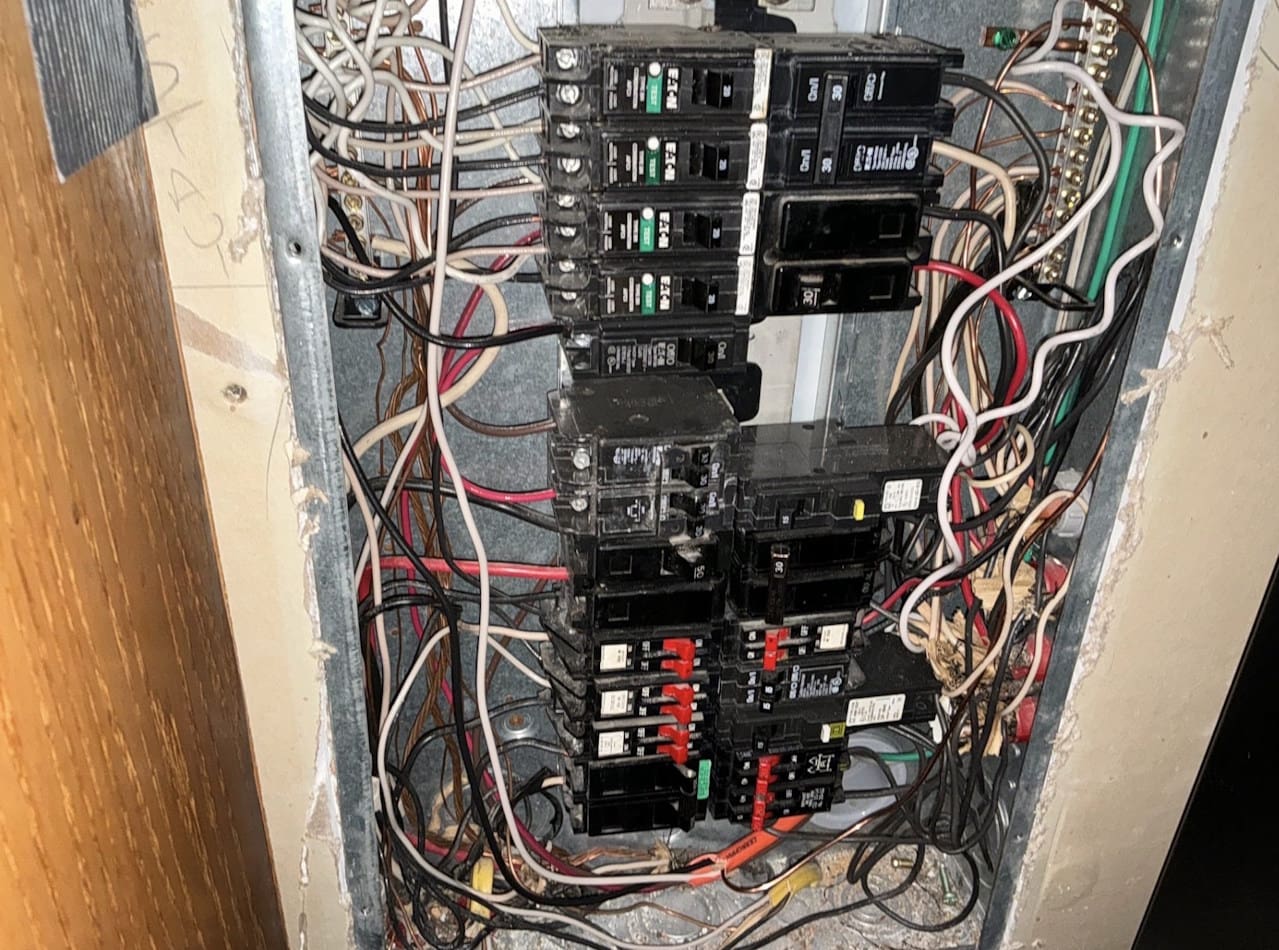
I introduced myself, they walked me to the electrical panel, and I opened the cover. I stood there for a moment before I said anything. The wiring inside wasn’t dangerous because something had recently failed. It was dangerous because of a long series of small decisions, made one after another, each one sounding reasonable on its own, each one quietly making the situation worse. The kind of decisions that don’t produce visible consequences right away. The kind that produces them later, in ways that are much harder to recover from.
I turned to the homeowner and asked the question I always ask in situations like this, because the answer almost always explains everything else I’m seeing. “Who did this wiring?” He said, “We did.” I kept looking. There was a second set of wiring: newer, for an air conditioning unit that had been installed not long before. I asked about that one too. It turned out the AC had been put in by a contractor, a real contractor, with a legitimate license. But his license was for HVAC work. Not for electrical. He had run the circuits anyway, and the homeowner had no reason to question whether that was within his scope.
By the time I finished the full assessment, the correction estimate came in at around $5,000. The homeowner signed the paperwork without negotiating the price, not because he had that money sitting around waiting to be spent, but because once you understand what you’re actually looking at, the math changes completely. This wasn’t a house with an untidy panel. This was a house where, under the right conditions, a fire could start inside the walls and have a significant head start before anyone noticed. It was also a house that, in its current state, would not pass the inspection required for sale and selling was exactly what they were planning to do.
The $5,000 wasn’t a repair. It was the price of having tried to save money earlier.
This Is Not an Unusual Story
I want to be honest about something before I go any further. When I describe that house in Mukilteo at the office, my colleagues don’t react with surprise. They’ve seen variations of it. I’ve seen variations of it myself across many jobs, many panels, and many homeowners who made decisions about electrical work the same way most people make financial decisions in home services: by trying to spend as little as possible right now, without a full picture of what that decision costs later.
The U.S. Fire Administration tracksresidential electrical fire data nationally, and the numbers are consistent enough that they’ve stopped being surprising to people in this industry, even though they should be. In 2023, there were 23,700 residential electrical fires across the country. Three hundred and five people died. Eight hundred were injured. Property losses came in at $1.5 billion.The National Fire Protection Associationfound that electrical failures or malfunctions cause roughly 13 percent of all home structure fires in the United States.
Washington State fire agencies report through the National Fire Incident Reporting System, andthe State Fire Marshal compiles that datainto annual statewide reporting. Electrical malfunction consistently ranks near the top of the causes of residential fires in this state.
But those numbers don’t explain why the fires happen. They tell you how many. The why is a different answer, and in my experience it’s almost always the same one. People didn’t call a licensed electrician. They did the work themselves, they hired someone without the right license, they let an HVAC contractor handle the electrical because he was already there, or they pulled no permits because permits feel like a bureaucratic obstacle when you’re trying to get a job done. And underneath all of those decisions, every single time, is the same thing: they were trying to save money.
That’s where the fire starts. Not in the wall. In the decision made before the work began.
When the Breaker Is Too Big and the Wire Is Too Small
The most common technical mistake I find, the one that most directly creates conditions for a fire, is a mismatch between the breaker and the wire it’s supposed to protect.
Here’s how it happens, because it’s easier to understand in practice than in theory. Someone reads online that a clothes dryer requires a 30-amp circuit. That’s correct, so they install a 30-amp breaker. But they also need to buy wire, and wire comes in different gauges, and thinner wire costs less than thicker wire. So they buy the thinner wire. The breaker handles the load, they figure. The wire just carries it.
That’s not how the system works.
A breaker is not a universal protection device. It’s sized for a specific wire gauge, and the two are designed to function together as a matched pair. If the wire is too thin for the breaker rating, here’s what happens when that circuit is under load: the wire starts to overheat. It begins to melt, slowly, inside the wall where no one can see it. And the breaker, which is calibrated to protect a heavier wire, doesn’t register a problem. It doesn’t trip. It’s doing exactly what it was designed to do: protecting a wire that isn’t there. The wire melts. The breaker sits there. And eventually, somewhere inside the wall, you get a short circuit.
I’ve opened panels and seen this exact combination. The person read the correct amperage requirement online. They bought the right breaker for that number. They just didn’t understand that the breaker rating and the wire gauge aren’t two independent decisions that can be optimized separately. They’re one decision. You don’t guess the load requirements and then economize on the wire. You calculate the load, you size the wire for that calculation, and then you match the breaker to the wire. That sequence is not optional.
What Sharp Metal Does to a Wire Over Time
The second pattern I see frequently is one that seems almost too minor to be serious until you understand what it’s actually doing inside the wall.
When a wire enters a metal enclosure (a panel, a junction box, a conduit fitting), it passes through an opening in the metal called a knockout. That edge can be sharp, and when someone without training pushes a wire through that opening, they often don’t install a protective bushing around it. They push the wire through the metal, the wire sits against that edge, and the cover goes back on.
The insulation on that wire is now resting against a sharp metal edge. Not firmly, just in contact, the way things sit inside walls that no one ever looks at again.
Then heat cycles begin. The appliances on the circuit run and stop, run and stop. The house settles through seasons. The panel itself vibrates. Expansion and contraction. Over months and years, that metal edge works through the insulation, slowly, the way these things always happen slowly. Until at some point, the copper conductor inside is in contact with the metal housing around it.
That’s a short circuit. Not an immediate one, not a sudden one, an eventual one. And in an enclosed wall with decades of accumulated dust and insulation, eventually is enough.
Why Panels Are Not Just Boxes for Wires
The third category of problems is harder to describe in a single image, but it’s just as serious, and in some ways it’s the hardest to find because it looks the most ordinary.
Inside a panel, precision matters at every connection. A neutral wire that wasn’t properly torqued under its terminal lug. Two conductors sharing a breaker that was designed and rated for one. Grounds and neutrals bonded in a subpanel where they shouldn’t be. Wire gauges mixed under the same connection point. These aren’t failures that announce themselves. A panel with problems like these can look completely normal to someone who isn’t trained to read what’s actually in front of them.
But arcing, which is what happens when electricity jumps across a poor or loose connection, produces heat. Heat inside a metal enclosure filled with wires and breakers is one of the most dangerous and hardest-to-detect conditions in a home. An arc doesn’t necessarily trip a breaker. It doesn’t produce smoke immediately. It builds heat, over time, until something around it reaches ignition temperature. And by then, the fire is already inside the wall.
A panel is an engineered distribution system. It wasn’t designed with extra tolerance for imprecision, because extra tolerance in electrical work tends to produce fires eventually. Every detail inside it matters, and the details that look the most unremarkable are often the ones that have been wrong the longest.
Back to Mukilteo: What the Full Picture Showed
When I finished the assessment at that house in Mukilteo, the $5,000 covered a lot of ground. Corrections to the homeowner’s own wiring. Corrections to the circuits the HVAC contractor had run without an electrical license. Bringing the grounding to code. Making the panel safe enough to pass inspection.
What I remember from that visit, more than the scope of work, was the homeowner’s reaction when I walked him through what I was seeing.
He hadn’t known. He’d done the wiring himself because he was careful and capable and he’d done his research. The AC contractor had seemed legitimate and professional, and there was no obvious reason to ask whether his license covered the electrical work he was doing. Nobody had set out to build something dangerous. They had each made decisions that seemed reasonable in the moment, and none of them had fully understood what those decisions added up to when they sat inside the same panel together.
That’s the thing about electrical work that’s different from most other projects in a home. The consequences are invisible and deferred. The cover goes back on, the lights come on, the appliances run, and everything seems fine. There’s no immediate feedback. The feedback sometimes comes years later, at two in the morning, in a form that nobody gets to walk back.
The Problem That Shows Up When You Try to Sell
There’s a second category of consequence that homeowners only discover when it’s already become expensive, and it almost always comes as a genuine surprise, because the connection between permits and real estate isn’t something most people think through in advance.
Electrical work done without permits doesn’t just create fire risk. It creates a documentation problem that surfaces at the worst possible moment. When a home goes on the market, when a refinance requires an appraisal, when an insurance claim gets filed after something goes wrong, the absence of permits and inspections becomes visible in ways that cost real money to address quickly.
Insurance companies can deny claims on work done without permits. A sale can fall apart at inspection. A buyer’s lender can require corrections as a condition of the loan, which puts the seller between a closing date and a contractor they need immediately. The homeowners I’ve seen in that position weren’t trying to create a problem for themselves down the road. They were just trying to get the job done without spending more than felt necessary. The permits felt like overhead. The unlicensed contractor quoted half the price of the licensed one. The savings seemed real.
Until they were standing in a kitchen trying to figure out how to close a sale in two weeks.
Why the License and the Permit Are Not Bureaucracy
To become a licensed electrician in Washington, you complete thousands of supervised field hours before you’re eligible to sit for the examination. After that, continuing education every three years, because the electrical code is not a fixed document. It gets revised. It changes when fires happen and the investigations reveal what failed. The code isn’t a set of restrictions invented to slow down homeowners. It’s a record, built over decades, of what goes wrong when those standards aren’t met.
When I pull a permit and request an inspection, I’m not adding paperwork to a project. I’m creating verification. A third party, employed by the jurisdiction, independent of me and my company, comes out and confirms that the work was done correctly. That record follows the property. It tells the next homeowner, and the one after that, that someone with the authority to check actually checked.
That’s what doesn’t exist when the permit isn’t pulled. Not a rule. Not a formality. A record. A confirmation that someone looked at the work before the wall went up.
What I Tell Homeowners Across Western Washington
Western Washington’s housing stock is aging, and the electrical demands on these homes keep increasing. Heat pumps. EV chargers. Induction ranges. Whole-home battery backup systems. Panels that were designed forty or fifty years ago for a fraction of today’s load are now being asked to carry circuits they were never sized for, and sometimes they’re being asked to do that by homeowners or contractors who don’t fully understand the limits they’re working within.
If your home is more than twenty-five years old and the panel has never been assessed by a licensed electrician, that’sscheduling a home electrical inspectionbefore something forces you to. Not because something is necessarily wrong, but because the only way to know is to look.
If you’re noticing lights that flicker when something large turns on, if you hear a faint buzzing near the panel, if there’s a burning smell somewhere in the house that you can’t locate, those are signs worth taking seriously that day, not next week. An electrical problem inside a wall doesn’t wait for a convenient time on your calendar. Feel free to read more aboutcommon electrical panel problems and how to prevent electrical fireshere.
And if you’re planning electrical work on your home, anything that involves the panel, adds a new circuit, installs an EV charger, or upgrades service, hire someone with a Washington electrical license, pull the permit, and let the inspector come out. The cost of that step is not overhead. It’s the guarantee that someone with the authority to verify the work actually did.
If you’d like us to come out and assess your panel, we do electrical maintenance visits across Western Washington. You can reach us at (425) 340-3576 or request a visit through our website. We’ll tell you exactly what we find, what it means, and what your options are. No pressure. No upsell. Just a clear picture of where things stand.
What “Saving Money” on Electrical Work Actually Costs
I’ve spent a lot of time over the years in homes where someone tried to save money on electrical work, and I’ve never once regretted being the person who found what they left behind. What I do think about is all the panels I haven’t seen.
The ones in homes across Everett, across Kirkland, across Seattle and Marysville and every other city we serve in Western Washington, where a wire is sitting against a metal edge somewhere inside a wall, or where a breaker is protecting a wire it was never sized for.
Those panels are out there. Not because the homeowners who built them are careless people. Because electrical mistakes are invisible until they’re not, and the decision to skip the license or the permit or the correct wire gauge always makes sense at the moment it’s made.
We don’t cut corners at Product Air. Not because there’s a rule on a wall that says we can’t. Because we’ve opened enough panels to know exactly what cut corners look like, and exactly what they eventually cost the family living on the other side of that wall. Every circuit we run is sized correctly. Every connection is torqued to spec. Every permit gets pulled, every inspection gets called. That’s not a differentiator. That’s the minimum standard of care that the people who let us into their homes deserve.
—Serge Nikolin, Co-Founder, Product Air Heating, Cooling and Electric
Marysville · Issaquah · Seattle · Western Washington
PLAN YOUR NEXT STEP
Need help with your home comfort?
Explore Product Air’s electrical services or contact the team.
Share this guide