


Location: NE 70th Street corridor, Seattle, WA 98115
Call Date: April 3, 2026
First Visit: April 7, 2026
Project Completion: April 12–13, 2026
Lead Technician: Serge Nikolin, co-founder, 12 years of HVAC experience
System Before: Oil furnace, original to the home
System After: Trane XV18 3-ton AC (18 SEER) + Trane S9V2B080 96% AFUE gas furnace, variable speed communicating
Final Project Cost: $19,982.16
The Basement Had Been Waiting Decades for This
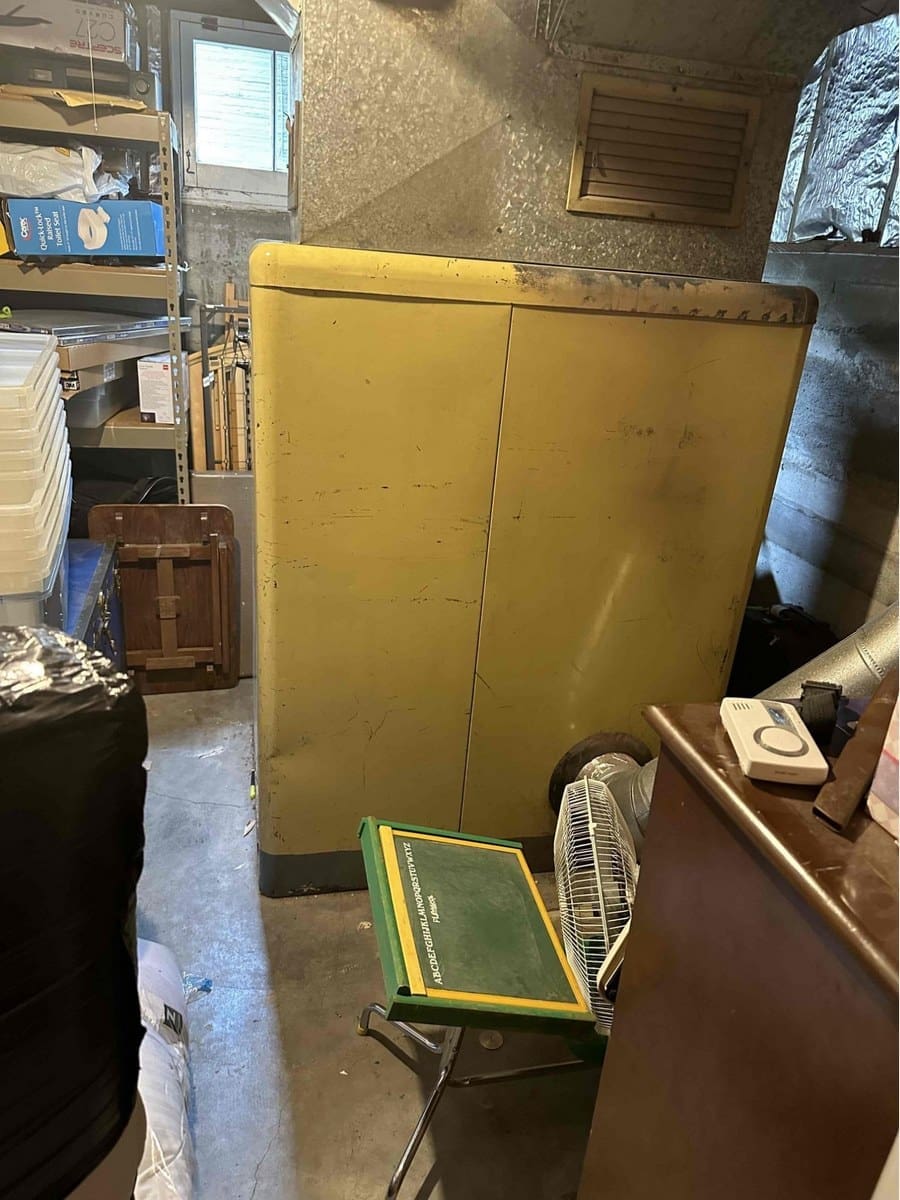
The house on NE 70th Street was built in 1947: four bedrooms, two stories, 2,450 square feet, and somewhere in the basement, the original oil furnace that had been heating the place for as long as anyone could remember.
It was still running. That part wasn’t the problem.
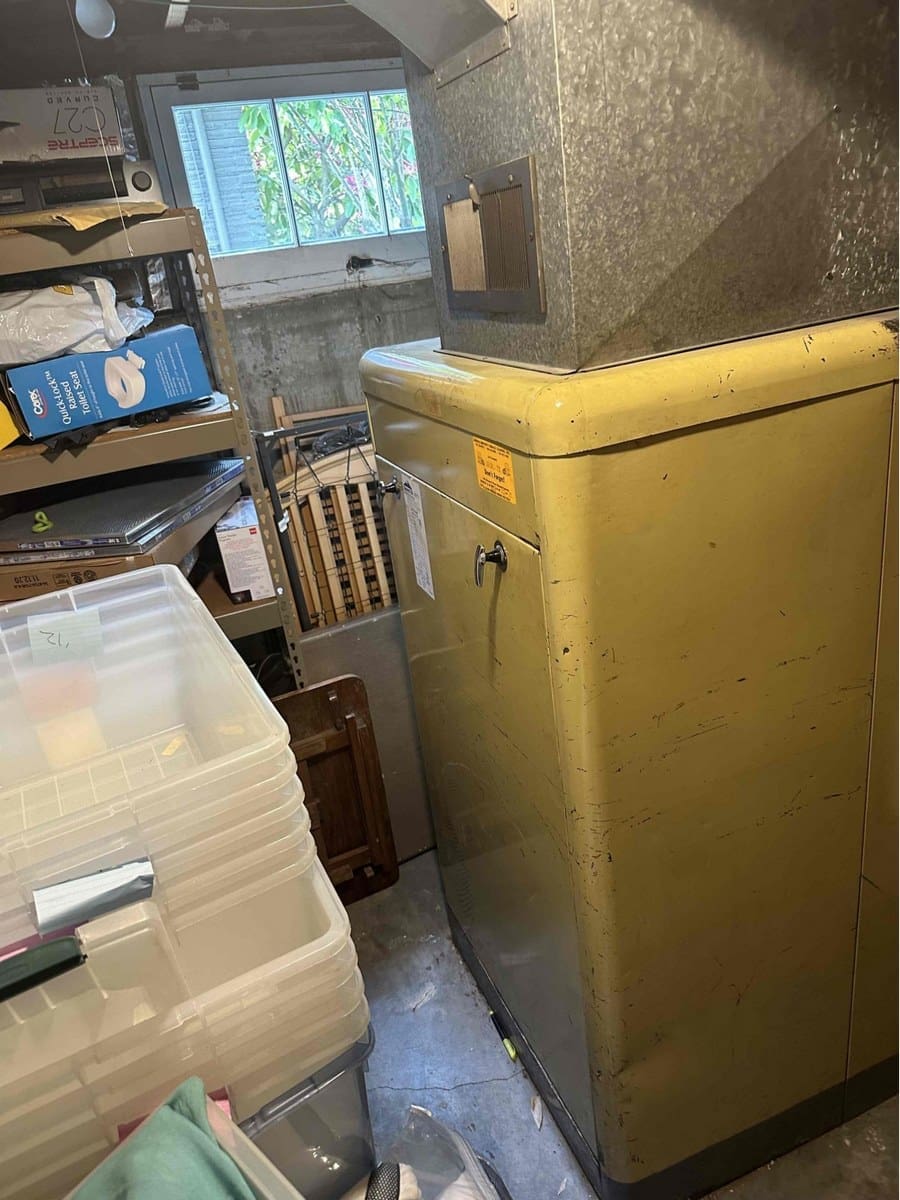
The problem was what it took up. Old oil furnaces from that era were built to last, and built big. You can see it in the photos. That yellow cabinet sitting in the corner of the basement, floor to ceiling, surrounded by everything Reema had arranged around it over the years.
Combustion chamber, heat exchanger, oil burner assembly, supply lines running to the tank. The kind of equipment that made sense in 1947 and had been claiming the same square footage every year since. Functional, the way very old things can stay functional. But large, and inefficient in a way that showed up on the utility bill every winter.
Reema had been thinking about this replacement for a while. She found Product Air on Google, called on April 3, and told Serge what she wanted: the oil system out, the basement space back, and a proper heating and cooling setup for a Seattle house in 2026.
That part was straightforward. What came next surprised Serge a little.
What She Already Knew
When Serge arrived on April 7, he started where he always starts, listening before he looks at anything.
Reema had done her research before making the call. She knew about heat pumps. She knew about the rebate programs. She had looked into Seattle City Light’s heat pump incentives, and understood that a qualifying installation could bring back $300 to $600 in direct savings. She understood the efficiency argument. She understood why most contractors in Seattle in 2026 are pointing homeowners toward heat pumps.
And then she told Serge she didn’t want one. “I don’t want a heat pump. I want hot air coming out of the vents in winter, the way a furnace does it. And I want real air conditioning in summer.”
That’s a considered preference, not a misunderstanding. There’s a specific quality to the heat a high-efficiency gas furnace produces (warm, full, immediate, with supply air typically in the 120°F to 140°F range) that a heat pump in heating mode doesn’t replicate in the same way.
Heat pumps in heating mode deliver supply air in the 90°F to 110°F range. Warm, efficient, and effective, but a different sensation from the vents. For plenty of homeowners, the difference doesn’t register. For Reema, it mattered. She had lived in this house long enough to know what she wanted her winters to feel like.
Serge moved to the basement.
What the Diagnostic Showed
The oil furnace had earned the word dinosaur. The unit carried the surface wear of decades in a Seattle basement: oxidized casing, a burner assembly layered with the residue of countless heating seasons, oil supply lines running to the tank, and the overall profile of a system that had been asked to keep running long past the point where efficiency was part of the conversation.
Oil furnaces from this generation operate at combustion efficiency in the range of 60 to 70%, often lower by the time they reach this age. That means 30 cents or more of every dollar Reema spent on heating oil was leaving the house through the flue without warming a single room. Her winter utility bills reflected it.
The ductwork was old but serviceable. The existing air distribution path through the home could carry the new system without modification: no ductwork tear-out, which kept the project scope clean. There was no air conditioning anywhere in the house. The 2,450-square-foot home had run on oil heat alone, through an increasing number of Seattle summers, with no cooling at all.
What the new system needed to do: replace the oil furnace and its footprint with something far more compact, add full cooling capacity for a house that had never had it, and produce the specific quality of heated air that Reema had been clear about from the start.
Three Options and a Decision That Surprised Serge
Serge put together three packages before sitting down with Reema. Each option carried a different AC unit paired to a different furnace, different efficiency ratings, and a different price point.
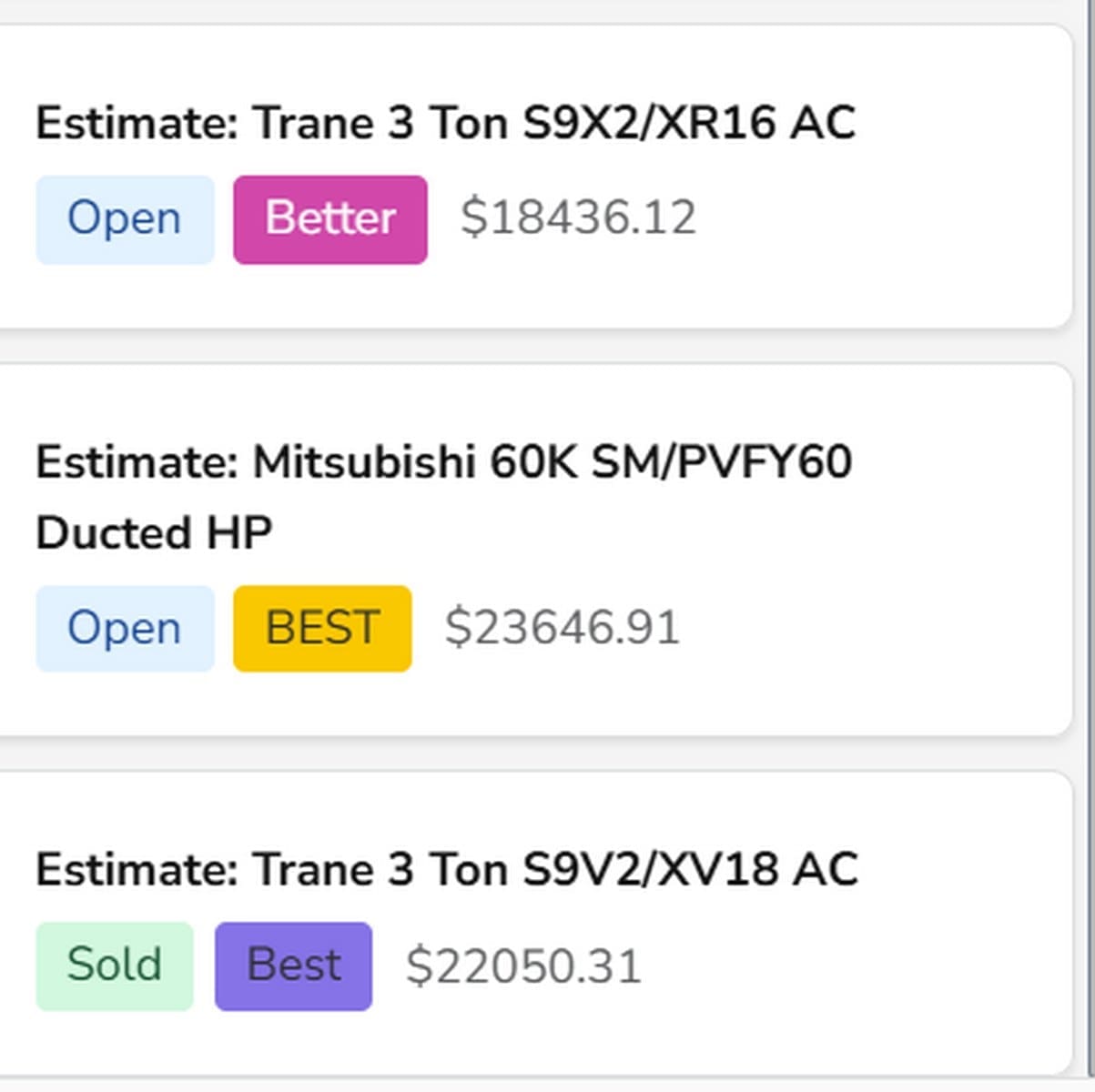
Option 1. Better: Trane 3-ton S9X2 furnace with XR16 AC. A solid mid-range combination, more compact than the oil system, variable speed on the furnace. $18,436.12.
Option 2. Best: Mitsubishi 60K SM/PVFY60 ducted heat pump. Full all-electric heating and cooling, the path to the rebate programs Reema had researched. This was the heat pump option, on the table with full pricing. $23,646.91.
Option 3. Best, Trane: Trane 3-ton S9V2 furnace with XV18 AC. The highest-efficiency gas furnace and AC combination in the lineup. Variable speed communicating across both units. $22,050.31 estimated.
The heat pump was there. Option 2 was a real proposal with a real number, the Mitsubishi ducted system Serge would have built if that’s what Reema had chosen. She looked at it, understood what it was, and pointed to Option 3. “I want the most efficient you have,” she said. “But not the heat pump. I want a furnace.”
Serge said she surprised him. Not because customers don’t choose the top tier, some do, but because of how quickly she said it and how settled she was. She wasn’t asking him to justify the premium. She had done her research, she knew what a heat pump could give her, she knew what the rebate programs looked like, and she had decided the furnace and AC combination was what she wanted to live with for the next 20 years. The decision had been made before the visit. Serge built what she asked for.
What We Installed
The Trane XV18 and S9V2B080 are designed as a communicating pair: two units that coordinate electronically rather than simply running side by side.
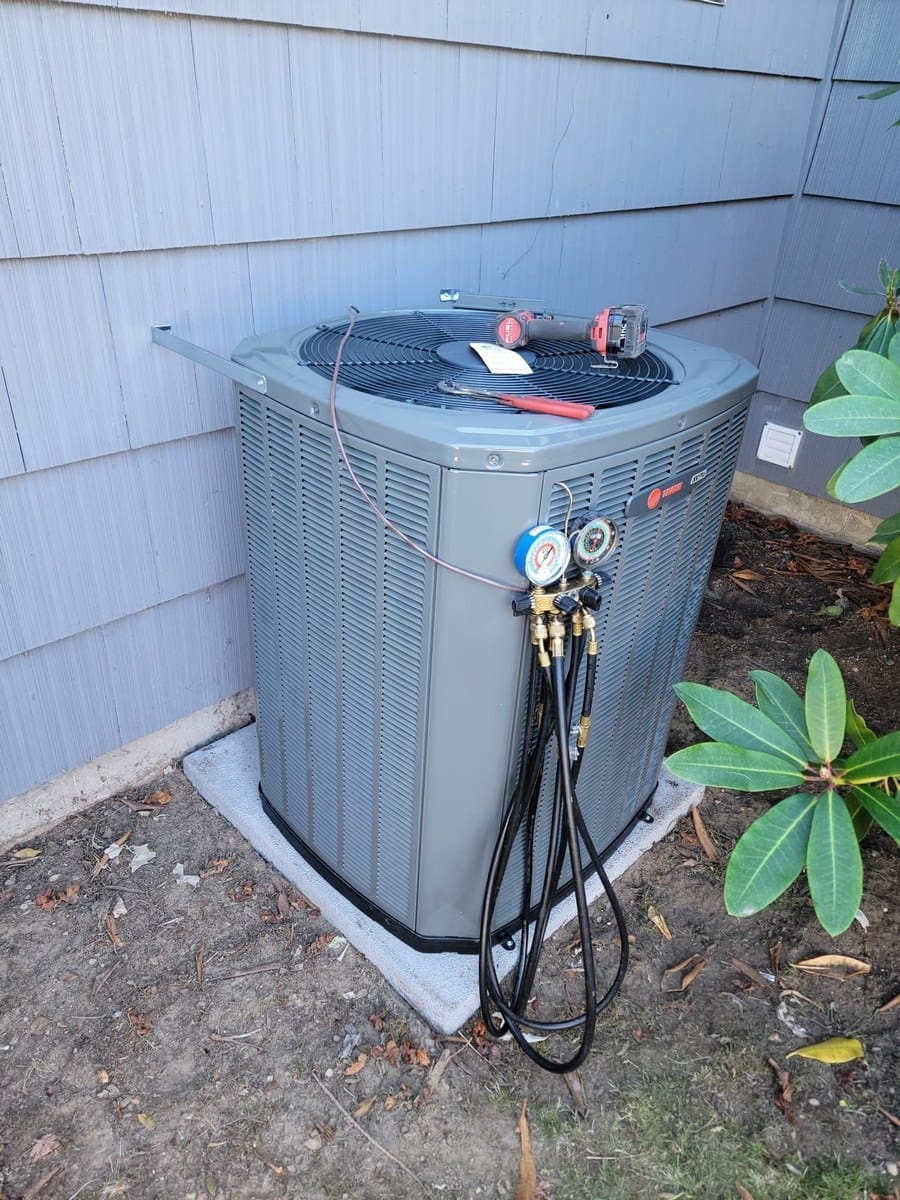
The XV18 outdoor AC unit is variable speed. It doesn’t switch on at full capacity and shut off. It ramps up, reads the load the house is placing on it, holds the output that matches the actual demand, and ramps back down. On a mild Seattle afternoon, the 68°F June day that represents most of the cooling season here, it runs quietly at partial capacity, not at maximum effort. That variable behavior is what an 18 SEER rating actually means in practice.
The S9V2B080 furnace runs the same way. Variable speed, modulating output, responding to what the thermostat and the outdoor unit communicate to it. The result is the heat quality Reema specifically asked for: not the blast-and-cycle of a single-stage furnace, but a sustained, steady airflow from the vents. The variable speed gas furnace is the only residential HVAC system that delivers heat exactly the way she described wanting it.
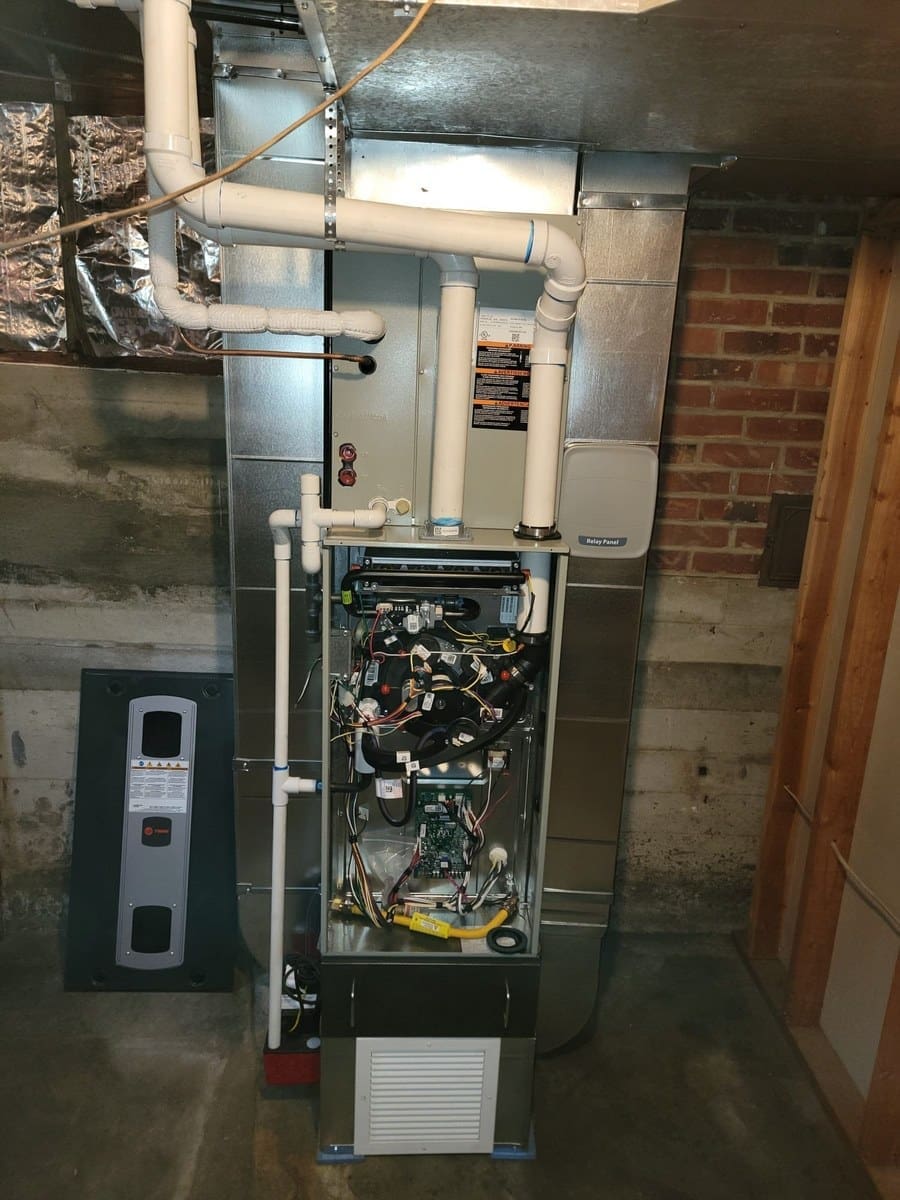
The new system is also dramatically more compact than what it replaced. The photos tell that story better than any description.
| Component | Detail |
| AC Unit | Trane XV18, 3-ton, 18 SEER, variable speed, ultra-quiet |
| AC Model | 4TTV8X36 |
| Furnace | Trane S9V2B080, 80,000 BTU, 96% AFUE, variable speed communicating |
| System Type | Communicating AC and furnace modulate as a coordinated pair |
| Manufacturer Warranty | 10 years on both units |
| Product Air Labor Warranty | 10 years |
When the High-Efficiency Furnace and AC Is the Right Answer
This case is worth pausing on, because Reema’s decision runs counter to the direction of most contractor conversations in Seattle right now and she made it correctly.
Heat pumps are the right answer for most Western Washington replacement situations in 2026. The efficiency numbers are real. Seattle City Light pays $300 to $600 on qualifying heat pump installations. The Energy Smart Eastside program can reduce the cost by $1,000 to $10,000 for eligible properties in Issaquah, Bellevue, Mercer Island, Kirkland, Redmond, and Sammamish. PSE has its own programs for King and Snohomish County homeowners. These aren’t theoretical incentives. Product Air handles all the paperwork, and customers see the deduction at time of installation.
But the heat pump is not the universal answer, and any contractor who only presents one option isn’t looking at the full picture.
The first situation is the one Reema was in: she had arrived at an informed preference deliberately, after understanding both paths. Serge put the Mitsubishi ducted heat pump on the table at $23,646.91, a real proposal with a real number. She looked at it and said no. That’s not a misunderstanding of how the technology works. That’s a clear statement about what she wants from her home, made by someone who had done her homework. Respecting that is basic.
The second situation involves infrastructure. Reema’s home already had natural gas service with a gas line run to the basement. The Trane furnace connected to existing infrastructure directly. Converting to all-electric would have required electrical work, potentially a panel upgrade that can add cost beyond what any rebate program recovers, depending on the home.
The third is the supply air question Reema named directly. Gas furnaces produce supply air in the 120°F to 140°F range. Heat pumps in heating mode produce supply air in the 90°F to 110°F range. Both heat a house adequately. They don’t feel the same coming out of the vents. For homeowners who have lived with furnace heat their entire lives and know exactly what they want from winter, that difference is not abstract.
Serge’s job is to give every customer the full picture, then let them decide. Reema had already done most of that work herself. She needed someone to build what she had decided on.
The Installation: One Day on Site
The installation ran on April 12. One day, start to finish. The oil furnace was disconnected, decommissioned, and removed from the basement. Oil supply lines were capped as part of the removal. The existing ductwork was inspected and confirmed serviceable. No ductwork modification needed.
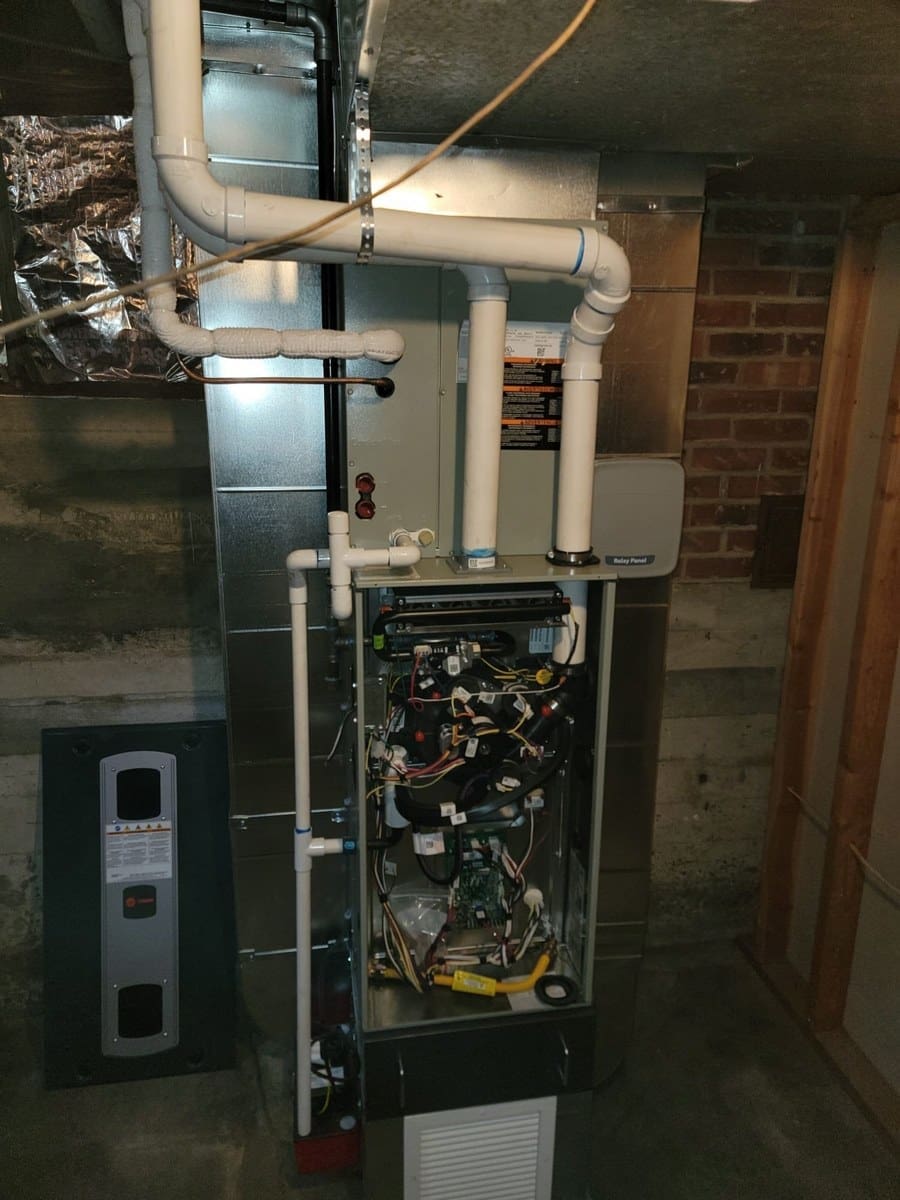
The Trane XV18 outdoor unit went in on a new concrete pad with vibration isolation. The S9V2B080 furnace went into the now-cleared basement footprint, a fraction of the space the old oil unit had occupied.
Both units were wired, interconnected, and commissioned as the communicating pair they were designed to be. Product Air pulled the permits ahead of installation: mechanical and electrical permits for this project in Seattle run $149 to $500; Product Air handles the permitting directly with SDCI, typically in 4 to 24 hours, and coordinates inspection scheduling. The homeowner files nothing. Inspectors came out on April 13 and signed off on schedule.
Nine days from first call to permitted completion. One afternoon of Reema’s time for the estimate visit. One day of access to the basement for the installation.
Price and Rebate Transparency
Final project cost: $19,982.16.
No rebates were applied to this project. The current Seattle rebate programs (Seattle City Light and Energy Smart Eastside) are structured specifically for heat pump installations. A high-efficiency gas furnace paired with an AC does not qualify. That’s not a loophole. It’s how the programs are designed: the incentives exist to accelerate the shift to all-electric heating.
Serge laid this out on the first visit. Reema weighed the rebate available on the Mitsubishi heat pump against her preference for how the system should perform, and she chose the furnace at full price. That was her call to make, and she made it with accurate information in front of her.
The number on the invoice is the number. $19,982.16. No rebate offset, no financing. Reema paid cash.
What 20 Years of This System Looks Like
A Trane XV18 paired with an S9V2B080 in a properly maintained 2,450-square-foot Seattle home runs for 15 to 20 years. That’s the horizon this investment was built around.
The 96% AFUE furnace returns 96 cents in heat for every gas dollar spent. Against an old oil furnace running at 60 to 70% efficiency, that’s a meaningful reduction in monthly heating costs, visible from the first full winter. The 18 SEER rating on the XV18 places it at the top tier of residential cooling efficiency, handling Seattle’s increasingly warm summers with the precision that a variable speed compressor provides on the partial-load days that make up most of the season.
Both units carry a 10-year manufacturer warranty. Product Air’s labor warranty on this installation runs 10 years. No fine print, no exclusions.
Reema has called back since the installation. Multiple times, Serge said. She wanted the team to know the system does exactly what she designed it to do. The basement has its space back. The winters feel the way she wanted them to feel. The summers are handled.
That’s the standard we hold every job to.
Key Takeaways for Seattle Homeowners Replacing an Oil Furnace
- An oil furnace running at 60 to 70% combustion efficiency is sending 30 cents or more of every heating dollar out of the flue. The replacement pays back from the first winter.
- Heat pump rebate programs in Seattle are real: up to $600 from Seattle City Light. A gas furnace and AC combination does not qualify. Any contractor who doesn’t tell you that upfront is not giving you the full picture.
- A heat pump is not the right answer for every homeowner. If you have a clear, informed preference for how your heat should feel, and your home is already set up for natural gas, the high-efficiency furnace and AC is a legitimate professional choice, not a fallback.
- When a contractor puts multiple options on the table, including the one they’re not pushing, that’s the contractor you want. Serge offered the Mitsubishi heat pump with full pricing. Reema said no. The job was built around what she actually wanted.
- A communicating AC and furnace. Two units that coordinate electronically as a pair perform more consistently, run more quietly, and operate more efficiently than two independent units. For a 15 to 20-year investment, that architecture matters.
- Permits for this project in Seattle run $149 to $500. Product Air handles all permitting, pulls permits in 4 to 24 hours, and coordinates inspection scheduling. The homeowner files nothing.
Product Air Heating, Cooling and Electric. HVAC and electrical service in Seattle, Marysville, Issaquah, Mercer Island, and across Western Washington. Licensed HVAC and electrical contractors. We put every option on the table: the rebates you qualify for, the ones you don’t, and the honest reasoning behind every recommendation. We came to solve your problem, not to sell you the fashionable answer.
— Serge Nikolin, Co-Founder, Product Air Heating, Cooling and Electric
Marysville · Issaquah · Seattle · Western Washington
PLAN YOUR NEXT STEP
Need help with your home comfort?
Explore Product Air’s heat pumps services or contact the team.
Share this guide