

If you are reading this, you are probably in one of two situations. Your house gets uncomfortably hot, or someone has already handed you a central AC quote that you cannot quite judge. A central air conditioning system works by moving heat out of your house: refrigerant in an indoor coil absorbs heat from the indoor air, an outdoor unit releases that heat outside, and a blower pushes the cooled air through ducts to every room.
I'm Eli Nikolin, co-owner of Product Air Heating, Cooling, and Electric, and I wrote this guide for the homeowner who wants to understand the decision before signing anything. We estimate that about 30 percent of homes in the Seattle area had cooling 10 years ago, compared with more than 55 percent today. Summers have grown warmer, and smoke and allergy seasons keep windows shut on the evenings that used to cool a house down. Many people are buying central AC for the first time, and few have had the project explained to them.
Quick Takeaways:
- A price quoted by phone is a guess, because ductwork, electrical capacity, home size, and an existing furnace all change the answer
- Ducts and electrical work can move the total more than the equipment: new or reworked ducts add $1,500 to $8,000, and a panel upgrade or long electrical run adds $1,500 to $4,500
- Compare quotes by scope, not by total, since one proposal may include ductwork and permits while another leaves them out
- Before calling for a repair, check the air filter, and remember that a 3- to 5-minute restart delay can be normal
Decide What Problem You Are Actually Solving
Start with the symptom, because the right answer is different for each one. A house that is hot only upstairs can point to airflow, ductwork, insulation, or the way the system is balanced. A house that never cools on hot days can come from equipment, airflow, sizing, or another system problem, so we test before blaming one component. A first-time buyer in a home with no cooling at all is solving a different problem again: whether the house can support a central system in the first place.
Before you call anyone, rule out a false alarm. The "3-minute rule" refers to the short delay that protects an air conditioner compressor from restarting too quickly. The exact delay depends on the equipment and thermostat, and many modern thermostats use about 3 to 5 minutes. During that time the outdoor unit may stay off even though the thermostat is calling for cooling, which can be normal operation. Also check the air filter: a clogged filter restricts airflow and can reduce AC performance.
If the system is old and the repair estimate is large, you may hear the “$5,000 AC rule.” This informal rule of thumb multiplies the age of the air conditioner by the repair estimate, and a result above $5,000 leans toward replacement. A 12-year-old unit with a $500 repair comes to $6,000. It can be a quick comparison tool, but it should not decide whether you repair or replace. Equipment condition, repair history, efficiency, refrigerant availability, warranty coverage, and the cost of the actual repair matter more than a single formula.
How Central Air Conditioning Works, So the Quote Makes Sense
You do not need to be able to service a system, but knowing the parts lets you read a proposal. A modern air conditioning system can cool a whole house from one coordinated set of equipment. According to the U.S. Department of Energy, it circulates the cool air through supply ducts and registers, which are the grilles in walls, floors, or ceilings, and pulls warm air back through return ducts.
Here is how a split-system air conditioner works in a typical central AC system, from thermostat to room.
The blower pulls warm indoor air through the filter. When the thermostat calls for cooling, the blower in the indoor unit starts up. The return ducts pull warm return air from inside your home, and that air passes through filters that catch dust before it reaches the evaporator coil.
The evaporator coil absorbs heat. The coil receives cold, low-pressure refrigerant, typically as a mixture of liquid and vapor. As warm indoor air passes over the evaporator coil, the remaining liquid refrigerant absorbs heat and evaporates. That is the step that cools the air. The coil also removes humidity from the indoor air, because moisture condenses on the cold surface and drains away. Dehumidifying has always been part of the job: Willis Carrier's first modern air conditioning system, installed in 1902 at a Brooklyn printing plant, was designed to reduce humidity.
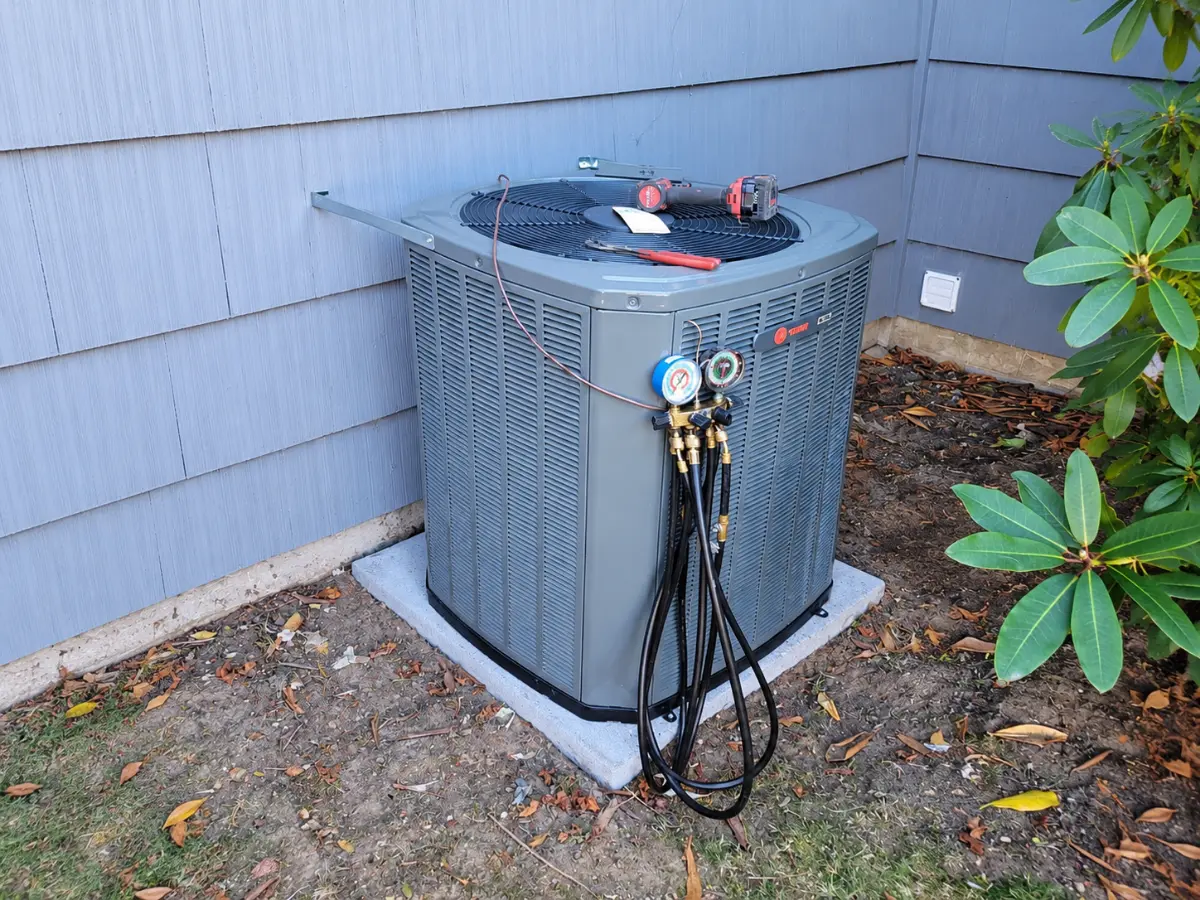
The compressor and condenser release the heat outside. The warmed refrigerant gas travels to the compressor in the outdoor unit, which raises its pressure and temperature. The hot gas then flows through the condenser coil, where a large fan pulls outdoor air through the condenser fins. Heat moves from the refrigerant into the outdoor air, and the refrigerant condenses back into a liquid. The outside air never enters your house; only the heat leaves. The liquid then passes through an expansion valve, which drops its pressure and temperature, and returns to the evaporator coil to start again.
The cooled air is distributed through the ducts. The blower pushes it into the supply ducts, and the registers release it into each room. As the air warms, it returns through the return ducts, and the cycle repeats until the indoor air temperature reaches the thermostat set point.
Every component on a quote maps to one of those steps: the evaporator coil, the compressor, the condenser coil, the expansion valve, the blower in a furnace or air handler, the ducts, and the thermostat. An indoor air handler is the unit that contains the blower fan, and many homes pair the coil with a furnace instead.
Different Types of Air Conditioners That May Fit Your House
Most residential air conditioning systems share the same basic refrigeration cycle but differ in layout.
A split-system air conditioner pairs an outdoor compressor and condenser with an indoor evaporator coil and blower. A packaged air conditioner puts every component in one cabinet, usually on a roof or a concrete slab beside the foundation, and connects to the home's duct system. A room air conditioner treats only the room it sits in, so it is not a central air system.
A heat pump uses the same basic refrigeration cycle for cooling and can reverse it to provide heating. The U.S. Department of Energy describes heat pumps as an energy-efficient alternative to furnaces and air conditioners. In Western Washington, where homes need heating for more of the year than cooling, we often discuss a heat pump when a homeowner is already weighing a major investment in new cooling equipment. Once a cooling project reaches $15,000 to $20,000, the same money buys a heat pump that works all year.
Ductless mini-splits serve one room or zone without ductwork. We use them in additions, garages, condos, and older homes where existing ducts don't reach every room. In homes built in the 1910s or 1920s, ductwork may serve the lower floors but perform poorly upstairs, so we can combine ducted equipment for part of the house with ductless units in the problem areas. In a 2,500-square-foot house with electric heat, cooling every room takes about five ductless units or a full set of new ducts. Either route lands between $28,000 and $35,000.
The right choice depends on the house. Ductwork condition, electrical capacity, home size, and whether you already have a furnace all change the answer. A price given over the phone skips every one of those checks, so the number only becomes real after someone has seen the house.
What the In-Home Visit Should Answer
By the time the technician leaves, the questions below should be settled.
Whether your existing ducts can carry cooled air to every room or whether some need to be reworked. Our published pricing adds $1,500 to $8,000 for new or reworked ducts, so this single answer can change the total more than the equipment does. Leaky or poorly insulated ducts also waste cooled air, so ask about sealing and insulation.
Whether your electrical service can handle the new equipment. A panel upgrade or a long electrical run adds $1,500 to $4,500.
Where the outdoor unit will go, and what that means for noise. The outdoor AC unit produces operating noise, so placement relative to bedrooms and neighbors is worth discussing before installation, not after.
Whether you already have a furnace the new coil can pair with, or whether a heat pump or a ductless unit would suit part of the house better.
Finally, ask what the system will and will not do. A conventional single-zone system treats everything on its ductwork as one area with one thermostat. If one room is the problem, say so during the visit.
How to Read a Central AC Quote
Read each quote alongside the scope of work. Two proposals can look far apart in price simply because one includes ductwork and permits while the other leaves them out.
Our published central AC installation examples start at $8,006 for adding a RunTru 14 SEER2 system to an existing setup. A full replacement with a Trane Priority 17 SEER2 system costs $19,002. Mitsubishi and heat pump options are priced separately because the equipment and project scope can differ.
Here is a structure you can use to compare proposals. Use it as a checklist. Your house will add or remove lines.
Line item |
What the quote should state |
|---|---|
Equipment |
Brand, model, SEER2 rating, refrigerant type, and whether it is a split system, packaged unit, or heat pump |
Indoor unit |
Furnace pairing or air handler and the evaporator coil |
Ductwork |
What is reused, sealed, reworked, or new |
Electrical |
Panel upgrade or long run, if needed |
Permit |
Fee, which ranges from $75 to $500 depending on the city, and who pulls it |
Thermostat |
Model and location |
Rebates |
Which programs apply and how they appear on the price |
Financing |
Provider and terms, if used |
Warranty |
Manufacturer warranty on the equipment and the installer’s labor warranty, listed separately |
Total |
With the exclusions listed |
If you already have a quote and want a second opinion, send it over. We'll tell you what we would do in that house.
Also, check the refrigerant line on the quote. New central AC equipment sold in 2026 runs on R-454B or R-32. R-410A units stopped being manufactured for the US market at the start of 2025, and service refrigerant for them costs more every year.
Two warranties sit behind every install. The manufacturer covers the equipment, and the length depends on the brand. The installer covers the labor. Ours runs 5 years, and we extend it when we maintain the system.
Rebates, Financing, and Timing
When an eligible utility or local rebate applies, Product Air Heating, Cooling, and Electric handles the program paperwork and takes the qualifying rebate off the project price, so you do not wait for a later reimbursement. Ask every contractor how they treat rebates, because some leave the paperwork to you.
The federal 25C tax credit ended on December 31, 2025. A quote that still subtracts it is out of date. In our area the remaining rebates attach mostly to heat pumps, including utility programs for switching from gas.
Financing is available through GreenSky and Service Finance Company, LLC. Most applications get a decision in minutes, and financing is subject to credit approval.
Permits and Electrical Work Before Install Day
Permit fees range from $75 to $500 depending on the city. Ask who applies for the permit, and make sure the quote lists the fee so it doesn't appear later as an extra. If your quote includes electrical work, ask when it happens relative to the equipment install and whether any power shutoff to the house is expected. Clear access to the indoor unit location and the outdoor pad or wall area saves time on the day.
What Happens on Installation Day
On installation day the crew sets the outdoor unit, installs or connects the indoor coil and blower, connects the refrigerant lines and electrical, and sets up the thermostat. Where the quote includes duct changes, that work happens too. Our crew checks in with you in the morning, at lunch, and around 4 p.m. if the job is likely to run to 6.
Before the crew leaves, walk through a short checklist with them. Run the system and confirm cool air comes from the registers in each room you expected. Check that the outdoor fan runs and that the unit sits level and clear of obstructions. Ask where the air filter is and how to change it. Make sure the thermostat is explained, including the delay described earlier. Listen for noise that seems out of proportion to what you were told. If something doesn't match the scope in your quote, say so before the crew packs up.
After the Install: Running the System, Maintenance, and Your Bill
A central air conditioner will increase your electric bill, since it uses electricity to run the outdoor unit and the indoor blower. How much depends on the system's efficiency, size, runtime, local weather, thermostat settings, and duct condition. A more efficient unit can use less electricity for the same cooling load, but actual operating cost depends on the house and how the system is used.
Routine maintenance is straightforward and helps keep the system working as intended. Check the air filter regularly during the cooling season and clean or replace it as needed. Keep leaves and debris away from the outdoor unit so outdoor air can move freely through the condenser. Annual professional maintenance can help maintain comfort and efficiency and catch developing problems before the cooling season. Product Air charges $149 for a single maintenance visit. Our most popular membership, at $24.99 a month, covers yearly maintenance on the heating and cooling system and the water heater, plus a full-home electrical inspection.
Keep your quote, permit paperwork, equipment model information, and warranty documents in one folder. You will want them if you ever service the system or sell the house.
Planning Your Central AC With Product Air
Product Air Heating, Cooling, and Electric is a family business run by three brothers, Serg Nikolin, Eli Nikolin, and Rob Nikolin, working in Western Washington since 2017. We don't come to sell. We come to solve the customer's problem in a way that's right for the customer. That is what we mean by being your tech brother from another mother.
If you are planning central AC for a home that has never had it, or replacing a system that no longer keeps up, contact us and we'll look at the house in person.
FAQ
How Does Central Air Conditioning Work?
It moves heat from inside the house to the outdoors: refrigerant absorbs heat at the indoor evaporator coil, and the outdoor unit releases it outside.
What Are the Main Parts of a Central Air Conditioning System?
The core parts are the evaporator coil, compressor, condenser coil, and expansion valve. A blower and ducts move the air, and the thermostat controls the cycle.
What Are the Disadvantages of a Central Air Conditioning System?
A home without ductwork costs more to equip, since new or reworked ducts add $1,500 to $8,000, and leaky ducts waste cooled air. A single-zone system also cools the whole ducted area rather than each room, and the outdoor unit makes noise.
Do Central Air Conditioners Increase Your Electric Bill?
Yes, cooling adds to your electric bill. The amount depends on the system's efficiency and size, the weather, and the condition of your air ducts.
What Is the 3-Minute Rule for Air Conditioners?
It is a short delay, often 3 to 5 minutes, that protects the compressor from restarting too quickly, so a brief pause in cooling can be normal.
What Is the $5,000 AC Rule?
It is an informal rule of thumb that multiplies the AC's age by the repair estimate. Use it only as a quick comparison, because equipment condition and the actual repair cost matter more.
How Do Different Types of Central Air Conditioners Work?
They share one refrigerant cycle and differ in where the parts sit. A heat pump runs the same cycle and can also heat.
How Much Does a Central Air Conditioning System Cost?
Product Air's published examples start at $8,006 for adding a RunTru 14 SEER2 system and reach $19,002 for a full Trane Priority 17 SEER2 replacement, with Mitsubishi and heat pump options priced separately. A panel upgrade or long electrical run can add $1,500 to $4,500.
What Maintenance Is Required for a Central Air Conditioning System?
Replace or clean the filter during the cooling season and keep debris away from the outdoor unit. Product Air charges $149 per visit, or $299 for a plan with two visits a year.
PLAN YOUR NEXT STEP
Need help with your home comfort?
Explore Product Air’s air conditioning services or contact the team.
Share this guide