

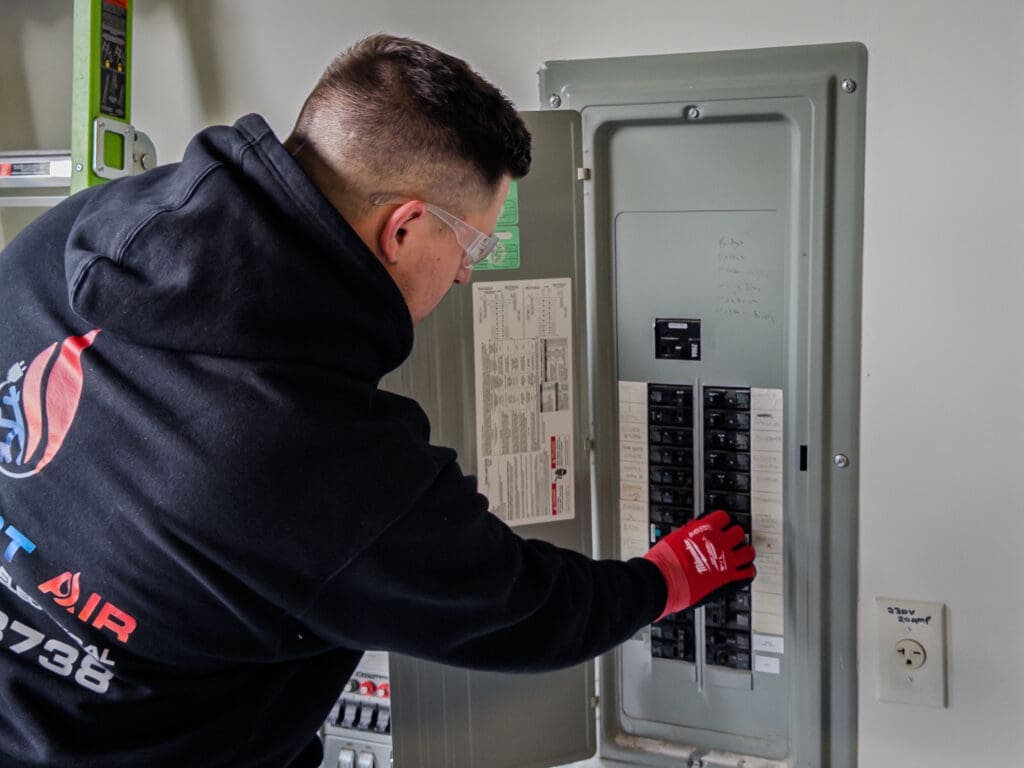
Most homeowners rarely think about their electrical panel. It’s mounted on a wall in the garage or basement, closed behind a metal door, quietly doing its job.
But that panel supports everything: your heating system, your refrigerator, your washer and dryer, your EV charger, your smart appliances, your lighting, your outlets. As homes become more electrified, that gray metal box becomes more important than ever.
The question is simple: Is your electrical panel still safe for what your home demands today?
How Long Does an Electrical Panel Last?
On average, an electrical panel lasts 20 to 30 years.
That doesn’t mean it automatically becomes unsafe at year 31. But like any mechanical or electrical system, wear happens.
“Is your car still safe to drive at 40 or 50 years old?” says Sergey Nikolin, co-founder of Product Air Heating, Cooling, and Electric. “It depends on the wear and how well it’s been maintained.”
Electrical panels are no different.
Connections loosen over time. Components age. Conductive materials oxidize. If the panel hasn’t been inspected or maintained, those small issues can turn into larger risks.
The only way to know its condition is to have it evaluated.
Old vs. Unsafe: There’s a Difference
An old panel isn’t automatically dangerous. But certain warning signs should never be ignored.
Homeowners call us when they notice:
- Buzzing or sizzling sounds coming from the panel
- Breakers tripping repeatedly
- Warmth around the panel door
- Visible corrosion or discoloration inside
“Without proper maintenance and with aging, it could lead to a fire,” Sergey explains.
Breakers are designed to protect wiring. If they’re tripping constantly, something is drawing more power than it should. That could be a faulty appliance. It could be overloaded wiring. Or it could be that the panel simply isn’t designed for the load your home now requires.
Modern Homes Demand More Power Than Ever
Homes built 20 or 30 years ago weren’t designed for:
- Heat pumps replacing gas systems
- Electric vehicle chargers
- Induction ranges
- Large smart refrigerators
- Home offices full of electronics
- High-capacity dryers and appliances
“A lot of older panels are not sized for modern technology,” Sergey says. “Heat pumps, electrification, car chargers just don’t have enough capacity to support all those things.”
When demand increases but capacity stays the same, stress builds. Electrical resistance increases. Heat builds up. Over time, that heat can damage components and increase fire risk.
It’s not always dramatic. Sometimes it’s gradual wear that shows up as flickering lights or nuisance breaker trips.
Panels Known to Be Unsafe
Some panels aren’t just outdated. They’re known hazards.
One example is the Zinsco panel, which has long been associated with fire risks and has effectively been recalled from modern installation standards.
If you have one of these panels:
- Many insurance companies will not provide coverage
- Some insurers will require replacement
- There is no current compensation program
It’s not a scare tactic. It’s simply industry reality.
Insurance companies view certain panels as unacceptable risk.
What Happens If You Delay Upgrading?
We’ve seen it firsthand.
A homeowner hears a faint sizzling sound. They ignore it. A breaker trips occasionally. They reset it. Lights flicker sometimes, but everything still works.
Eventually, something fails.
In some cases, panels stop functioning entirely. In rare emergency situations, we’ve had homeowners call at night and we’ve begun replacement the next morning with permits pulled and materials ready.
“In emergency cases, we’ve had power restored within 24 hours,” Sergey says.
But emergency replacement is not the ideal path. Planning ahead is safer, smoother, and less stressful.
Delaying an upgrade can also create complications during:
- Home sales
- Rental inspections
- Insurance renewals
Once an issue is documented in an inspection report, it becomes part of the property record.
The Role of Inspection and Maintenance
Just like HVAC systems, electrical panels require evaluation.
An inspection can include:
- Checking for loose or overheated connections
- Looking for corrosion or oxidation
- Verifying proper breaker sizing
- Confirming panel capacity against actual load
Thermal cameras and temperature testing can reveal hot spots that aren’t visible to the eye.
Maintenance is one of the best fire-prevention tools available.
“Maintenance is required,” Sergey says. “There’s wear in a panel. An inspection tells you what condition it’s in.”
Is Your Panel Ready for the Future?
If your panel is:
- 20–30 years old
- Struggling with new appliances
- Making noise
- Tripping breakers regularly
- Labeled with an outdated brand like Zinsco
It may be time for an evaluation.
That doesn’t mean you automatically need a replacement. It means you need information.
Modern homes are becoming more electric, not less. Heat pumps are replacing gas systems. EV chargers are becoming standard. Appliances are more powerful and more sensitive.
Your electrical panel sits at the center of all of it.
If it’s maintained, properly sized, and installed to current code, the risk of injury or fire is very low. But if it’s ignored, overloaded, or outdated, the consequences can be serious.
The goal isn’t to alarm homeowners. It’s to encourage proactive evaluation.
Because the safest electrical panel isn’t the newest one. It’s the one that’s properly maintained, properly sized, and professionally assessed for the way your home actually operates today.
And that starts with asking a simple question:
Is your panel keeping up with your life?
If you’re concerned about the condition of your electrical panel, it’s important to consult with experts who understand modern electrical demands.
For professional electrical services in Western Washington, including panel upgrades and inspections, our certified electricians are ready to assist.